A billion‑dollar World Cup security dragnet is coming to U.S. cities, and it brings powerful anti‑drone weapons plus airport‑style screening that could easily outlive the games if we are not careful.
Story Snapshot
- Trump White House is leading the largest World Cup security operation in U.S. history, with over $1 billion pledged for protection and crowd control.[1][3][5]
- Federal agents are rolling out new counter‑drone systems, radar, and no‑fly zones over every U.S. match, fan fest, and practice field.[4][5]
- Airport‑style screening, modern ID checks, and layered perimeters will shape how tens of millions move through stadiums and airports.[1][3][5]
- Human‑rights groups warn the same tools that stop bad actors could also fuel surveillance, immigration crackdowns, and limits on peaceful protest if guardrails are weak.
White House Promises ‘Largest Ever’ Security Push
White House World Cup task force leader Andrew Giuliani says this will be “the largest whole-of-government sporting event operation ever undertaken in the United States,” with more than $1 billion aimed at security.[1][3][5] That includes about $625 million in grants to help host states harden stadiums, improve cyber defenses, and boost emergency response.[5] Officials frame the effort as both protection and hospitality as the country expects between 5 and 7 million international visitors during the 2026 tournament.[1][3][5]
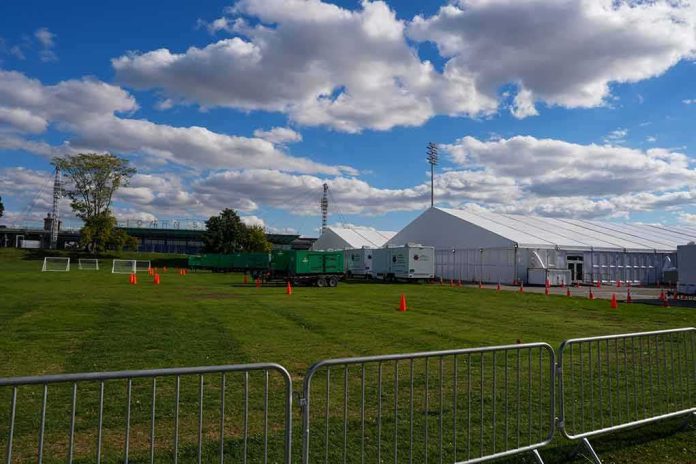
Giuliani and homeland security leaders say the model looks like an upgraded Super Bowl, but stretched across 11 U.S. host cities and 104 matches.[2][4][7] Plans call for layered stadium perimeters with several ticket checks, fenced fan zones for people without tickets, and heavy local police support.[3][5][7] Federal Emergency Management Agency grants are already flowing to states like Washington, which alone received over $32 million, including more than $19 million specifically to counter dangerous drones in the Seattle area.[5][3]
Counter‑Drone Weapons Turn Stadiums into No‑Fly Zones
Drone threats sit at the center of the new security playbook. The Federal Bureau of Investigation’s National Counter Unmanned Aircraft Systems Training Center in Huntsville, Alabama has already trained and certified more than 60 state and local officers on drone‑mitigation tools.[4][5] A Federal Bureau of Investigation demonstration for reporters showed how operators can detect a drone near a soccer stadium and send a command telling the pilot to “land your drone immediately,” using electronic signals rather than bullets.[5]
Temporary flight restrictions will cover every U.S. match venue and its surrounding event sites, including fan celebrations and team practice fields.[5] Federal officials have declared these spaces “no drone zones” for the full World Cup period.[5] Drone pilots who violate restricted airspace face fines up to $100,000, seizure of their drones, and potential felony or misdemeanor charges, with the Federal Bureau of Investigation focused on finding and prosecuting offenders.[5] In a recent test run at the Miami Grand Prix, homeland security teams grounded eight drones that breached protected airspace, which officials cite as proof the systems work.[4]
Airport‑Style Screening Spreads from Terminals to Turnstiles
Beyond the sky, fans will notice heavier checks on the ground. The administration is pushing “modernised screening lanes” at airports, eGate identity checks, and “one‑stop” international connections so travelers clear security once instead of at every layover.[1][3][5] At stadiums, fans should expect magnetometers, bomb‑sniffing dogs, and explosive‑detection teams at entrances, along with multiple ticket checks between transit stops and their seats.[5][7] Officials say these steps are needed to handle the huge crowds while keeping movement flowing.[1][3][5]
Security planners describe a layered approach that tracks with United Nations guidance for major sport events: protect venues and transport hubs with rings of screening, clear command structures, and joint planning across agencies.[6] In practice, that means the Secret Service guarding visiting leaders, the Federal Bureau of Investigation focusing on terrorism and cyber threats, the Coast Guard handling maritime security, and local police managing street closures and crowd control.[5][2][4] The goal, they say, is to prevent worst‑case attacks without turning cities into permanent militarized zones.
Civil Liberties Fears: Surveillance, Immigration, and Mission Creep
Human‑rights and civil‑liberties groups are sounding alarms about how far this security machine could reach. A coalition of more than 120 groups warns that immigration enforcement, surveillance, and protest limits could turn the tournament into a “stage for repression,” citing risks like social‑media screening, device searches, and racial profiling of fans and residents. They note that immigration officers have said their agents will play a “key part” in World Cup security, raising fears that event checkpoints could double as immigration dragnets.
FIFA World Cup 2026™ is a No Drone Zone
As the FIFA World Cup comes to the Bay Area this June and July, be aware that the Federal Aviation Administration (FAA) is issuing Temporary Flight Restrictions (TFRs) that will be in effect around stadiums and event areas during matches… pic.twitter.com/Njy9ppqe1J
— Fremont Police Department (@FremontPD) June 11, 2026
Groups such as Amnesty International and Human Rights Watch argue that while the drone and terror threats are real, there is little public detail on what data will be collected, how long it will be kept, or how protest zones will be policed. Past studies of protest surveillance in the United States show how tools like drones, facial recognition, and cell‑tower data “can be so invasive as to intimidate and deter people from exercising their First Amendment rights,” especially when agencies quietly build dossiers on peaceful demonstrators. Without clear guardrails, critics warn that World Cup security could normalize that same level of tracking at every big event.
Security Without Surrendering Freedom: What to Watch
For many conservatives, the tension is clear: we want safe stadiums and skies, but we also know how easily a crisis mindset can justify permanent expansions of federal power. The administration has not yet released detailed threat assessments, cost‑benefit studies, or venue‑level rules for search and surveillance, even as it spends hundreds of millions on new tools.[1][2][3][5] History shows that Americans often accept extra security after attacks, only to later regret how far government surveillance quietly spread.
As the World Cup nears, key questions remain. Will counter‑drone powers be used only to stop real dangers, or also against harmless hobbyists and journalists?[5] Will airport‑style checks stay tied to the event, or become the “new normal” at every large gathering? And will courts and Congress step in if security agencies start treating fans, peaceful protesters, or church groups like suspects? Patriots who care about both safety and the Constitution will need to watch not just the games, but the rulebook written around them.
Sources:
[1] YouTube – US ramps up 2026 FIFA World Cup security with counter-drone tech, …
[2] Web – US Pledges’ Safe, Welcoming FIFA World Cup In 2026
[3] Web – The World Cup poses an unprecedented security challenge at a fraught …
[4] Web – White House Details 2026 FIFA World Cup Safety and Hospitality …
[5] Web – US prepares massive security operation for 2026 World Cup, DHS …
[6] Web – US Promises ‘Safe, Welcoming, and Memorable’ FIFA World Cup in …
[7] YouTube – Counter-Drones & Tactical Escorts: Inside the Massive World Cup 2026 …