The real story in Taiwan’s latest drill is not the rocket smoke, but the message about who actually wants peace.
Story Snapshot
- Taiwan fired U.S.-made HIMARS rockets toward the Taiwan Strait in its first coastal live-fire use of the system.
- The drill simulated how to stop a Chinese amphibious assault, using short-range practice rockets near shore.
- Beijing’s media calls HIMARS a “deep counterstrike” threat, while Taiwan bills it as survival training.
- The fight is as much over narrative—defense vs. provocation—as it is over range and firepower.
Taiwan’s First Coastal HIMARS Live Fire Was About Survival, Not Showmanship
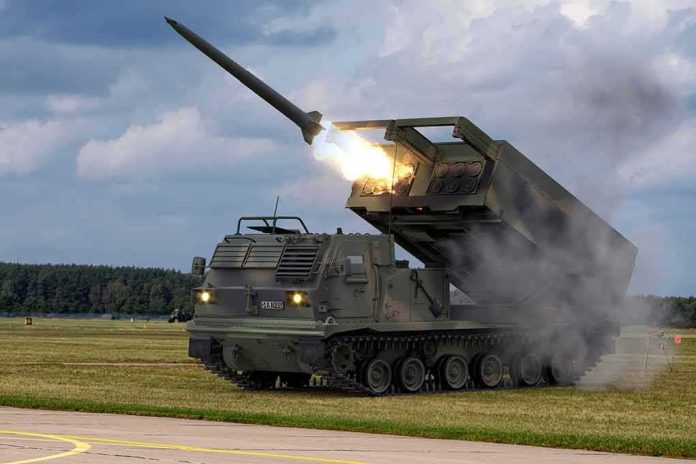
Taiwan did not pick a clear day and a neutral range for this. It chose its western coast, facing China, and fired U.S.-supplied High Mobility Artillery Rocket System (HIMARS) rockets out into the Taiwan Strait while cameras rolled. The drill was part of broader live-fire exercises that simulated a Chinese invasion, testing rapid deployment and precision strikes to repel an amphibious landing.[2] That is not a stunt. That is a small country rehearsing how not to be swallowed.
Reports say this was the first time Taiwan actually shot HIMARS rockets into the waters of the narrow strait, not just inland or on a test range.[2] The rockets used were reduced-range practice rounds, designed to fall into the water not far from shore, not to reach the Chinese coast.[2] The point was to drill the “shoot-and-scoot” tactic—fire, move, survive—against a real attack corridor, not to lob threats at Chinese cities.
Inside Taiwan’s Drill: A Defensive Playbook on Fast Forward
The live-fire event sat inside Taiwan’s larger war games, like the Han Kuang exercises, which military leaders describe as unscripted and designed to mimic real combat from the first enemy missile strike through a full invasion.[1] These drills aim to validate multi-layered anti-landing defenses and battlefield management on actual beaches and terrain, so troops learn the local ground, climate, and wind where a real fight would happen.[1] That is classic readiness, not brinkmanship.
Taiwan’s army mixed HIMARS with other systems—Thunderbolt-2000 rocket launchers, heavy howitzers, anti-tank missiles, and loitering munitions—to practice a layered kill zone against incoming forces.[1] The goal was simple and grim: make any Chinese amphibious assault so costly and uncertain that Beijing thinks twice. American military analysis describes HIMARS as central to “frustrating the fait accompli,” meaning blocking a fast land grab before help can arrive.[4] That is deterrence logic, straight out of common-sense self-defense.
Why Beijing Calls a Shield a Sword
Chinese state media sees the same HIMARS very differently. A recent Chinese drill broadcast singled out Taiwan’s HIMARS as a “major threat” and highlighted simulated “deep counterstrikes” against the launchers and their logistics.[4] Chinese experts on that program stressed HIMARS’ precision and its ability to hit People’s Liberation Army rocket units and supply hubs with an accuracy of around ten meters.[4] In that telling, Taiwan’s shield looks like a spear pointed at the mainland.
That view is not pulled from thin air. The system itself is no toy. The High Mobility Artillery Rocket System is a truck-mounted launcher that can fire guided rockets and, if equipped, longer-range tactical missiles.[6] Taiwan’s units, supported by the United States, can in principle strike targets across the strait. American commentary notes that mobile precision fires like HIMARS could seriously disrupt a Chinese amphibious assault and target staging areas.[4][6] So Beijing leans hard on the “strike threat” story because it undercuts sympathy for Taiwan’s defense.
Which Side’s Story Fits the Facts—and American Values?
When you strip away the press lines, the facts still tilt toward a defensive reading. Taiwan fired reduced-range practice rockets that stayed near its own coast.[2] The drill scenario was explicit: respond to a Chinese invasion with rapid deployment and counter-landing fires, not launch preemptive strikes deep into China.[2] Taiwan’s annual exercises, including the HIMARS integration, are framed as war survival training on home soil.[1][4] That maps neatly onto the basic right of self-defense most Americans accept as obvious.
🚨 Taiwan has conducted its first live-fire HIMARS exercise on the island's western coast, the area widely considered the most likely corridor for a potential PLA amphibious invasion.
During the drill, 32 of 36 planned rockets were successfully launched, while 4 misfires are… pic.twitter.com/Vo31IggYn5
— Global Frontline News (@OmeyLad23) June 10, 2026
Beijing’s framing depends less on what Taiwan actually did this week and more on what HIMARS could do someday. Chinese media highlights long-range strike potential and labels the system a threat to “internal affairs.”[4] But common sense says the aggressor is not the side training to keep foreign troops off its beaches. From an American conservative viewpoint that values sovereignty, deterrence, and peace through strength, Taiwan’s HIMARS drill looks like a homeowner checking the locks after hearing someone jiggle the front door.
Sources:
[1] Web – Taiwan Fires Rockets in China’s Direction from a US-Supplied Mobile …
[2] Web – Taiwan deploys advanced US HIMARS rockets in annual drills
[4] YouTube – Taiwan Tests US-Made HIMARS Rockets Ahead Of Drills
[6] Web – Taiwan tests US-made HIMARS ahead of drills – Facebook