
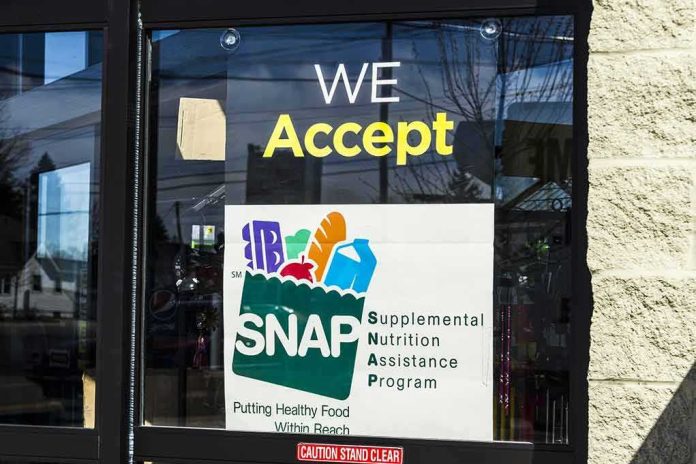
The Trump Justice Department is hauling four blue states into court for stonewalling vital fraud-fighting data from the federal food stamp program.
Story Snapshot
- Justice Department lawsuits target Kentucky, Pennsylvania, Michigan, and Minnesota for refusing to share five years of food stamp data.
- Federal officials say data from 28 other jurisdictions already exposed billions in overpayments and fraud that taxpayers have been funding.
- Blue-state officials claim the demand is “unprecedented” and illegal, raising privacy and immigration-enforcement fears.
- A prior court ruling blocked penalties on noncompliant states, setting up a major showdown over data, fraud, and government power.
Trump DOJ Moves to Crack Down on SNAP Fraud
On June 26, the Department of Justice filed four federal lawsuits against Kentucky, Pennsylvania, Michigan, and Minnesota. The suits ask judges to order each state’s food stamp agency to hand over five years of Supplemental Nutrition Assistance Program (SNAP) applicant data to the United States Department of Agriculture (USDA). The government says these states refused earlier requests, blocking checks on who gets benefits, how much they receive, and whether those decisions follow federal law.
The Justice Department’s Civil Division and National Fraud Enforcement Division are leading the push, showing how seriously President Trump’s administration is treating fraud in welfare programs. Officials say states that did cooperate gave data revealing at least billions of dollars per year tied to overpayments and possible fraud. Acting Attorney General Todd Blanche said these four holdout states are “thwarting” USDA’s effort to protect taxpayer dollars and that such obstruction “will not stand under this Administration.”
What Data Washington Wants—and Why Blue States Balk
The USDA demand covers five years of SNAP applicant and recipient information, going back to 2020. Requests to states and payment processors seek names, home addresses, dates of birth, Social Security numbers, benefit levels, and transaction records to spot abuse patterns. USDA claims it needs a centralized database to verify eligibility, compare records across states, and target waste, fraud, and abuse more accurately. That aligns with broader Trump policies pushing federal agencies to tighten oversight of all programs funded by Washington.
Democratic officials call the demand “unprecedented” and say it crosses the legal line for data sharing. A coalition of twenty state attorneys general previously sued USDA, arguing the agency’s order violates federal privacy laws, skips required public comment, exceeds its authority, and misuses the Spending Clause by threatening funds for noncompliance. Advocacy groups add that federal law says SNAP data can only be used for program administration, with limited exceptions, and that turning it into a broad enforcement tool breaks those limits.
Court Fights, Privacy Fears, and Immigration Politics
This fight is already in front of judges. In October 2025, a federal district judge in San Francisco issued a preliminary injunction blocking USDA from penalizing twenty-one states and Washington, D.C., that refused to submit SNAP data. The judge found those states were likely to win their claim that USDA acted “contrary to law” when it tried to force data sharing and threaten funding cuts. Those earlier rulings are expected to be part of the defense strategy for the four newly sued states.
Blue-state coalitions also warn that once the data is centralized, it could be shared across agencies far beyond food assistance. One public notice described broad “routine uses” that allow USDA to send SNAP records to other federal, state, local, or tribal authorities if it suspects a possible violation of law. Critics say that could let immigration authorities use the database to find and track recipients, turning a food program into an enforcement map. That claim has fueled partisan anger, with the left framing the dispute as an immigration and privacy fight rather than a fraud issue.
Taxpayer Protection vs. Government Overreach
For conservatives, the stakes are clear: billions in improper payments, a large welfare program serving 37 million people a month, and blue states refusing basic transparency. USDA’s own preliminary review of data from 29 cooperating agencies found at least $3 billion a year in potential fraud, waste, and abuse. The USDA also reported a 10.6 percent payment error rate in fiscal 2025, translating to roughly $10.1 billion in improper nationwide SNAP payments. That is not pocket change; it is taxpayer money in a time of high prices and budget strain.
At the same time, the law does place limits on how SNAP data can be used. Federal guidance says sharing recipient information is allowed mainly to administer and enforce SNAP and certain related social service programs. Privacy advocates argue the Trump administration’s push goes beyond that, especially when it seeks “unfettered access” to records held by private payment processors and hints at wide cross-agency sharing. The courts will now decide where the line sits between legitimate program integrity and government overreach into Americans’ personal data.
Sources:
redstate.com, justice.gov, litigationlogic.io, doj.state.or.us, facebook.com, thebusinessjournal.com, fox9.com, statescoop.com, frac.org, networkforphl.org, usda.gov, protectdemocracy.org