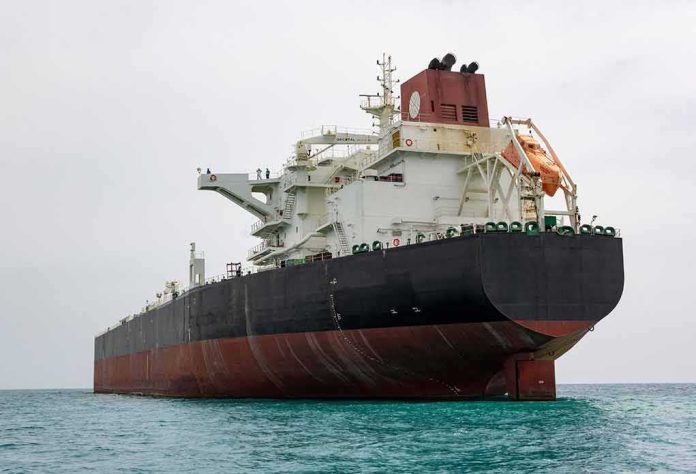
The United States is again using hard maritime power to stop a tanker it says was headed for Iran, and the move puts Washington’s blockade policy back at the center of the fight. The latest action has drawn fresh attention because CENTCOM says the ship ignored repeated warnings before American forces disabled it at sea.[1][2]
Quick Take
- CENTCOM says U.S. forces disabled the tanker after it ignored repeated warnings.[1][2]
- Military officials say the vessel was heading toward Kharg Island, an Iranian oil export terminal.[1]
- The U.S. has already used similar enforcement actions against other Iran-linked ships this spring.[2][4]
- Supporters see the operation as a necessary show of strength against sanctions evasion and Iranian pressure.[2][4]
Why Washington Says It Acted
U.S. Central Command said the Botswana-flagged tanker M/T Lexie was traveling through international waters toward Kharg Island when American forces intercepted it.[1] CENTCOM said the ship’s crew ignored repeated warnings over a 24-hour period and failed to comply with directions from U.S. forces.[1] According to the command, a U.S. aircraft ultimately fired a Hellfire missile into the ship’s engine room, disabling the vessel and preventing it from reaching Iran.[1]
The military also said the tanker was unladen, meaning it was not carrying oil or other cargo at the time of the interception.[1] That detail matters because it shows the ship was stopped for where it was going, not for what it was already transporting. For readers concerned about American energy security and pressure on Tehran, the administration’s case is straightforward: Washington says it enforced an ongoing blockade and stopped a vessel that would have aided Iran’s export network.[1][2]
A Broader Pattern in the Gulf
This was not an isolated event. CENTCOM said U.S. forces also disabled two Iranian-flagged unladen oil tankers earlier in May after they attempted to enter Iranian ports in violation of the blockade.[2] In those cases, American aircraft used precision munitions and cannon fire to stop the ships before they could continue toward Iran.[2] CENTCOM said all three vessels were no longer transiting to Iran after the enforcement actions.[2]
The pattern suggests Washington is treating the Gulf of Oman and nearby waters as an active enforcement zone, not a passive warning area.[2][4] CENTCOM later released images and video tied to another boarding of an Iranian-flagged tanker, showing U.S. Marines directing the crew to alter course.[4] That kind of visible intervention signals a hard line against maritime sanctions evasion and sends a message to ship owners who think they can slip Iranian oil through the cracks.[2][4]
What the Public Record Shows
The available reporting strongly supports the claim that U.S. forces disabled a tanker the military says was violating a blockade order and moving toward an Iranian port.[1][2] The record also shows the broader sanctions fight around Iran’s oil trade, including repeated U.S. actions against vessels tied to Tehran’s export system.[2][4] What the public record does not fully settle is every legal nuance behind the blockade authority, because the available reports rely heavily on CENTCOM statements and outlet reporting rather than a full documentary release.[1][2][4]
Seizure and inspection of a sanctioned ship linked to the Islamic Republic in the Indo-Pacific region
US naval forces, during a maritime operation in the Indian Ocean, have inspected and intercepted a stateless and sanctioned vessel linked to the Islamic Republic named "MT… pic.twitter.com/CjeCkFOvoe
— Iran Observatory (@IRObservatory) June 5, 2026
Still, the political meaning is clear. The Trump administration is showing that it is willing to back sanctions with force at sea, and that posture will likely please conservatives who have long argued that weak enforcement only invites more defiance from Iran.[1][2] At the same time, the episode underscores how quickly maritime confrontations can escalate when Washington decides to turn economic pressure into direct military action.[1][2]
Sources:
[1] Web – US says it fired on, disabled tanker that violated Iran port blockade
[2] Web – US seized Iran-linked oil tanker in the Indian ocean, WSJ reports
[4] YouTube – Video: US seizes Iranian linked oil tanker