
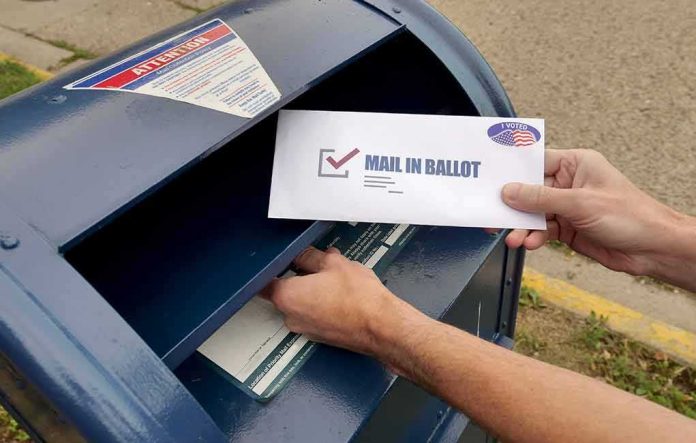
The fight over the Postal Service’s new mail‑ballot rule is not just another skirmish in the voting wars; it is an attempt to redraw, through a logistics agency, the boundary between state control of elections and federal gatekeeping over who even receives a ballot.
Key Points
- A federal appeals court has temporarily allowed the U.S. Postal Service to move forward with a proposed rule that ties delivery of federal mail ballots to state voter lists and serialized barcodes linked to individual voters.
- The rule implements a Trump executive order directing USPS to withhold ballots from voters not on a federally supported “participation list” of verified citizens, effectively making the Postal Service a gatekeeper of ballot access.
- Supporters, including federal prosecutors and administration allies, call the decision “a win for election integrity,” arguing that individualized barcodes and voter lists will deter fraud and improve traceability.
- Opponents—23 states, D.C., voting‑rights groups, and bipartisan state election officials—argue the rule is unconstitutional federal overreach that risks disenfranchising lawful voters and violates a 2021 USPS–NAACP settlement.
- The appeals court ruling is provisional; the legality and eventual fate of the rule will be decided in ongoing litigation, with a clear possibility that higher courts could yet block or narrow it.
What the new USPS rule would actually do
The proposed Postal Service regulation takes a set of technical sounding requirements—voter lists, barcodes, envelope formats—and uses them to create a powerful lever over who receives a mail ballot in federal elections. Under the rule, each state would be required to send USPS a “Mail‑In and Absentee Participation List” before every federal election. That list must identify every voter authorized to receive a mail ballot and match each name to a uniquely serialized Intelligent Mail barcode assigned to that voter’s ballot envelope.
When a state later presents trays of ballots for mailing, USPS would electronically cross‑check each envelope against the participation list. Ballot envelopes lacking a required barcode, using the wrong envelope format, or addressed to someone not on the list would be rejected at the point of acceptance and returned, rather than carried through the mail stream. The Postal Service itself describes the core purpose of serialized barcodes as providing “visibility into ballot mail transmission” and “facilitat[ing] the tracking of individual pieces of Ballot Mail to and from individual voters.”
This is a marked departure from USPS’s traditional stance. Historically, the agency has insisted that its role is to transport lawful election mail promptly and even‑handedly, not to judge voter eligibility or police the content of election materials. The new rule would make previously voluntary best practices—use of the Official Election Mail logo, standardized envelope designs, and barcoding—mandatory conditions of access to the mail for federal ballots.
The executive order behind the rule
The regulation does not appear in a vacuum. It is the implementing mechanism for President Donald Trump’s March executive order, “Ensuring Citizenship Verification and Integrity in Federal Elections.” That order directs the Department of Homeland Security, working with the Social Security Administration and other federal databases, to compile lists of verified U.S. citizens eligible to vote in each state, then requires USPS to send mail ballots only to individuals on those lists.
Section 3 of the order, as summarized in litigation, instructs the Postal Service that it “shall not transmit mail‑in or absentee ballots from any individual” who is not “enrolled” on the federally supported Mail‑In and Absentee Participation List. It also threatens that USPS will refuse to deliver ballots in states that do not submit voter lists by specified deadlines. In effect, the order attempts to use USPS’s control of the mail stream to enforce a new national baseline for verifying citizenship and eligibility, without new legislation from Congress.
This approach fits a broader pattern. Over the past several years, the Trump administration has repeatedly attempted to centralize aspects of election administration through executive action and federal agencies—from a stalled “SAVE” database for citizenship checks to proof‑of‑citizenship mandates for voter registration—efforts that courts have often blocked as exceeding presidential authority or encroaching on state powers.
The appeals court’s provisional green light
On Friday, a three‑judge panel of the D.C. Circuit Court of Appeals issued a stay of a lower court order that had barred USPS from moving forward with the rule, clearing the way for continued development while the case is litigated. The underlying block came from a federal judge in Washington, D.C., who agreed with the NAACP that the proposed rule would violate a 2021 settlement requiring the Postal Service to prioritize timely delivery of mail ballots and to avoid operational changes that could slow or restrict election mail.
The appeals court did not uphold the rule on the merits or declare it lawful. Instead, it found that USPS had met the legal standard for a stay pending appeal, emphasizing two points: that the rule is still proposed rather than final, making the dispute arguably premature, and that the 2021 settlement may not clearly govern this new regulatory initiative. In practical terms, the decision is a procedural but significant victory for the administration, allowing USPS to continue rulemaking, seek Postal Regulatory Commission review, and prepare operational plans as litigation proceeds.
First Assistant U.S. Attorney Bill Essayli hailed the ruling as “a win for election integrity,” echoing administration allies who portray the decision as a validation of their strategy to tighten mail voting controls before the next midterm cycle. But the stay does not settle the serious constitutional questions raised by states and civil‑rights groups; those challenges will move forward in multiple courts and almost certainly on appeal.
Supporters’ case: barcodes, traceability, and public confidence
Supporters of the rule make two main arguments. First, they claim that tying each ballot envelope to a specific, verified voter through an Intelligent Mail barcode will help ensure that only eligible citizens receive and return ballots, deterring both noncitizen voting and multiple voting by the same individual. USPS’s own notice in the Federal Register asserts that uniquely serialized barcodes will “assist in ensuring compliance with federal regulations and support law enforcement activities,” including investigations into ballot tampering or fraud.
Second, advocates present the rule as a way to restore confidence in a mail‑voting system that has come under intense partisan scrutiny since 2020, particularly in high‑mail‑ballot states such as California. They point to anecdotes, like Maryland’s 2024 mailing of hundreds of thousands of ballots where some voters received multiple party ballots, as evidence that stronger, federally enforced controls are needed, even when state systems claim to de‑duplicate votes using internal codes.
The Trump administration links the policy to its broader rhetoric about noncitizen voting, arguing that tighter controls are necessary to prevent ineligible participation, even as its own officials acknowledge that documented instances of noncitizen voting are rare and already illegal. What is notably absent from the public record so far is empirical evidence that the specific combination of federal participation lists and USPS‑managed barcodes would prevent fraud at any appreciable scale; supporters largely rely on theoretical deterrence and general concerns about system “rigging,” rather than audits or case studies.
The opposition: federal overreach and disenfranchisement risks
Opposition to the rule is unusually broad and institutionally grounded. Twenty‑three Democratic‑led states and the District of Columbia have sued, arguing the executive order and USPS rule violate the Constitution’s allocation of election powers to states and Congress, not the president or a postal agency. A federal judge in Boston has already halted major portions of the order, writing that “the Constitution does not grant the President any specific powers over elections” and blocking implementation of a federal voter list for mail ballots.
All Senate Democrats and two independents have jointly urged Postmaster General David Steiner to withdraw the rule, warning that it would impose “significant operational burdens on election mail processing systems” and effectively conscript states into a federal data‑collection regime. Their letter stresses that USPS lacks both the statutory authority and institutional expertise to decide whose ballots may be mailed, a role that has always belonged to state election officials.
Crucially, objections are not limited to one party. In Wisconsin—a battleground state heavily reliant on absentee voting—the Republican chair of the state elections commission, Don Millis, and Democratic commissioner Ann Jacobs jointly opposed the rule, warning that it would “likely disenfranchise a significant swath of Wisconsin voters.” Millis underscored that some in the administration “just think mail‑in ballots are bad,” suggesting a policy goal of suppressing mail voting rather than targeted fraud prevention.
Election‑law experts like David Becker of the Center for Election Innovation and Research argue that existing mail‑voting systems are already secure, with multiple layers of verification: identity checks at registration, signature matching or ID requirements when ballots are returned, and paper ballot records in nearly every state. Becker points out that mail voting has more than 150 years of history in the United States, has been used heavily by both parties, and that even Trump himself has voted by mail in Florida while condemning the practice nationally.
From this perspective, the USPS rule is not filling a genuine security gap; instead, it is introducing new, federal‑level veto points where technical errors or bureaucratic disputes could stop legitimate ballots from ever entering the mail stream, especially in states that conduct elections predominantly by mail.
🚨BREAKING: Big Election Integrity Win for Trump Administration
One night after delivering a national address on election integrity, President Trump has achieved a major legal victory.
The U.S. Court of Appeals for the D.C. Circuit has temporarily cleared the way for the U.S.…
— True Patriot Girl 🇺🇸 (@Betrue_Patriot) July 19, 2026
Privacy, data, and the risks of a national mail‑ballot file
Beyond immediate election‑law concerns, the proposed system raises deeper questions about data privacy and the long‑term use of voter‑linked mail tracking. To implement the rule as written, states would need to transmit to USPS the name, address, and unique Intelligent Mail barcode for each mail voter, effectively building a federal roster of who is eligible to vote by mail and, once scan data are added, who actually did so.
Legal analyses filed by states warn that this would give the federal government “a trove of information about not only who is eligible to vote but also who voted, barcode by barcode,” far beyond what USPS has ever held before. While ballots would remain secret, the pattern of ballot transmissions—who repeatedly receives and returns mail ballots, in which jurisdictions, and when—could become an attractive target for misuse, whether for political pressure, law‑enforcement fishing expeditions, or future policymaking unrelated to election administration.
The rule, as critics note, offers little in the way of explicit safeguards to prevent secondary uses of this data, nor does it grapple with the cyber‑security implications of concentrating such granular information on mail voters within a single federal system. For voters who already mistrust federal institutions, awareness that their mail ballot can be traced precisely to them by a national database may chill participation rather than build confidence.
What to watch as the rule moves forward
Because the appeals court’s decision is provisional, the future of the USPS rule will be shaped on two tracks. On the legal track, federal courts will decide whether the executive order and implementing regulation exceed presidential authority, infringe on state control of elections, or violate existing settlements like the NAACP agreement that constrain USPS’s election‑mail practices. The litigation record to date—multiple injunctions against related efforts and judges emphasizing that the president has no general election‑administration power—suggests substantial headwinds for the administration.
On the administrative track, USPS must complete the formal rulemaking process. That includes digesting an intense wave of public comments from states, local governments, and advocacy groups, and potentially securing review by the Postal Regulatory Commission. Given the operational stakes—retooling mail‑processing software, training personnel, and coordinating with thousands of election jurisdictions—implementation even of a narrowed rule would be a major logistical undertaking.
The central tension will remain the same. Supporters will continue to argue that the symbolism and mechanics of serialized barcodes and federal participation lists are essential to reassure skeptical voters that only eligible citizens receive a ballot. Opponents will counter that the system we already have—state‑run, paper‑backed, and procedurally redundant—is functioning, and that putting a federal logistics agency in the position of deciding which ballots may travel risks trading a manageable set of problems for a profound shift in democratic control.
Sources:
nypost.com, lynnwoodtimes.com, reuters.com, govexec.com, krishnamoorthi.house.gov, cyberscoop.com, protectdemocracy.org, youtube.com, facebook.com, democracydocket.com, wpr.org, npr.org, brookings.edu, verdict.news, campaignlegal.org, attorneygeneral.gov, newsweek.com