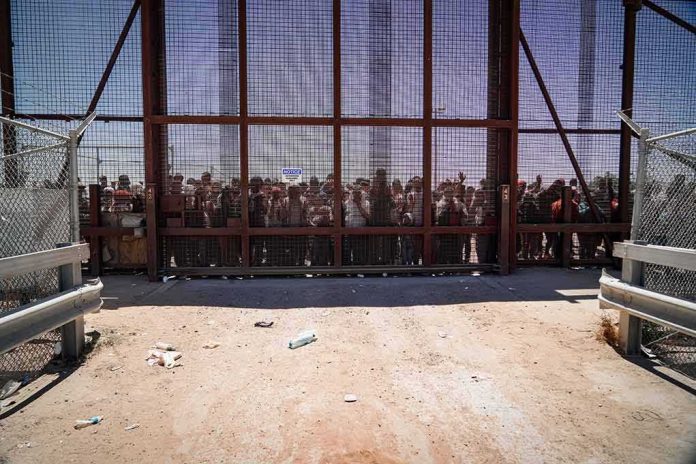
Israel’s decision to revoke most Palestinian work permits after October 7 turned a labor lifeline into a political and security flashpoint, and the effects have spread far beyond the West Bank.
Quick Take
- Israel canceled virtually all permits for Palestinians to enter Israel for work or medical care after October 7, citing security concerns.
- Palestinian workers inside Israel fell from 178,000 before the war to 35,300 by the first quarter of 2025.
- Israeli officials also backed the exclusion of Palestinian workers, saying they could endanger public security.
- The move deepened unemployment and economic strain in the West Bank while drawing criticism as collective punishment.
Permits Canceled After October 7
United States Department of State reporting says Israel canceled virtually all permits for Palestinians to enter Israel for work or medical care after Hamas’s October 7 attack. The same report says the Israeli army sealed entrances to most Palestinian villages in the West Bank and imposed tighter movement limits. That shift cut off many workers who had long depended on wages earned inside Israel.
The scale of the change was large and immediate. Al-Haq says the number of Palestinians working inside the Green Line dropped from 178,000 before October 7 to 35,300 by the first quarter of 2025. The International Institute for National Security Studies says 8,000 Palestinians were still classed as essential workers, while another 18,000 were allowed into industrial zones or settlements. That still left most workers blocked from regular jobs.
Security Claims and Economic Damage
Israeli Economy Minister Nir Barkat publicly argued that Palestinian workers should not be admitted because they could endanger public security. The security case has been broad rather than specific in public records. The State Department cites security concerns and attempted attacks, but it does not name a worker-by-worker threat record tied to the mass permit revocation. That leaves the policy justified in general terms, but not fully explained in public detail.
The economic cost has been severe on both sides of the border. The International Institute for National Security Studies says the Palestinian economy has suffered losses of hundreds of millions of shekels each month and that about 120,000 people became unemployed. It also says the measures were meant to pressure the Palestinian Authority, which suggests the policy was not only about immediate security. That mix of aims has fueled suspicion across the political spectrum.
Why the Story Keeps Growing
Human rights groups and international organizations have framed the permit revocation as collective punishment rather than a narrow security step. Al-Haq says the labor ban fits a wider pattern of denying Palestinians movement and work access after conflict spikes. That history matters because it shows the current shutdown is not an isolated case. It follows a familiar cycle in which labor access rises and falls with the political weather.
Is Israel’s ban on Palestinian workers meant to provide security to Israelis or meant to instill fear?
Fear is a very powerful emotion- allows level headed people to commit unspeakable acts.
Israelis have been living in fear for >70 years despite immense unconditional American…
— Norma (@Norma81321397) July 2, 2026
The wider media fight has made the issue even more loaded. Critics say the ban has been absorbed into a larger battle over how Israel’s actions are described, especially when journalists and advocacy groups accuse the government of collective punishment or worse. Supporters of the ban point to the October 7 attack and say security must come first. What is clear is that the policy has reshaped daily life, work, and movement for tens of thousands of families.
Sources:
townhall.com, facebook.com, state.gov, inss.org.il, amnesty.org