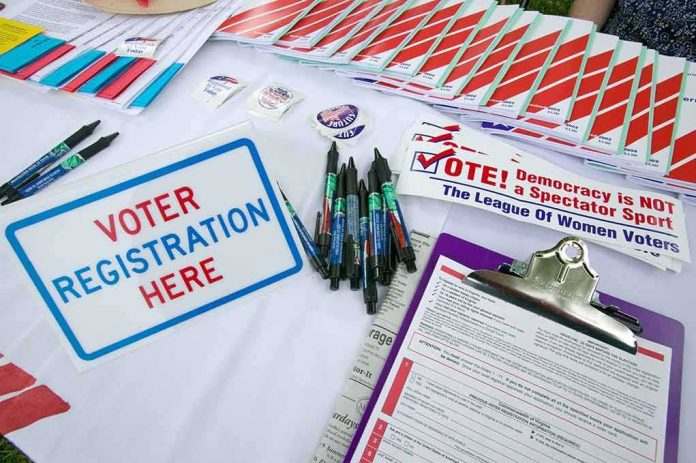
A former liberal television analyst now admits that Republicans were right to warn that our election systems are more vulnerable than Washington and the media have long claimed.
Story Snapshot
- Election security documents from the White House admit real risks in internet-connected voting systems.
- Experts say large-scale voter fraud is rare, but technical and foreign threats to election systems are real.
- Both parties have used election fears for political gain while trust in government and elections keeps dropping.
- Millions of Americans now believe the “system” hides problems instead of fixing them.
Election Security Warnings That Backed Republican Concerns
The White House’s own election integrity page now states that Americans “were blatantly lied to” for years about the security of voting machines and ballot-counting systems, and releases intelligence reports showing the risks to those systems. A separate presidential action from March 2025 orders the Department of Homeland Security to review “all electronic systems used in the voter registration and voting process” that connect to the internet and assess the risk of malicious software or unauthorized intrusions. These official moves confirm what many Republicans had long argued: that election technology was vulnerable while officials and media voices downplayed those risks.
The National Academies of Sciences, Engineering, and Medicine adds more weight to those concerns, stating that all forms of internet voting are vulnerable to denial-of-service attacks that can block or disrupt access to election systems. Security experts also warn that foreign actors have tried to gather American voter data and probe election infrastructure, forcing local officials to upgrade defenses. These are not partisan talking points; they are formal findings that our digital election tools can be targeted, which gives credence to long-standing right-of-center worries about hacking and cyber interference, even when fraud itself is hard to prove.
Fraud Claims vs. What Courts and Experts Actually Found
At the same time, major studies and court rulings have not backed claims of massive voter fraud changing national outcomes. A Harvard Kennedy School analysis of the 2020 elections found that election experts overwhelmingly rejected claims of widespread fraud in their states. The Campaign Legal Center reports that dozens of lawsuits about stolen-election claims were litigated after 2020, and judges across the country found the evidence of illegal voting or rigging “without merit.” These findings show a sharp line between real vulnerabilities in systems and unproven claims that whole presidential races were stolen.
Research from groups like the Brennan Center for Justice and think tanks such as Brookings concludes that voter fraud in the United States is extremely rare and almost never affects outcomes above the local level. A review of a large Heritage Foundation database of fraud cases found that the numbers, spread across many years and hundreds of millions of votes, do not support the idea of recent elections being widely rigged. So while Republicans were correct that election systems face real security threats, broad claims that these threats have already flipped modern national elections have not been backed by credible evidence presented to courts or expert panels.
Growing Public Distrust and the “Deep State” Feeling
Despite the lack of proof for large-scale fraud, public trust in elections has taken heavy damage. A study of voter attitudes found that many supporters of President Trump in 2020 lowered their view of election fairness after his unexpected defeat and held onto doubts even as investigations found no major fraud. Other research on “motivated reasoning” shows that both Trump and Biden voters were worried about foreign interference and mail-in ballots, but each side tended to see problems only when their own candidate might lose. This pattern feeds a sense across the spectrum that the system serves insiders first and everyday voters last.
When federal officials admit they hid or softened warnings about election technology risks for years, many Americans see it as one more example of a distant “deep state” protecting itself. Conservatives point to unsecured machines, ballot issues, and weak safeguards, while liberals worry about voter suppression, foreign meddling, and unequal access. Both sides, however, share a common fear: that those in power—politicians, bureaucrats, and media elites—are quicker to spin or bury problems than to fix them honestly. That shared frustration explains why an analyst’s admission that Republican warnings about system vulnerabilities were right hits such a nerve today.
What Real Election Integrity Would Look Like
Election integrity experts say the real answer is not to pretend fraud is everywhere or nowhere, but to separate different problems and address each one clearly. That means tightening security on voting technology and registration databases, improving audits and paper records, and being honest about rare but real cases of illegal voting without exaggerating them into national plots. It also means protecting fair access to the ballot so that efforts to fight fraud do not turn into hidden tools to block lawful voters, which has happened in some past fights over voter ID and roll purges.
For citizens who feel shut out by elites, this balanced approach can sound like more talk and little action. Yet it may be the only path that supports both security and trust. The intelligence and scientific reports now on the record prove that Republicans were right to say our systems had serious vulnerabilities. The same body of evidence also shows that many dramatic fraud claims went far beyond the facts. The challenge now is whether a deeply divided federal government can admit both truths at once—and then act in ways that protect every voter, not just the political class.
Sources:
heritage.org, hks.harvard.edu, votebeat.org, brennancenter.org, en.wikipedia.org, campaignlegal.org, pmc.ncbi.nlm.nih.gov, nationalacademies.org, aljazeera.com, congress.gov, online.hilbert.edu, ballotpedia.org, pbs.org, usa.gov