A foreign royal family just bought America a “free” Air Force One, and Trump has now taken his first flight on it — reopening a fierce fight over who really runs Washington and whose interests the government serves.
Story Snapshot
- Qatar donated a $400 million luxury Boeing 747-8 to the U.S. Defense Department, now flying as Trump’s interim Air Force One.
- The White House insists the jet is a legal gift to the U.S. government, not to Trump personally, and says all rules were followed.
- Critics in both parties warn the deal may clash with foreign gift limits, invite foreign influence, and pose serious security risks.
- The plane is slated to go to the Trump presidential library after he leaves office, raising questions about personal benefit from a foreign “gift.”
Trump’s First Flight on a Foreign-Gifted Air Force One
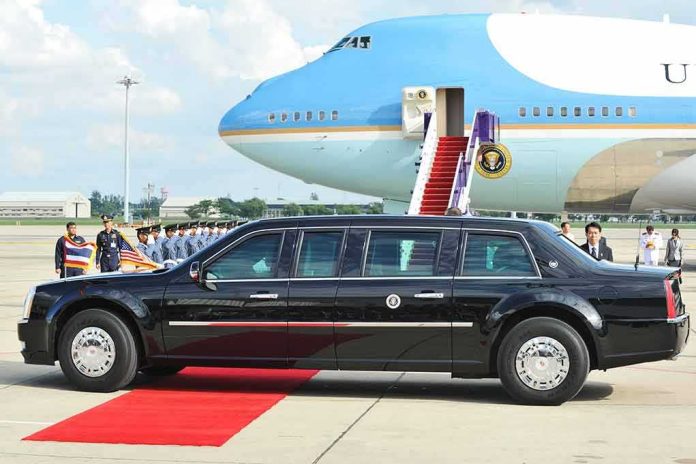
President Donald Trump has now flown on the new Air Force One, a converted Boeing 747-8 that Qatar donated to the United States. The Pentagon says the jet was accepted as a gift to the Department of Defense and will serve as Trump’s main aircraft until new, U.S.-built presidential jets arrive later this decade. Trump has praised the deal repeatedly, calling it “stupid” not to accept a free plane and saying it will save American taxpayers money for other priorities.
The aircraft started life as a ultra-luxury jumbo jet for Qatar’s ruling family, with a reported value of about $400 million before U.S. upgrades. It is now being modified and hardened to function as a secure presidential transport, with the Air Force handling the technical work and footing the bill for the extensive refit. Officials describe it as a “bridge” plane, filling the gap until new VC-25B aircraft, now delayed, finally enter service.
How the White House Says the Deal Is Legal
The core legal defense from the Trump administration is simple: this is a gift to the U.S. government, not to Donald Trump personally. Trump has stressed that the jet is going to the U.S. Air Force and Department of Defense, and that Qatar’s donation reflects long-standing military cooperation between the two countries. The memorandum of understanding between Qatar and the Pentagon reportedly labels the plane an “unconditional” donation and includes language rejecting bribery or undue influence, even if the text is awkwardly written.
White House Press Secretary Karoline Leavitt has repeatedly said that “any gift given by a foreign government is always accepted in full compliance with all applicable laws” and promised “full transparency.” Pentagon spokesperson Sean Parnell likewise stated that the secretary of defense accepted the Boeing 747 “in accordance with all federal rules and regulations” and pledged strong security measures before the aircraft carries the president. Supporters argue this “gift to the nation” framing fits past practice for large foreign donations like the Statue of Liberty, which are treated as property of the United States, not of any one leader.
The Emoluments and Ethics Fight Rekindled
Even with those assurances, the deal hits a raw nerve that cuts across party lines: foreign governments giving huge things of value while Washington struggles to represent average Americans. The Constitution’s Foreign Emoluments Clause bars officials from taking gifts from foreign states without consent from Congress, and federal rules say personal gifts from foreign governments must stay under about $480 in value. There has been no clear public vote from Congress to approve this aircraft, which worries many legal experts and watchdog groups.
Critics argue that calling a $400 million luxury jet a “gift to the Department of Defense” looks like legal wordplay that dodges the spirit of the rules. Organizations like American Oversight warn the Qatari plane is part of a “slippery slope” where foreign powers shower U.S. leaders with lavish perks while nudging policy in their favor. For Americans who already feel the government serves wealthy insiders and foreign interests more than taxpayers, a royal-family jet turning into Air Force One seems to confirm their worst suspicions about an unaccountable elite “above” the rules.
Security Risks and the Deep State Trust Gap
Beyond law and ethics, security professionals raise hard questions about using a plane once owned by a foreign monarchy as the president’s flying command center. Intelligence and defense experts have warned that prior foreign ownership can create “immense counterintelligence risks,” including hidden access points or unknown modifications that are difficult to fully track and verify. They say that, in a world of cyber warfare and espionage, even tiny vulnerabilities on Air Force One could be catastrophic.
Spectacle over Washington, D.C., during the July 4th Air Show as Boeing VC-25B Bridge, interim Air Force One for Donald Trump, arrives flying over the Washington Monument, as four F-22 Raptor air dominance fighter jets escort the aircraft.
VC-25B was originally a Boeing 747-8KB… pic.twitter.com/pJCKGawQ8s
— Inceptor57 (@Inceptor57) July 5, 2026
The Pentagon promises to run thorough security checks and redesign systems as needed, but none of those technical audits have been released publicly. That secrecy feeds a broader crisis of trust: both conservatives and liberals increasingly believe national security decisions are made behind closed doors by a “deep state” that rarely faces real scrutiny. When the government says “trust us, we checked the foreign gift and it’s safe” yet refuses detailed proof, it widens the gap between an anxious public and powerful institutions that often seem to protect themselves first.
Who Ultimately Benefits From the “Free” Jet?
Another major concern involves what happens to the plane after Trump leaves office. Reports say the aircraft will be transferred to the Trump presidential library, with the U.S. Air Force paying the transfer costs. Presidential libraries are supposed to serve as public museums and archives, but they also become monuments to one leader’s image, often funded and shaped by private interests. Watchdogs argue that sending the Qatar jet there makes it feel less like a gift to the American people and more like a personal trophy backed by taxpayer money.
The U.S. government also must pay for hundreds of millions of dollars in upgrades to make the jet fully secure, potentially pushing the total public cost well above the plane’s original sticker price. That leaves many Americans asking a blunt question: if foreign elites donate a flashy shell and Washington then spends huge sums to make it usable, is this truly a “free” gift — or another deal where regular citizens pay while insiders get the prestige? For a country already angry about inflation, wasteful spending, and unequal treatment, this luxury jet may look less like a win and more like another symbol of a system losing touch with its founding principles.
Sources:
cbsnews.com, washingtonpost.com, youtube.com, news.northeastern.edu, abc7ny.com, pbs.org, nbcnews.com, americanoversight.org, bbc.com, politico.com, npr.org, everycrsreport.com