
A viral rescue video from rural Indiana shows three lives saved—but also exposes how thin our public safety margins have become when infrastructure, warnings, and basic transparency fall short.
Story Snapshot
- An SUV carrying a high school senior and her grandparents was swept into a swollen creek near Holton, Indiana; all three were rescued, according to local video reports [1].
- Footage centers the dramatic extraction but leaves gaps on timing, agencies, methods, and injuries, limiting public verification [1].
- The episode spotlights nationwide gaps in flood-readiness, road closure protocols, and public communication during fast-rising waters [3].
- The incident underscores bipartisan frustration with government performance on basic safety and infrastructure upkeep.
What Happened Along a Flooded Indiana Back Road
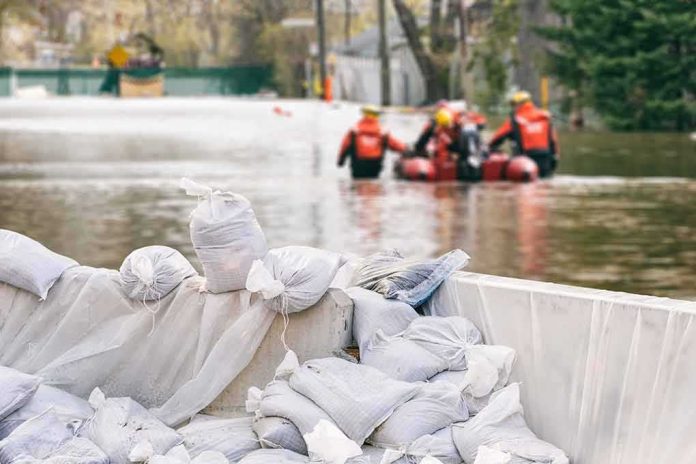
Local outlets reported that an SUV with a high school senior and her grandparents was swept from a roadway into a creek near Holton, Indiana during a morning drive to school, prompting a water rescue that ended with all three people saved [1]. Video coverage shows responders coordinating around swift water and a partially submerged vehicle, but it does not identify agencies by name or display an official incident timeline. Additional regional newscasts describe similar rescues during the same weather pattern, underscoring fast-moving conditions [3].
Available clips emphasize the moment of rescue while leaving operational details unclear. The public record shown so far does not confirm whether responders used throw bags, ropes, boats, or whether occupants exited the vehicle under direction rather than by self-evacuation [1]. No published dispatch logs, incident reports, or patient care summaries appear in the coverage to corroborate the precise sequence or medical outcomes. That documentation gap is common in local flood rescues that end without fatalities [1].
Verification Gaps And Why They Matter
Because video drives the narrative, strong claims about methods, timing, and medical status require supporting records. The current reporting says the occupants were rescued safely, which the visuals support, but does not present official documentation, interviews with named rescuers, or hospital disposition data [1]. Researchers who study disaster communication caution that first narratives often compress complexity, and later records may be sparse, leaving the public with a compelling clip but limited accountability for response quality or infrastructure decisions that set the stage [3].
Those gaps are not trivial. Residents want to know why a road remained open, how quickly responders arrived, and whether signage, barricades, or digital alerts were deployed as water rose. Without dispatch times, road closure logs, and after-action reports, taxpayers cannot easily assess whether protocols kept pace with conditions. The absence of specific data feeds a broader bipartisan perception that government systems underperform when everyday risks—like flash flooding on rural routes—turn dangerous [1].
The Infrastructure And Policy Backdrop
Flood rescues like this one recur when drainage systems, culverts, and low-water crossings meet heavier rainfall and saturated ground. Local governments hold responsibility for roadway maintenance and closures; state and county emergency managers coordinate alerting and resource requests; and federal agencies set funding streams that shape resilience investments. When these layers fail to align, drivers meet high water with little warning, and first responders shoulder elevated risks during swift-water calls, as seen across southern Indiana coverage during this weather window [3].
A morning drive to school turned into a dramatic flood rescue in Indiana after an SUV carrying a high school senior and her grandparents was swept into a swollen creek.
Emergency crews battling fast-moving water as rescuers used ropes to reach the stranded family near Holton. pic.twitter.com/nTgPIOD7xo— NYC News 24 🗞️ (@NYCNews24) May 22, 2026
Both conservatives and liberals share a central complaint here: the basics are not getting done. Conservatives point to deferred maintenance, slow barricade decisions, and the sense that budgets miss practical needs. Liberals point to inequities in infrastructure investment and communication that leave rural and working-class corridors exposed. The common ground is simple—residents expect timely closures, clear alerts, and professional, well-equipped rescue capacity. When video becomes the main proof of performance, trust erodes even after a successful save [1].
What Would Strengthen Public Confidence Now
Officials can reinforce confidence with straightforward steps tied to this incident. First, release an incident summary with timestamps: 911 call receipt, dispatch, first unit arrival, rescue initiation, and patient transfer if applicable. Second, identify responding agencies and equipment used so residents understand capabilities. Third, publish whether the roadway was posted, barricaded, or flagged in digital navigation data before the sweep. Finally, issue practical guidance for school commute decisions during flood advisories to reduce exposure at low crossings [1].
For the public, the safety guidance remains consistent: turn around, do not drive through water, and treat fast-moving runoff as life-threatening. For policymakers, the path is tangible and measurable: inventory low-water crossings, upgrade culverts, harden shoulders, install automated flood gates where warranted, and standardize alerting tied to rainfall thresholds. A short, dramatic clip should be the exception—not the main record—when lives and tax dollars are on the line [3].