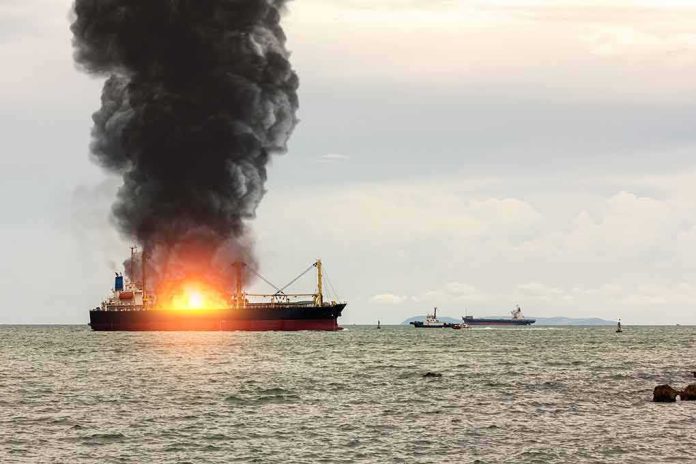
A new round of shipping attacks in the Strait of Hormuz has again turned a narrow waterway into a global flashpoint.
Quick Take
- The United Kingdom Maritime Trade Operations center said a tanker was hit by an unidentified projectile near Oman.
- United States officials said three commercial vessels were struck in Oman’s territorial waters near the Strait of Hormuz.
- Qatar and Saudi Arabia publicly blamed Iran and called the attacks a threat to international navigation.
- Iranian state media gave an indirect account, but no official Iranian statement in the research package directly claimed responsibility.
What Happened in the Strait
The British navy-linked United Kingdom Maritime Trade Operations center said a commercial tanker near Oman was struck and caught fire after an unidentified projectile hit it. A separate United States official said three commercial vessels were attacked in Oman’s territorial waters close to the Strait of Hormuz. The reports point to a fast-moving incident in one of the world’s most important shipping lanes, where even a single strike can rattle energy markets and shipping insurance.
That location matters because the Strait of Hormuz handles a huge share of the world’s oil and gas traffic. The research package says the attacks came during a broader crisis in which shipping has faced repeated threats and direct strikes. It also says the United Kingdom Maritime Trade Operations warning described the vessel as being hit near the eastern entrance of the strait, which made the incident feel less like a random blast and more like part of an ongoing pattern.
Who Blamed Iran
Qatar’s Foreign Ministry said the attack on its liquefied natural gas tanker was a serious breach of international law and blamed Iran directly. Saudi Arabia’s Foreign Ministry said Iran bore full responsibility for the strikes on Saudi and Qatari vessels. Those statements were not small diplomatic reactions. They signaled that two major regional players saw the attack as a direct threat to trade, energy supplies, and the rules that are supposed to protect civilian shipping.
The United States also treated the incident as an Iranian attack. United States Central Command said it launched strikes against Iran to impose heavy costs for targeting commercial shipping. That response shows how quickly attacks on tankers can move from a maritime security problem to a military one. It also explains why the episode drew so much attention beyond the Gulf: any strike in this corridor can pull in governments, navies, and energy buyers far outside the region.
What Is Still Unclear
The strongest fact in the research is that a tanker was hit and a fire broke out. The weaker part is attribution from the available record. Iranian state television did not directly claim the assault, and the research package says the reported Iranian account relied on anonymous sources. That leaves a gap between accusation and proof. For a crisis this serious, the difference matters because shipping lanes, war planning, and public trust all depend on clear evidence.
The Strait of Hormuz was quiet the way a rattlesnake is quiet. Then Iran moved.
By Francis Gauthier
Three commercial vessels tied to Qatar, Saudi Arabia, and the United Arab Emirates were targeted near the narrow waterway that carries a major share of the world’s oil traffic.… pic.twitter.com/NktjfPR88g— Faith Gonzales (@faith3155) July 9, 2026
The bigger lesson is not just about one tanker. It is about how quickly the Strait of Hormuz can expose the limits of government control and the fragility of international trade. Supporters of a hard line see the strikes as proof that Iran is willing to use force at sea. Critics see the same moment as another example of a crisis where blame moves faster than verified facts. Either way, the public pays the price when the world’s energy artery comes under attack.
Sources:
insiderpaper.com, cnn.com, npr.org, upr.org, youtube.com, pbs.org, apnews.com, instagram.com, facebook.com, thehill.com, en.wikipedia.org, crisisgroup.org, wsj.com, reuters.com, news.usni.org