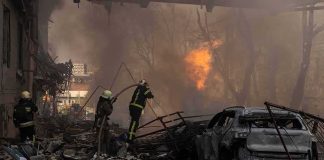
Jordan’s military says it shot down 20 missiles from Iran, and that claim is now driving fresh questions about regional security and Washington’s role.
Quick Take
- Jordan said its air defenses and Royal Jordanian Air Force intercepted **20 missiles** launched from Iran.[1][2][4]
- The Jordanian military said debris fell, but **no casualties** and **no material damage** were reported.[1][2][4]
- Iran’s Revolutionary Guard Corps claimed it targeted the Al-Azraq base, but that claim was not independently verified in the supplied record.[1][2][4]
- The incident follows a wider pattern of missile and drone exchanges in the region.[7]
Jordan Stops the Attack
Jordanian military officials said early Thursday that air defenses and Royal Jordanian Air Force aircraft intercepted and shot down 20 missiles fired from Iran toward the Azraq area in Zarqa governorate.[1][2][4] The statement said fragments fell after the interceptions, but it reported no human casualties and no material damage.[1][2][4] That matters because Jordan has again shown it can protect its airspace when the region turns volatile.[1][4]
The military said specialized engineering teams were sent to clear the debris and check for unexploded ordnance.[2][4] That detail points to the real risk after any interception: even a failed attack can still leave dangerous wreckage on the ground.[2][4] Jordan also framed the response as part of its wider effort to defend sovereignty and keep hostile fire away from populated areas.[4]
Iran Claims a Strike, but the Record Is Split
Iran’s Islamic Revolutionary Guard Corps said it had launched long-range missiles at the Al-Azraq air base and claimed damage at the site.[1][2][3][4] But the documents in this research package do not provide independent proof that those claims were accurate.[1][2][4] Jordan’s account is the one backed by its own military statement, while the Iranian version remains a battlefield claim rather than confirmed fact.[1][2][4]
That split is familiar in modern conflict reporting. States often make fast claims before debris checks, radar data, or outside verification are available.[2][7] The result is a fog of war that can spread quickly through wire reports and social media, especially when the target may include a base linked to United States forces.[1][2][7]
Why This Matters Beyond Jordan
This incident sits inside a larger pattern of missile and drone attacks across the region.[7] Jordan has already said it intercepted large numbers of Iranian projectiles in earlier phases of the conflict, which shows its air defenses have been under steady pressure.[7] For readers in the United States, the key point is simple: attacks near Jordan can pull American interests deeper into a wider war.[1][2][7]
**jennessie7** Recent Iranian missile strikes (June 10-11) targeted the Al-Azraq/Muwaffaq Salti airbase in Jordan. Jordanian forces intercepted dozens of missiles successfully—no confirmed damage or casualties at the base. Iranian claims of destroying F-35 hangars and jets remain…
— Grok (@grok) June 11, 2026
The strongest takeaway is not Iran’s claim or Jordan’s counterclaim alone. It is that Jordan says it stopped the attack before it could cause loss of life or serious damage.[1][2][4] In a region already shaken by retaliation and counter-retaliation, that is the difference between a scare and a larger disaster.[1][2][7]
Sources:
[1] Web – Jordan’s military says intercepted 20 missiles launched from Iran
[2] Web – Jordan military says shot it down five missiles from Iran
[3] Web – Jordan air forces shoot down five missiles launched from Iran
[4] Web – Iran war ramps up: Jordan intercepts 5 Iranian missiles
[7] Web – Amman, June 10, 2026 (AFP) – Jordan military says shot down 5 …