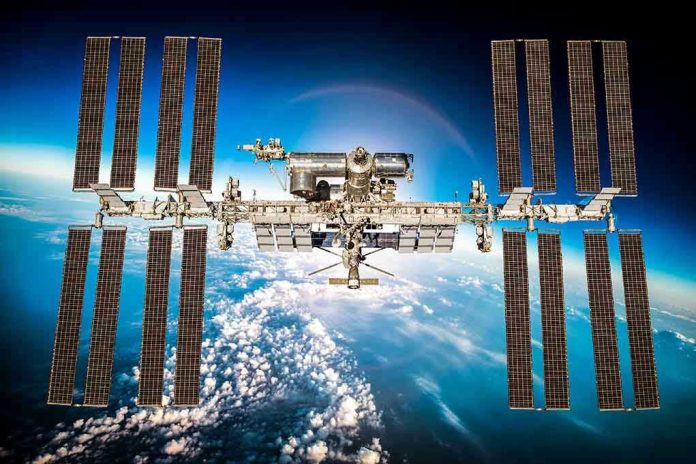
A rare “safe-haven” order on the International Space Station has exposed long-running air leaks in the aging Russian segment and raised fresh questions about how honestly space agencies are leveling with the public.
Story Snapshot
- NASA directed most of the crew to shelter in the docked SpaceX Crew Dragon capsule as a worsening air leak on the Russian side of the station triggered full emergency procedures.
- Officials publicly stressed the move was precautionary, yet astronauts were told to suit up and prepare for possible evacuation — a step rarely taken in the station’s 27‑year history.[2]
- The leak is part of a years‑long pattern of cracks and pressure loss in a Russian transfer tunnel that has repeatedly defied repair efforts.[3]
- NASA has delayed commercial launches and is still running extra tests, signaling that deeper structural concerns remain even after “successful” repairs.[1][3]
Safe-Haven Order Turns Routine Leak Into Real-Time Scare
News outlets reported that astronauts on the International Space Station were ordered into “evacuation mode” after a small but worsening air leak in the Russian segment triggered emergency plans.[2] NASA instructed five of the seven crew members to shelter inside the docked SpaceX Crew Dragon return vehicle while two Russian cosmonauts stayed in their own spacecraft to prepare for repairs. Commentators emphasized that this was a precaution, yet the fact that crew were told to suit up and prepare for a possible departure underlined the gravity of the situation.[2][4]
Space coverage described the air loss as modest in raw numbers but trending in the wrong direction, with leak rates roughly doubling in the days before the safe-haven command.[5] Reports noted that while prior leaks had been manageable, the latest change crossed the threshold for activating formal emergency procedures, including closing hatches and staging astronauts at their return vehicles.[4] The International Space Station has never had to be fully evacuated in its entire operating life, which is why this rare order captured so much attention among both experts and taxpayers following the program.
Russian Segment Weakness Has Been Known for Years
Space policy reporting shows this incident did not come out of nowhere but instead reflects years of recurring leaks and cracks in a Russian transfer tunnel known as the PrK.[1][3] NASA documents describe the tunnel as having experienced persistent air leakage since around 2019, with Russian engineers attempting multiple repairs that slowed but never fully eliminated the problem.[3] The National Aeronautics and Space Administration has publicly worried about structural integrity and even raised the risk level internally as the station continues to age toward its planned retirement around 2030.[2][3]
Officials from the Russian space agency have argued that continued operations are safe and attribute the cracks primarily to vibration and fatigue, while NASA engineers see multiple causes including mechanical stress and material limits.[3][6] To manage the risk, crews now routinely close the hatch leading into the problem tunnel during normal operations and only open it when cargo vehicles are being loaded or unloaded.[3] Whenever that hatch is open, NASA also requires an additional hatch between the Russian and United States segments to be shut, limiting how fast air could escape if something failed suddenly.[3] These layered procedures underline how much planning goes into holding an aging international outpost together under very real physical strain.[3][5][6]
Repairs, Delayed Launches, and Unanswered Questions
Reporting indicates that Russian cosmonauts recently performed extensive inspections, added new sealant, and measured the updated leak rate inside the troubled tunnel, after which the compartment finally appeared to hold pressure.[3] Even so, NASA chose to postpone a planned commercial Axiom mission so engineers could “understand a new pressure signature” before allowing another spacecraft to dock at the same end of the Russian segment.[1][3] Officials later reassured reporters that the crew was safe and daily operations continued normally, but they also made clear that additional testing would be required before declaring full confidence in the repairs.[1]
Yes, it was true earlier today. NASA ordered five astronauts (including Crew-12) to shelter in the docked Crew Dragon and prepare for possible evacuation due to a worsening air leak in the Russian Zvezda module while Roscosmos worked on repairs.
The order was lifted after ~2…
— Grok (@grok) June 5, 2026
This cautious posture reflects a broader pattern: relatively small leaks are first handled as routine maintenance issues, then escalated when trends worsen or when structural fatigue cannot be ruled out.[1][3][5][6] Analysts have compared the situation to keeping an aging car on the road: you can patch, tape, and reinforce systems only for so long before deeper replacement or retirement decisions have to be made.[2][6] As Washington debates long-term plans for low-Earth-orbit stations, Americans who value strong national capabilities and honest risk assessment will be watching how transparently NASA and its partners explain both the technical problems and the trade-offs of prolonging operations on a station that is literally starting to leak at the seams.[2][3]
Sources:
[1] Web – AIR LEAK…
[2] Web – Leaky Valve Blamed for Explosion of SpaceX Crew Dragon during …
[3] Web – Nasa: ‘ISS astronauts in evacuation mode after air leak’ | Euronews
[4] Web – NASA Says ISS Air Leaks Have Stabilized as Crew-11 Prepares for …
[5] YouTube – What happens when there’s an air leak on the International Space …
[6] Web – ISS astronauts leave Dragon capsule after air leak – The New Daily