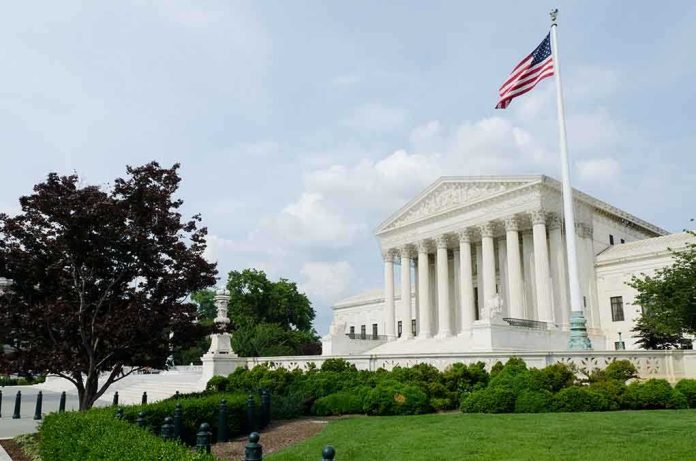
The Supreme Court is weeks away from rulings that could either rein in Washington’s unelected power centers—or lock in new precedents that expand them.
Quick Take
- Eleven high-impact cases from the 2025–26 term remain undecided as of May 7, 2026, with opinions expected by late June or early July.
- Several pending cases directly test the reach of federal surveillance, corporate liability, and states’ authority on cultural flashpoints like sports eligibility.
- Two Trump-era power cases could reshape how “independent” agencies like the FTC and even the Federal Reserve are insulated from presidential control.
- A birthright-citizenship dispute tied to a Trump executive order could have far-reaching immigration consequences if the Court reaches the merits.
Why this end-of-term sprint matters
The Supreme Court’s 2025–26 term has moved into its familiar endgame: a rush of major opinions after months of arguments. Public records show dozens of rulings already released, but a cluster of the most contested cases remains unresolved heading into late spring. The timing matters because these cases touch daily life—privacy, immigration, and education costs—and also the bigger question both parties increasingly argue about: who really governs, elected officials or entrenched institutions.
As of May 7, the remaining cases span executive power disputes involving President Trump, Fourth Amendment questions triggered by modern data tools, and high-profile culture-war litigation. Supporters of limited government see an opportunity for clearer constitutional boundaries. Critics fear that some outcomes could reduce checks on the executive or narrow civil-rights theories. What is not in dispute is the scale: a handful of opinions can reset legal expectations nationwide for years.
Digital privacy meets modern policing in geofence litigation
One closely watched case, Chatrie v. United States, centers on “geofence” warrants—requests that can pull location data for devices within a geographic area during a set time window. The Justice Department has defended the tool as necessary for public safety, while privacy advocates argue it risks sweeping up data from innocent people. The Court’s decision could clarify how older Fourth Amendment doctrine applies to mass-location searches in the post-smartphone era.
For conservatives wary of a growing surveillance state, the geofence fight lands in a familiar tension: supporting effective law enforcement while resisting dragnet-style information collection that treats everyone like a suspect. The Court’s post-Carpenter direction on digital data has already signaled that “third-party” possession does not automatically erase privacy interests. This pending ruling will indicate whether that logic extends to broader, area-based location collection rather than one person’s records.
Trump’s agency-control cases put the “deep state” argument on the docket
Two pending matters tied to President Trump’s second term target the legal architecture of “independent” agencies—structures conservatives often describe as the operating machinery of an unaccountable federal bureaucracy. One case asks the Court to revisit the precedent that limits a president’s ability to remove certain agency officials. Another involves a dispute connected to the Federal Reserve, raising questions about how far presidential authority reaches when courts block firings or restructuring.
The underlying legal issue is not personalities; it is separation of powers. If the Court strengthens presidential removal authority, supporters argue voters gain clearer accountability because the executive branch answers to an elected president. Opponents argue that loosening removal protections could politicize enforcement and monetary policy. Either way, these cases force a direct answer to a question many Americans share across party lines: when agencies make rules that feel like laws, who can truly rein them in?
Immigration and citizenship: a high-stakes constitutional collision
Another major dispute relates to President Trump’s executive order on birthright citizenship and the Fourteenth Amendment’s citizenship clause. Reporting and case summaries indicate the justices have probed the order’s constitutionality, and public debate has focused on whether the Constitution allows a narrower interpretation than the modern, widely accepted understanding. Because citizenship rules affect everything from federal benefits to voting eligibility, even incremental changes would carry enormous social and political impact.
The practical stakes help explain why the fight is so intense. Immigration policy has been a core point of frustration for conservatives who see lax enforcement and expansive interpretations as incentives for illegal entry, while many liberals view restrictions as discriminatory and destabilizing for families. If the Court reaches a definitive merits ruling, it could settle a long-running conflict over whether the citizenship clause is as absolute as commonly taught—or whether Congress and the executive have more room to define its boundaries.
Culture-war cases and economic ripple effects beyond Washington
Little v. Hecox and related disputes put state laws on sex-based sports eligibility into direct tension with Equal Protection arguments. States defending these laws argue they protect competitive fairness and women’s sports; opponents argue they unlawfully single out transgender athletes. Because school sports touch community identity, parental authority, and youth development, the ruling is likely to reverberate well beyond the states directly involved, shaping school policies and litigation strategies nationwide.
Other pending cases carry major economic implications even without the same cable-news heat. The Court is weighing disputes involving tariff authority, corporate liability for alleged overseas misconduct, investor suits, and questions involving Cuba-related claims under U.S. law. Businesses want predictable rules and limited litigation exposure; activists want broader accountability and stronger consumer or human-rights remedies. With opinions expected soon, Americans should watch not just who “wins,” but which institution—Congress, the courts, or agencies—ends up making the real rules.
Sources:
List of pending United States Supreme Court cases
Supreme Court of the United States – Slip Opinions (October Term 2025)
Major Supreme Court Cases from the 2025-26 Term