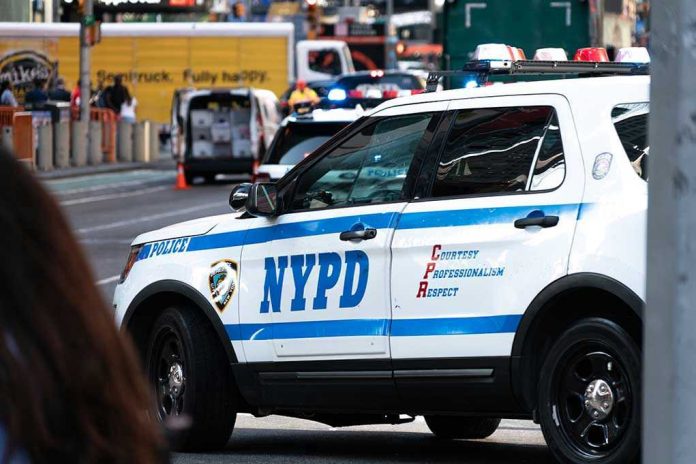
When protesters shut down a Manhattan avenue to pressure U.S. lawmakers, the NYPD response underscored a basic question many Americans keep asking: who gets to disrupt daily life—and for how long?
Quick Take
- NYPD detained roughly 50 to nearly 100 Jewish Voice for Peace protesters after they blocked traffic outside Sen. Chuck Schumer’s and Sen. Kirsten Gillibrand’s Manhattan offices.
- Organizers said the demonstration opposed U.S. military aid and bomb sales to Israel amid regional conflicts involving Lebanon and Iran.
- Security prevented protesters from entering the building, and the group shifted to the street, blocking a major avenue for under an hour.
- High-profile names, including Chelsea Manning, actress Hari Nef, and NYC Council Member Alexa Avilés, were reported among those detained.
Traffic blockade ends with arrests outside senators’ offices
NYPD officers detained Jewish Voice for Peace demonstrators after a Monday protest outside the Manhattan offices of Democratic Sens. Chuck Schumer and Kirsten Gillibrand. Reports put the total turnout around 200, with an arrest count ranging from about 50 to nearly 100. After building security stopped a planned sit-in, the group moved outside and blocked a major avenue for less than an hour before officers loaded detainees onto buses.
Hauling the Trash: NYPD Carries Away Jewish Voice for Peace Protesters Blocking Traffic https://t.co/9p0geQ4z21 pic.twitter.com/zU6xgmfE8m
— Twitchy Team (@TwitchyTeam) April 13, 2026
Protesters chanted variations of “fund people, not bombs” while demanding an end to U.S. military support for Israel, including specific complaints about bomb sales. Coverage of the event indicates the demonstration was tied to escalating conflict dynamics in the region, including Israel-Lebanon clashes and tensions connected to Iran. Available reporting does not provide official statements from Schumer or Gillibrand responding to the action, and it does not specify final charges.
Who Jewish Voice for Peace is—and why its tactics keep drawing attention
Jewish Voice for Peace, founded in 1996, is a U.S.-based Jewish organization that advocates for Palestinian rights and criticizes Israeli policies and U.S. support for Israel. The group gained wider visibility after major rounds of Middle East fighting and has used direct-action tactics—from office occupations to transportation disruptions—especially since the post-October 2023 protest surge. Monday’s action fits that pattern: create maximum visibility by targeting high-profile lawmakers and high-traffic public space.
That strategy also explains why these protests often end the same way. City governments have an obligation to keep roads open for emergency vehicles, workers, and commuters, and New York regularly enforces rules against traffic obstruction regardless of the cause. For conservatives—and many non-ideological New Yorkers—the practical issue is less about the protesters’ foreign-policy argument and more about whether political activism is being prioritized over public order and the rights of ordinary people.
High-profile arrests amplify the message, but details remain limited
Multiple reports said notable individuals were among those detained, including Chelsea Manning, actress Hari Nef, and New York City Council Member Alexa Avilés. That kind of roster reliably drives press coverage and social media distribution, even when the protest itself is brief. At the same time, the available reporting leaves gaps: it does not clearly identify what each person was charged with, whether summonses were issued, or how quickly arrestees were released.
What this says about politics in 2026: street pressure vs. governing responsibility
The protest targeted Schumer, a central figure in Senate Democratic leadership, highlighting internal Democratic tensions over Israel policy. With Republicans controlling Washington in 2026, demonstrations aimed at Democratic senators also reflect activists’ belief that intra-party pressure is where they can still move votes or messaging. For voters already convinced government is unresponsive, the recurring cycle—disruption, arrest, viral clips, and few concrete policy changes—can look like politics has become performative rather than results-driven.
The larger issue: equal enforcement and a functioning public square
Public protest is protected, but blocking major roads is where constitutional rights collide with basic civic expectations. If laws against obstructing traffic are enforced consistently, the public can still speak loudly without turning working families into collateral damage. If enforcement becomes selective or politicized, distrust deepens across the spectrum—feeding the belief that elites and institutions apply one set of rules to activists and another to everyone else trying to get to work.
Hauling the Trash: NYPD Carries Away Jewish Voice for Peace Protesters Blocking Traffic https://t.co/3KqslYnl19
— ConservativeLibrarian (@ConserLibrarian) April 13, 2026
For now, the confirmed facts are narrow: the attempted office sit-in was denied, the group blocked traffic briefly, and NYPD removed and bused detainees away. Without more official detail on charges or outcomes, broader claims about the protesters’ legal treatment cannot be verified from the available sources. What is clear is that these confrontations are becoming a routine feature of national politics—especially when foreign policy debates spill onto local streets.
Sources:
https://www.arabnews.com/node/2639805/world
https://www.arabnews.com/node/2639805/amp
https://www.wftv.com/news/national/dozens-arrested/W75NH4W62456DJEVDLXXNMIW34/