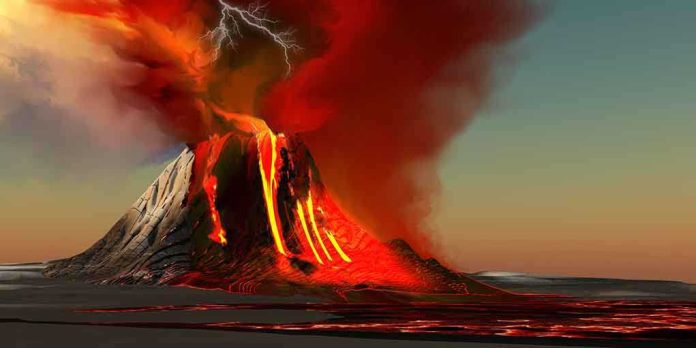
Kīlauea’s 46th eruption in just 17 months signals an unprecedented volcanic cycle that challenges conventional understanding of Hawaiian hotspot behavior and raises critical questions about long-term hazard preparedness.
At a Glance
- Kīlauea entered its 46th episodic lava fountaining event on May 5, 2026, at 8:17 a.m. HST, approaching the historical record of 47 episodes from 1983-1986
- USGS raised alert status to WATCH/ORANGE on May 4 after detecting rapid magma inflation, demonstrating effective precursory monitoring that enabled advance warning
- Tephra and Pele’s hair fallout threaten downwind communities, requiring coordinated federal, state, and local response to protect residents and tourism-dependent economy
- The sustained 17-month eruption sequence reshapes Halemaʻumaʻu crater floor and contributes invaluable geologic data on mantle plume dynamics
Unprecedented Episode Frequency Challenges Volcanic Monitoring Models
Since December 23, 2024, Kīlauea has produced 46 separate lava fountaining episodes, each lasting under 12 hours and separated by pauses exceeding three weeks. This pace approaches the 1983-1986 Puʻu ʻŌʻō record of 47 episodes, marking a dramatic shift in eruptive behavior. Episode 45, occurring April 23, 2026, ejected approximately 6.8 million cubic yards of lava with fountains reaching 900 feet. The current Episode 46 continuation underscores the volcano’s sustained magma supply and challenges scientists’ understanding of Hawaiian hotspot recharge cycles.
USGS Monitoring Demonstrates Effective Predictive Capability
The Hawaiian Volcano Observatory issued a forecast window of May 4-7 for Episode 46 on May 3, based on tiltmeter and GPS data tracking magma inflation. Post-Episode 45 deflation measured 16.0 microradians, followed by 13.2 microradians of inflation by May 4, triggering the alert upgrade to WATCH/ORANGE status. This precision monitoring enabled park officials and county civil defense to prepare communities downwind for potential tephra and Pele’s hair fallout, exemplifying how science-based early warning systems protect public safety.
Tephra and Ash Pose Immediate Threats to Communities and Infrastructure
Episode 46 fountaining from Halemaʻumaʻu crater’s north and south vents produces ash clouds and tephra fallout, with heaviest deposits within three miles downwind under current light trade wind conditions. Pele’s hair—fine volcanic glass strands—poses respiratory and skin irritation risks to residents in affected areas. Hawaii County Civil Defense issued preparedness alerts advising residents to disconnect water catchments and prepare for cleanup operations. While Episode 45 caused minimal visitor impact at park facilities, sustained eruptions increase cumulative hazard exposure for communities relying on tourism and agriculture.
Long-Term Eruption Cycle Reshapes Crater Geology and Global Understanding
The 17-month eruption sequence has added hundreds of millions of cubic yards of lava, fundamentally reshaping Halemaʻumaʻu crater’s floor and walls. Geologically, this sustained activity provides unprecedented data on Hawaiian hotspot mantle plume dynamics, informing models of volcanic systems worldwide. Scientists note that the episodic pattern—short fountaining bursts separated by extended pauses—reflects cyclical magma degassing and recharge processes. If Episode 47 occurs, Kīlauea will match the historic Puʻu ʻŌʻō record, cementing this eruption sequence as a defining geologic event of the 2020s.
Hawaii’s Kilauea Volcano blasts out fountains of lava in 46th eruption of 2026 Cameras set up by the USGS around Hawaiʻi Volcanoes National Park show the growing strength as lava continues to gush from the summit. https://t.co/fTGiJrf8w2 pic.twitter.com/oAkFCpBBHQ
— UnfilteredAmerica (@NahBabyNahNah) May 6, 2026
Federal and state coordination through USGS, the National Park Service, and Hawaii County Civil Defense demonstrates institutional capacity to manage volcanic hazards in real time. Ongoing monitoring, community alerts, and adaptive closure protocols balance public access to Hawaiʻi Volcanoes National Park—a major economic draw generating roughly 20 percent of Big Island tourism revenue—with resident and visitor safety. As Episode 46 continues, officials remain prepared to escalate responses if fountaining intensifies or wind patterns shift tephra toward populated areas, ensuring that scientific expertise translates into effective protective action.
Sources:
Kilauea Volcano Lava Eruption Window Opens
USGS Hawaiian Volcano Observatory Notice – May 3, 2026
Mount Kilauea Volcano Spews Out Fountains of Lava Amid 46th Eruption
USGS Hawaiian Volcano Observatory – Kīlauea Volcano Status
Kilauea Volcano Alert Level Raised to WATCH as Lava Flows Begin