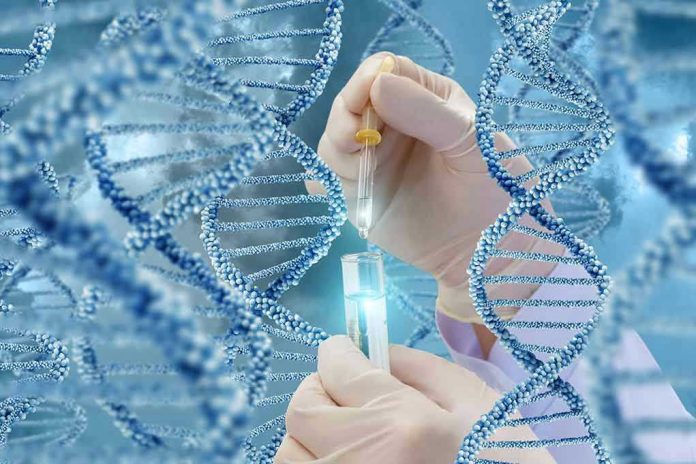
CRISPR breakthroughs now silence the extra chromosome causing Down syndrome in lab cells, raising alarms over elite-driven eugenics that could redefine human diversity and challenge parental rights to natural-born children.
Story Highlights
- 2025 Mie University study removes extra chromosome 21 from Down syndrome cell lines using CRISPR-Cas9.
- April 2026 Harvard/Beth Israel team achieves 20-40% efficiency silencing the chromosome via XIST gene insertion.
- Proof-of-concept restores normal gene expression but remains far from human trials amid ethical debates.
- Affects 1 in 700 births; targets root genetic cause, shifting from symptom management to potential cures.
Breakthroughs in CRISPR for Down Syndrome
Ryotaro Hashizume’s team at Mie University in Japan conducted the first proof-of-concept in February 2025. They used CRISPR-Cas9 to remove the extra chromosome 21 from Down syndrome-derived cell lines. This trisomy 21 causes cognitive and developmental challenges in about 1 in 700 newborns. The method targeted the chromosome directly, unlike prior single-gene edits. Researchers restored normal gene expression levels in treated cells. Off-target effects required further refinement for safety.
Harvard’s XIST Silencing Advance
Beth Israel Deaconess Medical Center and Harvard researchers reported in April 2026 a modified CRISPR approach. They inserted the XIST gene into Down syndrome stem cells, silencing the extra chromosome 21 with 20-40% efficiency. XIST mimics natural X-chromosome inactivation in females. This preserved other chromosomes while normalizing gene dosage. The team stated this paves a road for therapies against Down syndrome and other aneuploidies. Preclinical status limits immediate applications.
Earlier 2025 work used allele-specific CRISPR cleavage in induced pluripotent stem cells and fibroblasts. This rescued trisomy by preserving parental chromosome copies. Nanotech delivery reduced off-target risks compared to early CRISPR tools. Mouse models explored brain cell targeting to address intellectual disabilities, a core Down syndrome impact.
Historical Path to These Milestones
CRISPR-Cas9 originated from bacterial immune systems in 2012, enabling precise DNA cuts via guide RNA and Cas9 enzyme. Down syndrome research identified gene dosage effects from triplicate chromosome 21 genes over 50 years ago. No cures existed despite prenatal screening. A 2019 hypothesis proposed dual CRISPR with nanotech to cut and replace the Down syndrome critical region, emulating X-inactivation.
Stakeholders and Ethical Tensions
Academic leaders like Mie and Harvard teams drive progress through publications. Funding from bodies like NIH supports work, but no commercial trials launch yet. Ethicists from Genetic Literacy Project and Stanford Law warn of implications for human diversity. They question if “curing” Down syndrome erodes acceptance of natural variations. Both conservatives valuing life’s sanctity and liberals championing diversity share unease with elite interventions reshaping humanity.
Impacts and Broader Concerns
Short-term, these lab successes validate chromosome-level editing, spurring research into cancers and other aneuploidies. Long-term, they promise symptom reversal like improved cognition, but chromosome instability risks persist. High R&D costs burden families without government overreach. Social debates pit innovation against equity. In Trump’s America First era, such advances demand scrutiny to protect individual liberty from deep state biotech agendas favoring the powerful over everyday parents.
Sources:
CRISPR Snips Away Extra Chromosomes, Offering New Hope for Down Syndrome Treatment
Hypothetical CRISPR/nanotech proposal for DS
CRISPR takes a bold leap toward silencing Down syndrome’s extra chromosome
Trisomic rescue via allele-specific CRISPR
Cutting to the Core: Down Syndrome, CRISPR, and the Future of Human Diversity