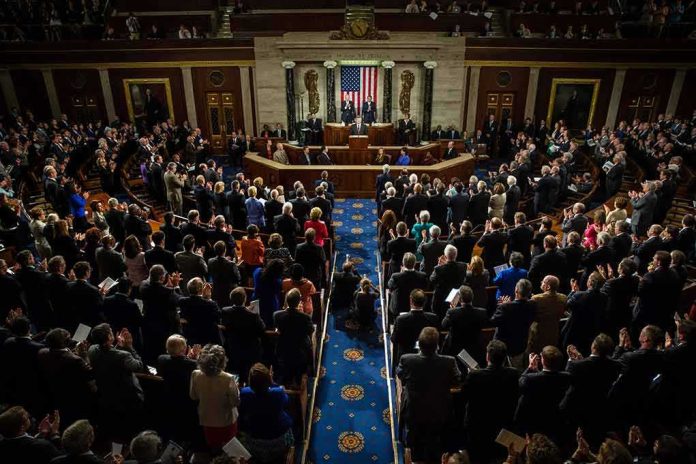
A furious House showdown over secret spying has stalled Washington’s favorite surveillance tool and exposed how far Democrats will go to protect warrantless snooping on Americans.
Story Snapshot
- House lawmakers rejected a short-term extension of Section 702, putting powerful spy tools on shaky ground.
- Democrats erupted over President Trump’s pick of Bill Pulte as Director of National Intelligence, tying it to the 702 fight.
- Section 702 lets agencies collect foreign communications without a warrant, but it also sweeps in Americans’ calls, texts, and emails.[1]
- Conservatives are split between defending national security and demanding real warrant protections for Americans’ Fourth Amendment rights.[2][3]
House Revolt Freezes Short-Term Spy Extension
House leaders tried to rush through another “temporary” patch to keep Section 702 alive, but this time the vote blew up on the floor. Recent coverage shows the House has used short stopgap bills, some as short as ten or forty-five days, to prevent the powers from expiring while leaders haggle over reforms.[1][4] This week, enough conservatives joined privacy-minded Democrats to reject another quick fix, saying leadership cannot keep asking for blind trust after years of warrantless lookups of Americans’ data.[2][3]
Section 702 of the Foreign Intelligence Surveillance Act lets intelligence agencies tap into emails, texts, and calls of foreign targets overseas without going to a judge for each person.[1][4] The catch is simple and dangerous: when those foreigners talk with Americans, our side of the conversation gets pulled in too.[1] The Federal Bureau of Investigation can then search those databases for Americans’ names, phone numbers, or email addresses without a warrant, something even mainstream outlets now admit is a central point of anger in Congress.[2]
Trump’s Pulte Pick Triggers Democrat Outrage
President Trump’s decision to tap businessman Bill Pulte as the next Director of National Intelligence landed right in the middle of the 702 brawl, and Democrats are using it to inflame the fight. Coverage of the politics around reauthorization shows Democrats already warning that extending 702 gives “warrantless surveillance powers” to the current administration. Now they argue that letting a Trump-aligned outsider oversee the intelligence community while Congress rubber-stamps 702 would supercharge the White House’s ability to spy on political enemies, donors, and activists.[2]
Democrats’ sudden panic ignores a hard truth: they had no problem with these same powers when a liberal administration was in charge. Civil-liberties groups on the left and right have documented how agencies used 702 data to look at journalists, protestors, religious leaders, and political figures across the spectrum, all without telling the targets or getting a warrant first.[4] A 2025 federal court ruling even found that using U.S. person search terms on 702 databases requires a warrant under the Fourth Amendment, unless a narrow exception applies. Yet many Democrats still refuse to back serious warrant rules and instead focus on attacking Trump’s nominee.
What Section 702 Really Does To Americans’ Privacy
Official intelligence community booklets admit that Section 702 is “targeted” at foreigners abroad but still gathers communications of non-targets, including Americans, when they talk to those targets. Analysts call this “incidental collection,” but that label does not make it harmless. Policy experts say the National Security Agency can collect full conversations with overseas targets, then store that content in large databases where the Federal Bureau of Investigation later searches for information about Americans in a “finders keepers” style system.[4] Critics point out that most people swept up have done nothing wrong.
Heritage Foundation analysts and civil-liberties advocates agree on one basic fact: the law does not allow direct targeting of Americans, but it does allow massive incidental collection of their communications without a warrant. The fight is over what happens next. Reformers argue that, once the government wants to read or use Americans’ side of those conversations, it should have to go to court first, just like it would for a wiretap at home. Intelligence officials and some Republicans respond that broad warrant rules would slow time-sensitive work tracking terrorists, hackers, and foreign spies.[4]
Republican Split: Security Tool Or Constitutional Threat?
For years, Congress has renewed 702 only after last-minute standoffs, each time calling it “too vital” to risk letting lapse.[1][4] The House recently passed a three-year extension bill with added penalties for abuse, new reviews of Federal Bureau of Investigation searches, and more access for lawmakers to the secret surveillance court, but no warrant mandate for U.S.-person searches.[2] Senate Republicans later floated a similar three-year plan, again leaving out the warrant rule that privacy hawks demand, while tossing in a ban on a Federal Reserve digital currency to win over skeptics.
That pattern has many conservative voters angry. They remember how secret courts and spying tools were twisted in the past against President Trump’s own campaign and allies. Now, with a Trump administration back in power, some Republicans still argue that 702 is “not broken” and that existing reforms are enough. Others say a tool that lets any administration quietly search Americans’ communications without probable cause is a standing threat to the Constitution, no matter which party holds the White House.[4] The failed short-term extension shows that this split is no longer hidden in back rooms; it is playing out in public, and the votes are getting closer every round.
President Trump nominates new DNI. But comes just a day before FISA Section 702 anti-terrorism provision expires. House Democrats earlier blocked a short-term extension of the bill due largely to opposition to the naming of acting DNI Bill Pulte, who has no intel background. https://t.co/41f4V34AkW
— Mitchell Miller (@mmillerwtop) June 11, 2026
Groups like the Electronic Frontier Foundation and the Brennan Center warn that Section 702 has “rife” loopholes and compliance problems and that privacy “cannot afford a clean extension” anymore.[4] They point to years of secret abuses, murky internal audits, and a lack of notice to people whose data was used in court so they can challenge it.[4] On the other side, many national-security veterans insist that more than a quarter of U.S. intelligence reporting depends in some way on 702 collection and say letting it expire or adding strict warrants would leave dangerous blind spots. Caught between those warnings, House Republicans now have to decide whether the next move is another patch, a full rewrite with real warrant protections, or finally forcing the intelligence community to live within the same Fourth Amendment limits every ordinary police officer must follow.
Sources:
[1] Web – House Rejects Short-Term FISA 702 Spy Powers Extension As Dems Rage …
[2] Web – FISA Section 702: Congress passes short-term surveillance program …
[3] Web – House passes 3-year FISA 702 extension – Nextgov/FCW
[4] Web – Congress Poised to Consider FISA Extension in April