
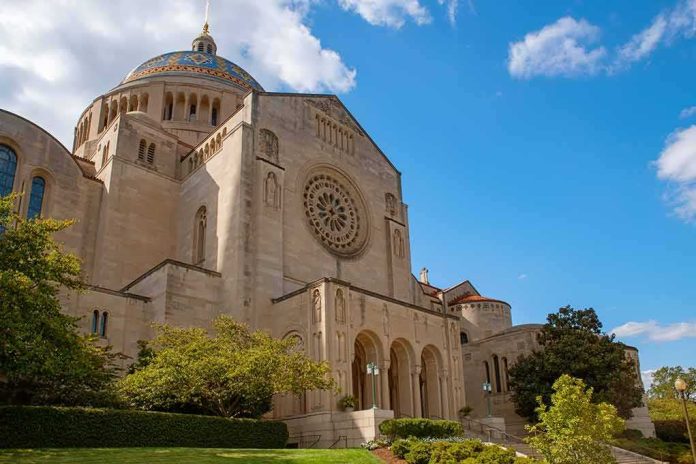
A single act inside a regional basilica captured the collision of faith, heritage, and criminal law: a man was arrested after admitting he smashed a display, stole a reliquary holding a bone fragment attributed to Saint Nicholas, and destroyed it rather than try to profit from it.
At a Glance
- Police arrested a suspect at his home following the theft of a Saint Nicholas relic from the Basilica of Saint-Nicolas-de-Port in Lorraine.
- According to parish accounts reported by multiple outlets, the suspect confessed to breaking the display case, stealing the reliquary, and burning and crushing the fragment.
- The object was a bone fragment venerated as a relic of Saint Nicholas, the 4th‑century bishop whose legacy informed the Santa Claus tradition.
- The reported motive was ideological repudiation of relic veneration, not resale or trafficking.
What Happened and Why It Matters
Regional and faith-oriented publications report that police identified and arrested a man after the disappearance of a reliquary containing a bone fragment attributed to Saint Nicholas from the Basilica of Saint-Nicolas-de-Port, southeast of Nancy. Parish accounts quoted in those reports say the suspect admitted he smashed the protective case, removed the reliquary, and later burned and crushed the fragment, describing relic veneration as idolatry or fetishism rather than an object to be fenced for money. Authorities have not publicly named the suspect; news summaries describe an arrest at his residence after investigators followed up on the priest’s complaint and parish report.
The basilica houses multiple objects linked to the saint, notably the “blessing hand” reliquary, but the missing fragment had been displayed more accessibly and, by local accounts, became the target of a straightforward break-and-remove. The reported confession anchors the criminal narrative: this was not a theft to monetize, but a deliberate destruction rooted in hostility to the practice of venerating relics. While the precise chronology varies slightly across summaries, the core sequence—disappearance, complaint, investigation, arrest, admission—holds across coverage and forms a coherent picture of the case.
Mechanism of the Crime: Simple Access, Irreversible Damage
Crimes against religious objects, even those of significant devotional value, are often depressingly low-tech. A display case is forced or glass is shattered; a small, portable object is removed in seconds. In this case, accounts converge on a manual breach of a protective case and the removal of a small reliquary, with subsequent off-site destruction by burning and crushing. That combination is important. Burning organic material—human bone in particular—does not reduce it to powder in an ordinary fire; crushing afterward is a practical method to ensure irrecoverable loss of form and devotional integrity. The result is catastrophic for the community: even if an ash-and-fragment mixture were recovered, its spiritual and heritage value is, for many believers, destroyed by the desecration itself.
Investigatively, such crimes hinge on three avenues: scene forensics (glass transfer, tool marks, prints), movement tracing (CCTV, mobile data, witness routing), and suspect interviews. Public reporting here emphasizes the interview and admission element. That is not unusual—police worldwide routinely solve church thefts by pairing quick suspect identification with a confession, because the items are distinctive and the community response is swift.
Where This Fits in the Broader Pattern of Cultural and Religious Property Crime
Places of worship are persistent targets for theft and damage. International bodies and national agencies flag churches and shrines as vulnerable due to public access, predictable hours, and small, portable valuables in semi-secured displays. The FBI has characterized theft from religious heritage as a recurring problem, while also acknowledging the difficulty of quantifying its frequency across jurisdictions because incident reporting and coding vary widely. INTERPOL similarly lists places of worship among common targets for cultural property crime, alongside private homes and museums.
Most church theft is pragmatic rather than ideological: metal stripped from roofs, chalices stolen for bullion value, statuary and art lifted for resale. Historic England’s strategic assessment of heritage crime highlights how marketable material—especially metals—drives many offenses against sacred sites, even as commodity prices fluctuate. The Saint-Nicolas-de-Port case is distinct because the suspect, according to reports, rejected the core premise of relic devotion and destroyed the fragment rather than view it as a commodity. That does not make it unique in history—iconoclastic acts have accompanied religious disagreement for centuries—but it does place this event outside the typical market logic of cultural property theft.
The Reliquary and the Saint: Devotion, History, and Symbolic Stakes
Relics tie communities to a past that is both historical and devotional. Saint Nicholas, bishop of Myra, occupies an unusual space where hagiography and popular culture meet: the protector of children and sailors whose legend ultimately informed the modern Santa Claus. Across Europe, Nicholas’s feast on December 6 anchors processions, gift-giving traditions, and civic identity. In Lorraine, the basilica at Saint-Nicolas-de-Port is a focal point for that identity; damaging a relic there is not merely theft, but an affront to a regional symbol that integrates faith, history, and communal memory. The reported intention to continue honoring Saint Nicholas Day with remaining relics underscores resilience after desecration, a familiar pattern in communities that have experienced past acts of vandalism and theft.
From a heritage perspective, fragments matter. Devotional culture developed around distributed relics—multiple authenticated fragments venerated in different places. Whether one accepts their spiritual claim or not, these objects anchor centuries of art, ritual, and local continuity. Their loss cannot be remedied by insurance; it is a permanent subtraction from a living tradition.
Law Enforcement Response and Case Trajectory
Based on published accounts, police located the suspect at his residence soon after the complaint, and he reportedly admitted to the break-in and destruction during questioning; one report references a court appearance and psychiatric evaluation, which is consistent with French criminal procedure in cases involving apparent ideological or disorganized motives. While such procedural steps occur largely out of public view for privacy and due process reasons, the arc—complaint, identification, arrest, interview, and judicial oversight—is standard.
In the narrow sense, this investigation does not resemble organized antiquities trafficking. There is no suggestion of a market chain, handlers, or export risk. In the wider landscape, however, it illustrates why cultural property teams emphasize prevention, not just recovery: small reliquaries are inherently hard to protect without degrading the openness that defines a living church. International and national guidance for cultural property risk management repeatedly points to layered security—sightlines, controlled display access, alarms, and local vigilance—as the only sustainable answer for community sites that cannot operate like high-security museums.
MAN ARRESTED FOR SMASHING CASE, STEALING, BURNING & CRUSHING BONES OF ST. NICHOLAS AT BASILICA IN LORRAINE FRANCE
A Suspect Has Been Arrested (BUT NOT NAMED) After Breaking Into A Protective Display Case At The Basilica Of Saint-Nicolas-De-Port In Meurthe-Et-Moselle, France,… pic.twitter.com/lLb8a9tvv7
— John Basham (@JohnBasham) November 9, 2026
What Endures After the Damage
Two truths sit side by side. First, the immediate object of devotion is reportedly gone by the suspect’s own account, destroyed by fire and force. Second, the web of meaning around it—the saint’s story, the basilica’s role in Lorraine, the communal practice that fills the nave each December—persists. That is not consolation for the loss, but it is a reminder of why such thefts are more than property crimes: they aim at the bonds that hold a community together. Law enforcement can close a case; only the community can restore its rhythms of trust and worship.
Sources:
nashaniva.com, dailycaller.com, thecatholicherald.com, catholiconline.news, dailymail.com