
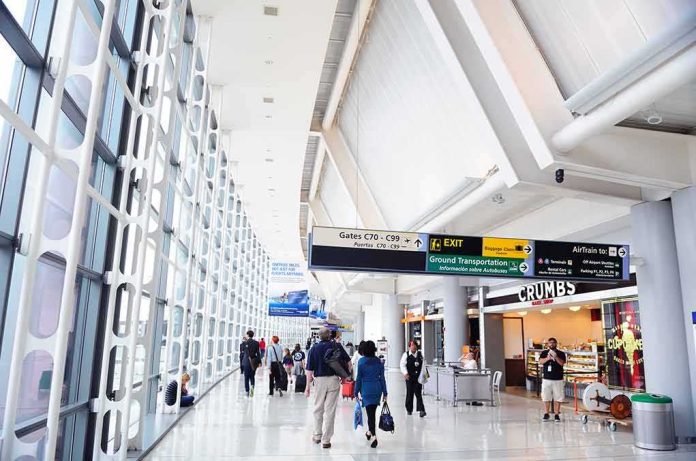
Presidents do not typically redesign airports; yet the Dulles overhaul is precisely that—a head-of-state–level push to replatform a major U.S. gateway with a clearly defined scope, an unusually visible financing plan, and a coalition of airport, airline, and federal actors aligned to execute it.
At a Glance
- President Trump and Transportation Secretary Sean Duffy unveiled a multi-year reconstruction of Washington Dulles International Airport centered on replacing the aging C and D concourses.
- The administration framed the project as roughly a $22–$22.5 billion program, with funding led by airport revenues and airline participation rather than direct federal appropriations.
- Core elements include over 5 million square feet of new or renovated terminal space, a new passenger train replacing mobile lounges, and a 32,000-space parking complex.
- The initiative is a coordinated effort among USDOT, the Metropolitan Washington Airports Authority (MWAA), and United Airlines, with renderings and sequencing described at the unveiling.
What Was Announced: Scope, Sequencing, and the Passenger Use Case
The Dulles program aims to solve an obvious operational pain point: the 1980s-vintage C and D midfield concourses that long outlived their intended lifespan. The plan replaces them with modern, high-capacity facilities integrated into a new circulation system—think clear sightlines, shorter transfer paths, and a rail link that makes the old people movers obsolete. The administration’s briefing and contemporaneous coverage describe more than 5 million square feet of newly built or renovated terminal area, a horseshoe-configured train, and a central pedestrian spine to rationalize gate access. A 32,000-space parking complex—with weather-protected connections to the terminal—expands landside capacity to match the airside rebuild.
For travelers, the mechanism is straightforward: eliminate chokepoints and friction. New concourses consolidate security design standards and utilities. A purpose-built train absorbs the last-mile function once handled by mobile lounges, freeing up apron space and smoothing apron operations. And by preserving the Saarinen-designed headhouse while modernizing the processing halls behind it, the program marries architectural heritage with throughput—exactly what a hub airport must do to grow without degrading the experience.
Who Is Paying and How the Money Flows
The administration presented the program as financed primarily through airport system revenues and airline participation, not through new federal appropriations. That matters for two reasons. First, it places the project within the well-established U.S. airport financing toolkit: revenue bonds backed by airport fees, airline rents, passenger facility charges (PFCs), and long-term use-and-lease agreements. Second, it clarifies the federal role as regulatory and facilitative—permits, environmental review, and eligibility interfaces—rather than as the primary fiscal backstop.
Coverage clustered around a $22–$22.5 billion headline figure for the program. Later reporting pointed to an MWAA board funding authorization on the order of $19.9 billion, illustrating a familiar distinction between total program scope and staged financing waves—a normal cadence for multi-phase airport work where bond issuance tracks design maturity and construction packaging. The institutional architecture—USDOT, MWAA, and a hub carrier (United)—is exactly the triad that makes such scale bankable: governance to issue debt, an anchor tenant to sign long-term agreements, and a federal partner to keep approvals moving.
Why Dulles, Why Now: Performance, Demand, and Network Strategy
Dulles has been a paradox: a globally connected hub saddled with legacy concourses and awkward landside access. J.D. Power rankings in recent years placed it near the bottom of large U.S. airports, a signal as much about experience metrics—time, clarity, ambience—as about raw capacity. United’s East Coast network strategy amplifies the imperative: premium long-haul and connecting traffic requires modern gatehold rooms, efficient boarding, and short, legible transfer paths. A concourse replacement, integrated train, and expanded processing halls directly target those variables, which is why airline leadership stood with MWAA and USDOT at the rollout.
On the regional side, Northern Virginia’s continued population and employment growth—coupled with Dulles’ international route map—puts pressure on both airside and curbspace. The 32,000-space garage and improved terminal connectivity address ground access and weather resilience. Meanwhile, the rail link within the terminal precinct replaces non-scalable mobile lounges with predictable, high-frequency capacity—an operational upgrade that reduces variance in connecting times and gate-to-gate transfers.
Execution Risk: Airport Megaprojects Rarely Fail Quietly
Airports are among the hardest classes of infrastructure to expand: fixed airfield geometry, live operations, security zoning, and phasing that must keep carriers moving even as demolition and rebuilding occur. The global record shows that cost and schedule pressures are the rule, not the exception, across megaprojects; governance discipline, scope control, and contractor integration determine whether a marquee plan holds its line or succumbs to drift. The teams involved in Dulles framed the sequencing as faster and less disruptive than a drawn-out, decadal patchwork—a posture consistent with design-build packaging, progressive GMP (guaranteed maximum price) techniques, and early contractor involvement that compress learning curves and reduce change orders when done well.
Two mitigants stand out. First, replacing entire concourses in modernized footprints allows utility corridors, baggage systems, and concessions to be designed as coherent systems rather than retrofits—less rework, better lifecycle cost. Second, anchoring finance to revenue bonds and airline agreements imposes market discipline; bond buyers and airline credit committees scrutinize scope, contingencies, and milestone risk before underwriting multi-billion-dollar tranches. Those are not guarantees, but they are meaningful guardrails.
WATCH LIVE: Trump gives remarks at Donald J. Trump International Airport
https://t.co/uOufBb742v— Fox News (@FoxNews) November 8, 2026
How This Announcement Was Communicated—and Why Mislabeling Matters
The unveiling unfolded as a White House event featuring President Trump and Secretary Duffy, with agencies and stakeholders providing project materials and renderings. Multiple independent outlets—the wire services, broadcast and local news—covered the announcement and reiterated the core elements: concourse replacement, the train, square footage, the parking complex, and the financing posture. In the age of real-time streaming, mislabeled clips and errant captions can muddy venues and subjects; the consensus reporting and the Transportation Department’s briefing anchor the specifics to Dulles, the Oval Office venue for the unveiling, and the USDOT–MWAA–United collaboration.
What to Watch Next: Milestones That Signal Real Progress
For a program of this size, three milestones separate aspiration from execution. First, finalized airline use-and-lease terms and concourse allocation plans—these determine the revenue underpinnings for bonds and the operational choreography during phasing. Second, environmental and federal approvals aligned to the chosen delivery model; protracted review elongates holding costs and procurement timetables. Third, procurement of the enabling works—utilities, site logistics, and temporary facilities—because smooth enabling contracts are the precondition for predictable vertical construction. Public board actions at MWAA, design packages moving from 30% to 60% to 100%, and bond offering documents will chart that path.
Bottom Line
The Dulles reconstruction is not a slogan; it is a defined capital program with the right institutional players and a credible passenger-centric design logic. The headline dollar figure will evolve as packages move from rendering to bid to build, but the throughline is consistent: replace obsolete concourses, unify circulation with a train and walkable spine, expand landside capacity, and do it on a timetable—and with a financing structure—that matches a top-tier international hub’s ambitions.
Sources:
facebook.com, reuters.com, pbs.org, washingtonexaminer.com, nytimes.com, northstarmeetingsgroup.com