
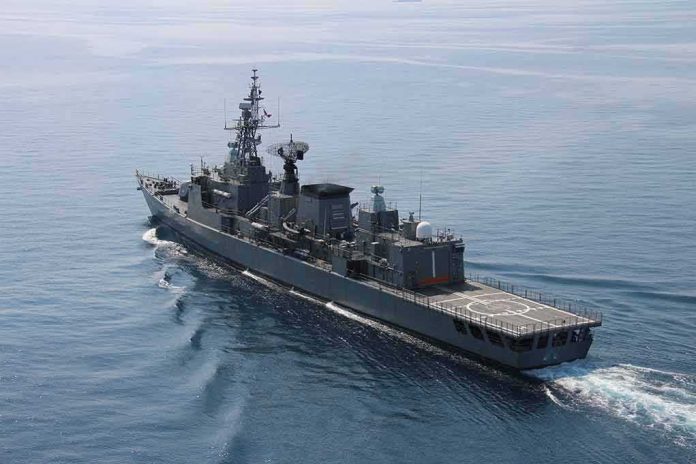
The Strait of Hormuz doesn’t have to be “closed” to convulse global oil: the practical difference between maritime control and persistent maritime disruption is the difference between orderly commerce and a risk-priced trickle that ricochets through freight, insurance, and ultimately pump prices.
At a Glance
- Iran and aligned groups have repeatedly disrupted—but not conclusively controlled—traffic through the Strait of Hormuz; targeted strikes and routing pressure reduced flows and raised risk premia.
- The shock has been large enough at times to trigger the IEA’s largest emergency stock release on record, underscoring real supply jeopardy even when barrels still move.
- Adaptive workarounds—escorts, alternate ports and pipelines, and ship-to-ship transfers—have partly offset losses and, at points, lifted regional exports back toward prewar levels.
- Freight and insurance are now central to price discovery: the voyage cost on a Gulf–China VLCC route climbed to the equivalent of roughly $24 per barrel at peaks, a quarter of cargo value.
What “control” means at sea—and what it doesn’t
States talk about “controlling” chokepoints as if sea lanes were gates to lock and unlock. Maritime reality is messier. A navy can make commercial passage dangerous, slow, and expensive without exercising sovereign control; conversely, escorts can sustain traffic without making it safe. Evidence from the 2026 phase of the U.S.–Iran confrontation fits this pattern. A Congressional Research Service brief details Tehran’s post–February 2026 effort to assert primacy in Hormuz—threatening and striking noncompliant ships and pressuring vessels to hug Iranian waters rather than established separation schemes. Those actions did not extinguish trade, but they degraded its reliability and economics. That distinction—disruption versus dominion—is the operating truth of Hormuz.
Operationally, the disruption toolbox is well known: warning shots, drone or missile strikes at propulsion, selective interdiction, and leveraging ambiguity to scare insurers. Iran’s Islamic Revolutionary Guard Corps publicly framed at least one strike as enforcing routing “rules,” a classic attempt to launder coercion into coastal-state administration. The effect is visible in traffic counts and in changed behavior—more night transits, transponders off, and clustering under allied overwatch—even as the waterway remains legally open.
How big was the supply shock?
When skeptics ask whether this is theater more than threat, the International Energy Agency’s actions answer plainly. The IEA characterized the Hormuz disruption as the largest supply interruption in energy-market history and coordinated a 400‑million‑barrel emergency stock release—its biggest—after flows fell to a fraction of normal during the acute phase. Spot prices responded accordingly; Brent’s jumps were not sentiment alone but a rational repricing of logistics, risk, and time-to-market as crossings fell and attack tallies rose.
Granular flow data capture the see-saw. Kpler’s counts and allied maritime reporting showed days with only single-digit transits and weeklong stretches of near-daily attacks, alongside episodes when crude flows rebounded to roughly three-quarters of prewar norms and, on select days, total Middle East exports exceeded prewar levels as barrels were rerouted. In other words: a shock severe enough to force strategic stock draws, yet porous enough to let adaptation do real work within weeks. That paradox is typical of maritime crises rather than an outlier.
The mechanics of adaptation: keeping barrels moving when the strait is unsafe
Energy logistics is not binary. Producers and traders widened their option set in three ways. First, geography: Saudi Arabia and the UAE leaned harder on bypass infrastructure—westward pipelines to Red Sea outlets and loadings east of Hormuz—reducing exposure to the narrowest channel mile for at least some flows. While the region’s pipelines cannot fully replace Hormuz, they meaningfully cushion the blow and enable blended export programs that flex with risk. Second, choreography: ship-to-ship transfers in the Gulf of Oman and creative scheduling under convoy-like overwatch lengthen supply chains but preserve liftings. Third, portfolio substitution: refiners and traders draw strategic stocks, reshuffle grades, and accept higher freight in exchange for assured arrival. The IEA’s subsequent statement—no need for a fresh coordinated release because “there is plenty of oil in the market”—reflects these cumulative offsets and inventory buffers tempering the initial shock.
None of this is free. Every workaround inserts delay, operational risk, and cost. At the peaks, chartering a very large crude carrier from the Gulf to China effectively embedded a $24-per‑barrel freight toll; in tight markets, that quantum reframes arbitrage, discourages marginal voyages, and ripples into delivered prices for refineries thousands of miles from the Gulf. The market’s price of risk therefore migrates from war headlines into refinery margins and wholesale rack prices, even if nominal OPEC+ output is unchanged.
Where the genuine disagreement lies
The argument is not whether attacks occurred or flows dropped; they did. The argument is over characterization. Tehran and its proxies advance a narrative of controlled, even “defensive,” actions that impose limited, manageable effects. The data do not support that framing. The IEA’s resort to its largest-ever stock action, coupled with multi-day collapses in crossings and persistent attacks logged by UKMTO and trade trackers, demonstrates systemic supply risk—not a cosmetic exercise of coastal-state “order”. At the same time, sweeping claims that Hormuz was functionally closed for a sustained period also overshoot. Regional exports on several days rebounded above prewar levels thanks to rerouting and pipelines, and seven-day averages briefly hit 18.5 million barrels per day—still below historical norms but well off the trough. Both things can be true: the strait was neither secure nor sealed.
Investors and policymakers should therefore discount maximalist rhetoric on both sides and watch the operational indicators that actually set prices: insured liftings, daily transits, attack tempo, and delivered-freight quotes on key lanes. These are the instruments that translate geopolitics into costs.
Historical lens: why Hormuz bends but rarely breaks
Hormuz has absorbed violence before without permanent closure. During the Iran–Iraq “Tanker War” of the 1980s, more than 500 merchant vessels were damaged or destroyed, yet crude continued to move; navies escalated escorts, insurers repriced risk, and shippers adapted tactics. Today’s market is larger, faster, and more financially intermediated, but the structural logic persists: chokepoint insecurity converts into delay and price, not into a binary stop. That dynamic is reinforced by the limited capacity of overland and bypass routes, which can blunt but not replace the 20 million barrels per day that routinely thread Hormuz in more placid times.
Hence the strategic burden shifts from “Can someone close Hormuz?” to “How long can the system carry elevated logistics risk before inventories, credit, and consumer demand reprice materially?” The answer depends less on any single strike and more on the durability of adaptation and the credibility of protection.
While Trump brings Russian diesel into the US, a tanker carrying 750,000 barrels of oil has struck a sea mine in the Strait of Hormuz.
As a reminder: according to Trump, oil prices are determined by Ukrainian attacks on Russian refineries, while the pic.twitter.com/bv75uX3vQs
— QThestorm RV🦅🇺🇲 (@17QStorm6RV) October 12, 2026
Implications: pricing a longer, costlier barrel
For producers inside the Gulf, the premium is twofold: a discount at the load port to reflect voyage risk and a higher delivered-cost base that can erode demand for heavier, sour grades when freight spikes compress refining margins. For consuming regions, the key variable is not just headline Brent but regional differentials and time spreads that reveal stress in physical delivery. Policymakers have two proven tools: visible naval assurance to suppress attack frequency and, when that fails, transparent stock draws to cap panic. Both calm prices faster than rhetoric does—because they speak to the mechanics of getting a barrel from manifold to refinery gate.
Bottom line: Iran has shown it can raise the cost and hazard of traversing Hormuz; it has not demonstrated durable operational control of the strait. The market has shown it can route around part of the problem; it cannot make the problem cheap. In a world where logistics is price, that is the enduring lesson.
Sources:
zerohedge.com, aljazeera.com, iea.org, edition.cnn.com, reuters.com, businessday.ng, iranintl.com, eia.gov