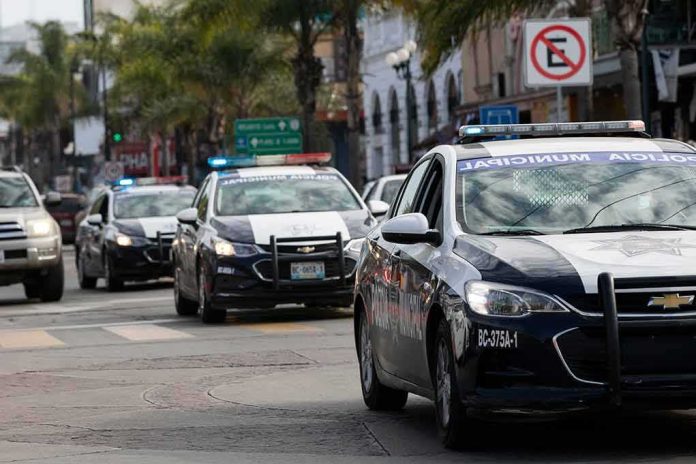
Washington Township, New Jersey, took money set aside to treat addiction and spent nearly $268,000 of it on two police SUVs and a network of automated license-plate cameras — a use of opioid-settlement funds that a state-recognized addiction researcher says has nothing to do with evidence-based treatment.
Key Points
- Municipal records show Washington Township, Gloucester County, used its dedicated opioid-settlement account to buy two 2024 Chevrolet Tahoe police SUVs and 17 Flock license-plate readers, totaling nearly $268,000 from 2024 through 2026.
- A Rutgers public-health expert says ordinary surveillance cameras do not qualify as an evidence-based opioid intervention.
- The township reported to the state that $170,446.70 went to a “school-based narcotics and education program,” a figure that matches, to the penny, the combined cost of the Tahoes and the first 15 cameras.
- New Jersey’s own guidance restricts settlement funds to opioid prevention, treatment, and recovery — “and may not be used for other purposes.”
- The township is far from alone: national data show roughly 41% of reported opioid-settlement spending falls into a loosely defined “other” category that often includes police equipment.
What the Records Show
The expenditures, reported by NJ.com and corroborated by an independent audit of state opioid-fund filings, break down into discrete, itemized payments rather than a single lump purchase. Ten Flock cameras cost $35,000 in April 2025; two more cost $7,020 in February 2026; five additional units added $17,634.99, with further payments to Flock Group Inc. covering data retention and contract renewals. Layered atop that are the two Chevrolet Tahoe SUVs purchased for the police department. Together, the vehicle and camera purchases pushed the township’s opioid-account spending toward the quarter-million-dollar mark over roughly two years.
Police Chief Patrick Gurcsik defended the camera purchase at a September council meeting, telling residents the license-plate readers were intended to “play a role in breaking the cycle of addiction-related crime” in the township, and said officials were developing a longer-term master plan for future settlement-fund priorities. That is the township’s stated rationale on the public record — a law-enforcement justification for a law-enforcement tool, offered after the purchases had already been made.
Why the Paper Trail Raises Flags
The most pointed irregularity isn’t the purchase itself but the certification the township filed with the state. Washington Township reported spending $170,446.70 on a “school-based narcotics and education program” and on “drug education.” That figure lines up, dollar for dollar, with the combined cost of the two Tahoes and the first 15 Flock readers. No school-based narcotics program tied to that spending appears in the township’s own records, according to the audit that surfaced the discrepancy. A match that precise, attached to a program description that doesn’t correspond to any documented initiative, is the kind of detail that invites scrutiny regardless of how the underlying purchases are ultimately justified.
New Jersey’s rules for this money are not ambiguous in principle, even if they leave room for argument at the edges. The state’s opioid-funds office says settlement dollars must go toward the prevention, treatment, and recovery strategies enumerated in the national settlement agreements, and explicitly “may not be used for other purposes”. Rafael E. Pérez-Figueroa, an associate professor at Rutgers who studies addiction, put it plainly: Flock cameras are a surveillance and law-enforcement tool, not “an evidence-based public health intervention for addressing opioid use or preventing overdose deaths”. That assessment comes from someone whose job is distinguishing genuine clinical and harm-reduction strategy from spending that merely touches the subject of drugs.
Where the Legal Ground Is Genuinely Softer
It would be inaccurate to say every dollar spent on policing automatically violates settlement terms. New Jersey’s framework, like the national settlement agreements it implements, does permit certain law-enforcement-adjacent uses — pre-arrest diversion programs, co-responder models that pair officers with clinicians, overdose-response efforts, and transportation to treatment, among others. A police vehicle assigned specifically to one of those functions could, in principle, qualify. What the public record does not show is any documentation tying the Tahoes or the cameras to such a program, rather than to ordinary patrol duty. The gap between “law enforcement can sometimes qualify” and “these specific purchases qualify” is exactly where township officials would need to make their case — and so far, the township’s own filings point toward a narcotics-education program that the available records don’t substantiate.
Washington Township spent opioid settlement funds on license plate cams, police SUVs, according to https://t.co/L0lJyHE8sK investigation https://t.co/AO2ZKFFDkz pic.twitter.com/OC2gEhc4PC
— The Philadelphia Inquirer (@PhillyInquirer) October 9, 2026
A Pattern Playing Out Nationwide
Washington Township is a conspicuous example of a much larger phenomenon, not an outlier. National settlement agreements require that at least 85% of proceeds go toward opioid remediation, yet the “other” category — which legislative analysts define to include law enforcement spending, among other uses — accounts for roughly $903 million, or about 41% of all reported spending through 2024. New York counties have purchased surveillance cameras and phone-cracking technology with settlement funds. West Virginia localities funneled nearly 70% of their fiscal-2025 opioid money into law enforcement, jails, and EMS. Louisiana now directs a fifth of its settlement payouts to sheriffs statewide. Closer to home, Irvington, New Jersey faced state scrutiny after spending $632,000 on an “Opioid Awareness Day” concert series, and a separate NJ.com review identified at least 25 towns stretching settlement language toward purposes the agreement’s drafters likely never intended.
The common thread is structural, not merely a matter of individual bad judgment. Settlement language leaves “remediation” loosely defined, oversight is largely delegated to states that vary widely in rigor, and local officials control pools of money with few binding checks before the spending happens. Massachusetts has responded by building a public dashboard that tracks every settlement dollar by municipality — a transparency standard New Jersey has not yet matched. Until states close that gap, towns facing ordinary budget pressure will keep finding addiction money easiest to redirect toward the equipment they already wanted to buy.
Sources:
nypost.com, inquirer.com, nj.com, hoodline.com, opioidaudit.com, reddit.com, nj.gov, tapinto.net, ajmc.com, themainemonitor.org, statnews.com, osa.nm.gov