
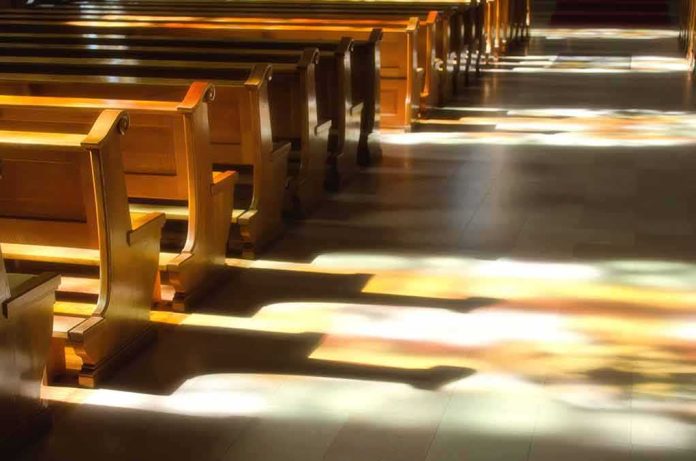
When a sacred place is publicly mocked from its altar, the Church’s first response is not press conference or protest but penance; a reparation Mass is how the wound is acknowledged, the scandal addressed, and the sanctuary restored to use.
The Short Version
- Teenagers filmed themselves inside a Vendée church blasting a rap track invoking jihadist mass killers; the diocese called it a grave violation and closed the building pending a reparation Mass.
- Under canon law, a bishop may suspend worship in a desecrated church until a penitential rite repairs the injury; this is a standardized response, not an improvisation.
- France has faced recurrent desecrations and thefts in churches in recent years, shaping how dioceses interpret and answer incidents that cause public scandal.
- A reparation Mass addresses two audiences at once: God, through a liturgy of contrition, and the faithful, by reassuring them the sanctuary’s holiness has been deliberately restored.
What happened in Saint-Hilaire de Soullans and why the Church called it desecration
In Saint-Hilaire de Soullans, in France’s Vendée, a video circulated widely of minors in a parish church broadcasting and dancing to a rap track that referenced Mohamed Merah, Salah Abdeslam, and the Bataclan massacre—names inseparable in France from jihadist murder. The diocesan authorities publicly denounced the act as a grave affront to the sanctity of the place, shuttered the church, and announced a Mass of reparation to restore the building for worship. The description “apology of terrorism” is not casual rhetoric here; in French public life those names carry the precise referent of terror attacks against civilians, which is why the incident was read as sacrilege rather than mere mischief.
The bishop’s decision sits squarely within Catholic law and practice. Canon 1211 states that sacred places are violated by gravely injurious actions done in them with scandal to the faithful; when that threshold is met, public worship is to be halted until the injury is repaired by a penitential rite as prescribed by the liturgical books. In plain terms: if an act from the altar scandalizes the faithful and contradicts the holiness of the place, the local ordinary has both the authority and the duty to pause Masses and to order a ritual of reparation before resuming them.
How a reparation Mass works and what it is for
A Mass of reparation is not a publicity exercise. It is a liturgy—a concrete sequence of prayers, Scripture, and penitential rites—celebrated to acknowledge before God that the sanctuary’s holiness was publicly violated and, by that violation, the faithful were scandalized. The form varies with the injury, but the structure is consistent: an act of contrition on behalf of the Church’s local community, prayers for mercy, and the re-consecration of the space to its proper end. The point is theological as much as pastoral: a church is not a hall; it is set aside for divine worship. When that consecration is mocked from within, the Church answers—not by pretending nothing happened, and not by nursing outrage—but by doing the prayer that repairs the breach. Canon law articulates this logic clearly, and bishops apply it in practice whenever a desecration rises to the level of public scandal.
Because the rite is formal and restorative, it also serves the community’s common good. Parishioners who saw their altar treated as a stage for the glorification of terror are given a definitive, public marker that the church has been reclaimed for worship. Closing the building until the rite is celebrated underscores that the sanctuary’s character is not symbolic sentiment but a juridical and liturgical reality with consequences.
Why France reads these incidents against a wider pattern
To understand the intensity of the response, place it in France’s recent history with church violations. Catholic churches have endured recurrent thefts, profanations of the Blessed Sacrament, decapitation of statues, and vandalism of altars across multiple dioceses. The Conference of French Bishops reported 228 “violent anti-Christian acts” in the first quarter of 2019, and subsequent tallies by the Interior Ministry counted hundreds of anti-Christian acts annually in 2021, 2022, and 2023; most targeted property rather than persons. In this environment, a viral video from the sanctuary railing off terror attacks is not interpreted as a harmless prank; it lands amid an established pattern of sacrilege and hostility toward Christian sites, which is why bishops often move quickly to close a building and schedule reparatory worship.
This is not to say every incident bears the same moral weight or motive; many are opportunistic thefts or juvenile transgressions. But Catholic discipline does not calibrate a church’s holiness to the intruder’s intention. What matters for the rite is whether the action was gravely injurious and caused scandal to the faithful—a standard the local ordinary judges, case by case, and then answers with the appropriate penitential remedy.
Mechanism and meaning: the bishop’s role and the community’s repair
Authority and responsibility meet in the figure of the diocesan bishop. He is the ordinary—literally the one with ordinary jurisdiction—charged with safeguarding the integrity of divine worship. Canon 1211 assigns to his prudential judgment the discernment of when an injury is grave and scandalous enough to suspend liturgy and require reparation. In practice, that involves consultation with the parish priest, review of facts (including video evidence in this case), and a pastoral decision calibrated to heal, not merely to punish. Ordering a reparation Mass does three things at once: it withdraws the church from ordinary use to signal the breach, it undertakes formal contrition and purification, and it restores the community’s confidence that worship is again fittingly offered in that place.
The rite is therefore both spiritual and public. It does not address the civil dimension—law enforcement handles minors, trespass, and any incitement issues under French law—but it does set a marker within the Church’s own order that what happened was wrong and has been answered appropriately. Over time, that consistent pattern of response becomes catechesis in itself: the faithful learn, by what the Church does, what a church is.
What this tells us about sacred spaces in a secular age
Incidents like Saint-Hilaire de Soullans lay bare a simple truth that modern pluralism can obscure: religious buildings are not generic venues. They are consecrated for worship, and their sanctity is not a private sentiment but a public claim backed by law and ritual. In France, the Catholic Church has had to make that claim repeatedly amid a steady drumbeat of profanations and vandalism, even as Catholic practice has ebbed in many regions. The steady, legally grounded choice to repair rather than rage is not weakness; it is fidelity to a discipline that knows how to respond when the altar is misused. Close the doors. Tell the truth about the wound. Pray the rite that heals. Then open them again.
Sources:
washingtonpost.com, ground.news, wral.com, video.lefigaro.fr, vaticannews.va, intoleranceagainstchristians.eu, ncregister.com, france24.com, catholicphilly.com, realclearinvestigations.com, x.com