When a brush fire crosses the line onto federal land, the question of who lit the first spark is no longer just forensic; it is jurisdictional, criminal, and, if prosecutors can prove intent, a federal arson case that carries serious prison exposure.
At a Glance
- Federal prosecutors charged a Santa Clarita man with arson after investigators tied the Bouquet Fire’s ignition to fireworks near his home.
- A criminal complaint cites the defendant’s alleged admission: he threw a cigarette onto fireworks, triggering an explosion and the blaze.
- Investigators say they ruled out other common ignition sources and recovered items consistent with the account, including cigarettes, a lighter, and an aerial mortar.
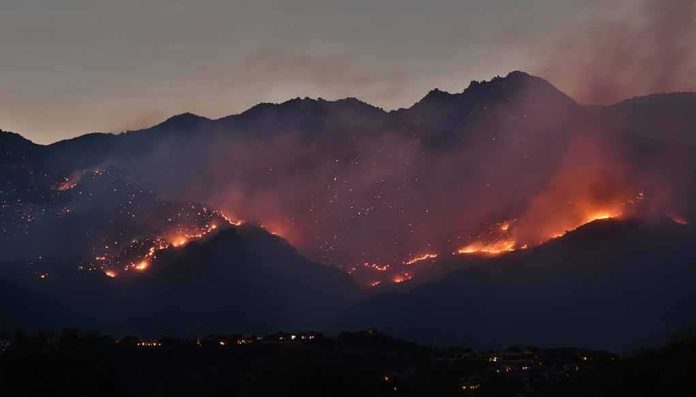
- The fire burned about 1,048 acres, including federally owned Angeles National Forest land, establishing federal jurisdiction.
What prosecutors say happened and why it matters
According to a federal criminal complaint filed in Los Angeles, the Bouquet Fire began shortly after 2 p.m. behind a residence on Bouquet Canyon Road. Investigators from the U.S. Forest Service placed the ignition point behind that home; the defendant, 70-year-old Rodney Saba, was allegedly at the scene. The complaint asserts that Saba told law enforcement he flicked a cigarette off his porch, it landed on consumer fireworks, and an explosion followed—an ignition sequence that comports with what witnesses described as a shotgun-like blast just before a fast-moving fire ran upslope in hot, dry conditions.
That chain of events matters for two reasons. First, cause and origin anchor any wildfire case; once investigators tie the spark to human activity—and, more specifically, one person’s conduct—they can move from suppression to accountability. Second, because the fire spread into Angeles National Forest, burning roughly 1,048 acres of federal property, the United States charged arson involving federal lands, a distinct offense that places the case in federal court.
How investigators built the ignition theory
Wildland origin-and-cause work proceeds by the scientific method: fix the area of origin, examine burn patterns and heat vectors, collect physical remnants, and systematically exclude alternative causes until one remains as the most probable. In this case, Forest Service investigators reported excluding lightning, campfires, debris burning, and other common sources. Their conclusion—probable fireworks—fit the alleged admission and physical context, including the recovery of an aerial mortar firework, cigarettes, a lighter, and ammunition in the cabin. None of those items is dispositive alone, but in aggregate they are consistent with a fireworks-and-ember ignition scenario in dry fuels.
Probable cause in a fire investigation is not guesswork. It reflects convergence: the mapped origin behind the porch; time stamps aligning with witness reports; elimination of natural causes; and tangible items compatible with the mechanism advanced. Local reporting echoes those anchors, placing the start behind the residence around 2:13–2:15 p.m. and describing neighbors who heard an explosion and then saw the blaze, with Saba present and calling for help as the fire moved.
Where the law draws the lines: cause, culpability, and federal reach
Three questions often get conflated in public discussion but are distinct in court. First, what ignited the fire? Second, did this defendant cause that ignition? Third, did he act with the state of mind required for the charged offense? The complaint, as summarized by the Justice Department, addresses the first two directly: fireworks as the probable source; a cigarette onto fireworks as the alleged act; and physical items supporting that sequence. The third—mens rea—is more technical: federal arson tied to wildland property requires proof the defendant set the fire intentionally and without justification or lawful excuse. In short, deliberate ignition, not mere presence at a disastrous accident, is the element that elevates the conduct to arson.
Jurisdiction is straightforward here. Because the fire burned across Angeles National Forest, federal prosecutors assert authority to charge an offense involving damage to federal property. That jurisdictional hook is routine in wildland cases, separating them from state-only prosecutions when national forest or other federal holdings are involved.
What the record shows so far
The core evidentiary pillars are specific and mutually reinforcing. Investigators fixed the area of origin behind the defendant’s home at about 2:13 p.m.; local coverage reported a near-identical ignition time. The alleged admission describes a plausible mechanism—cigarette-to-fireworks ignition—that aligns with a “shotgun-blast” sound neighbors said they heard before flame spread. Aerial mortar fireworks and smoking materials were reportedly seized from the residence. And the burn scar includes more than a thousand acres of federal land—an element relevant to the charge as filed.
As with any charging document, the complaint reflects the government’s view of the facts and will be tested in court. But taken on its own terms, the narrative is internally coherent: a human-caused ignition linked to a discrete porch-side act, a brief explosive event consistent with consumer fireworks, and immediate flame spread into receptive fuels during a heat spell. That is exactly the kind of sequence wildland investigators are trained to reconstruct from debris fields, witness timelines, and elimination matrices.
Santa Clarita man charged with federal arson in the Bouquet Fire. Prosecutors say he flicked a cigarette onto fireworks. Full story:https://t.co/TBlatMPPJR
— The Southbound 105 (@Southbound105) October 11, 2026
Why wildfire cause cases depend on probabilities—and how this one fits
Origin-and-cause determinations in the wildland context are rarely anchored by a single eyewitness to the spark. They are built from pattern recognition, physical remnants, and exclusion of alternatives under accepted investigative standards used by federal and tribal agencies. Even in advanced statistical research, distinguishing among specific human causes is harder than separating human-caused from natural starts—one reason investigators lean heavily on site-specific artifacts, statements, and time-aligned witness accounts to reach a legally adequate conclusion in a given case. That is what the Bouquet Fire record, as publicly described, reflects: a convergence of a stated act, compatible debris, and ruled-out alternatives.
Consequences and next steps
Large human-caused wildfires carry cascading consequences: emergency evacuations, multi-agency suppression costs, and post-fire risks such as debris flows and infrastructure damage. When a start is traced to conduct on the doorstep of federal land—or on land contiguous with it—accountability moves from civil liability to potential imprisonment. If prosecutors prove their case, the law treats a tossed ember onto an illegal ignition source during dangerous conditions as intentional fire-setting rather than mere negligence. That distinction is the fulcrum of arson law and the reason origin-and-cause work, witness timelines, and a defendant’s own statements matter so much in federal court.
In the meantime, the incident record remains the factual backbone: a wildfire that scorched approximately 1,048 acres, an alleged admission describing an ignition mechanism, a suite of seized items consistent with fireworks use, and investigators’ conclusion that fireworks were the probable source after other causes were excluded. The case will turn on those specifics.
Sources:
nypost.com, justice.gov, nbclosangeles.com, hometownstation.com, rollingout.com