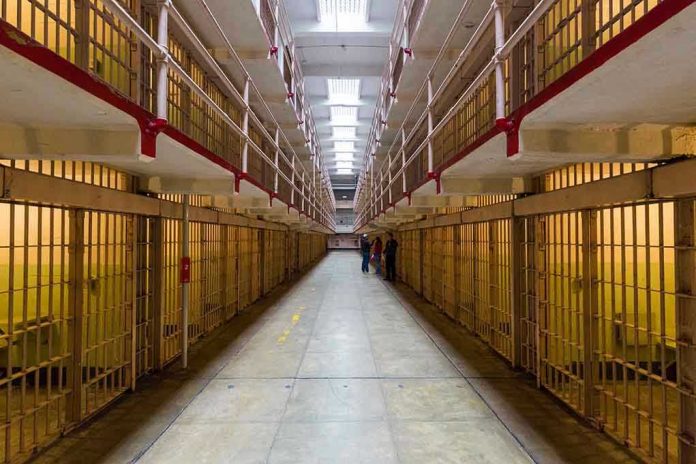
Keir Starmer’s prison release plan is a blunt fix for a broken system, and it has set off a fresh public backlash over safety and order.
Quick Take
- The government’s SDS40 scheme lets eligible prisoners leave after serving 40 percent of their sentence instead of 50 percent.[5]
- Officials say serious violent, sex, terror, and domestic abuse-linked crimes are excluded from the policy.[3]
- More than 16,000 prisoners had already been released early under the scheme by late April 2025.[4]
- Critics say the move is only a stopgap and does not solve Britain’s prison overcrowding crisis.[18][19]
Why the Government Moved First
The Ministry of Justice moved to cut prison pressure after years of overcrowding left the system close to collapse. Under SDS40, some prisoners serving standard determinate sentences are released earlier so space opens up faster, while probation officers keep them on licence and can send them back to prison for rule breaches.[3][5] Officials say the change was urgent, temporary, and designed to avoid a deeper breakdown in court and prison operations.
The state argued that the plan was narrow, not blanket leniency. The published guidance says the policy applies to current prisoners from September 2024 and will be reviewed after 18 months.[5] It also says people convicted of the most serious violent and sexual offences are excluded, along with terror and some domestic abuse-linked crimes.[3] That detail matters, because the public debate has often blurred the line between eligible prisoners and those the government says remain barred from early release.
What the Numbers Show
The official record shows the scheme was not small. Transparency data released in 2025 said 16,231 prisoners had been released early under SDS40 between September 10 and December 31, 2024.[4] Separate commentary on the policy says the government expected it to free roughly 4,900 to 6,200 prison places overall, though the exact number depends on short-term prison population changes.[2] That means the plan can buy time, but it does not erase the deeper shortage of cells.
That point is where critics have the strongest case. Even after the early releases, prison pressure remained severe, and wider reports still described England and Wales as deeply overcrowded in 2024–25.[18][19] The Howard League said the prison system had fewer than 80,000 safe and decent places in March 2025, while the prison population was close to 88,000.[18] That gap helps explain why many voters see the policy as damage control rather than a real fix.
Why the Backlash Is So Strong
The loudest criticism comes from the fear that dangerous offenders will slip through the cracks. Viral headlines have framed the policy as freeing “killers and rapists,” but the government says those categories are excluded by design.[3][5] The more accurate concern is different: many non-violent and lower-level violent offenders still qualify, and a system already under strain may struggle to supervise them well after release. That is a public-safety risk even without the worst offenders in the mix.
Reform critics also say the policy exposes a wider failure of state competence. The prison estate has faced repeated emergency measures because overcrowding has become chronic, not rare.[18][19] The Institute for Government argued that ad hoc early release schemes do not fix the wider criminal justice system and can leave probation overloaded.[13] For conservatives, that is the real warning: when government grows too weak to hold criminals safely, it starts moving the burden onto families, police, and local communities.
What Happens Next
The key test is whether the government uses this breathing room to build capacity and reduce repeat overcrowding. The Ministry of Justice says the policy is temporary, and broader planning has included more prison places and related sentencing changes.[5][19] But the record of repeated emergency releases suggests the state has relied on patchwork measures for years. If that pattern continues, the public will keep seeing the same cycle: release, backlash, and then another crisis.
For now, the facts are plain. The scheme does not release the worst offenders the viral claims suggest, but it still releases thousands of prisoners early because the prison system lacks room.[3][4][5] That makes the plan politically explosive and strategically limited at the same time. It may ease overcrowding for a while, but it does not answer the larger question of whether Britain can still punish crime without weakening public confidence in justice.
Sources:
[2] YouTube – Government to release prisoners up to 60 days early
[3] Web – Prisoner Early Release Schemes impact report – Skills for Justice
[4] Web – Lord Chancellor sets out immediate action to defuse ticking prison …
[5] Web – Everything we know about early releases – Russell Webster
[13] Web – Blog Archive » ONE LAST F-U ON HIS WAY OUT THE DOOR
[18] Web – Overflowing prisons are just one aspect of deep dysfunction across …
[19] Web – Using Early Release to Relieve Prison Crowding – A Dilemma in …