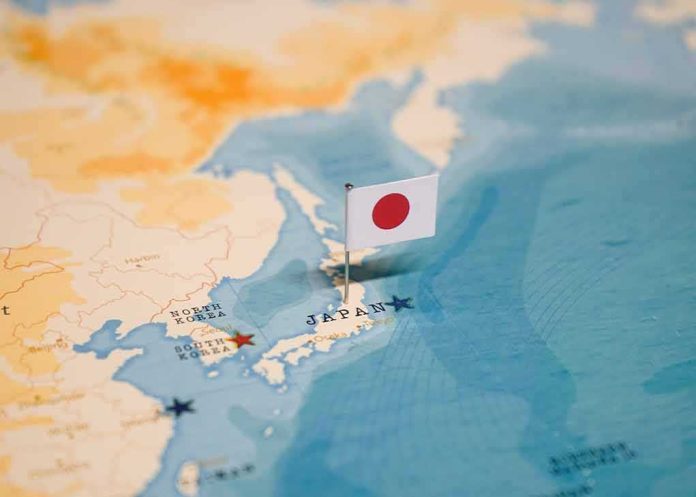
A powerful quake just rocked northern Japan, but the bigger shock is how fast global media twisted the story.
Story Snapshot
- A strong offshore earthquake hit near Iwate in northern Japan, shaking towns with upper 6 intensity but causing no tsunami.
- Prime Minister Sanae Takaichi quickly activated a crisis task force and ordered damage checks and clear public updates.[1][6]
- Japan’s Meteorological Agency first reported magnitude 6.9, then revised it to 7.2 as data improved, while some outlets cherry‑picked numbers.[8][7]
- Foreign and social media hyped “powerful 7.2 quake” and “tsunami alerts,” feeding fear and confusion that did not match official information.[2][3]
Strong Quake, No Tsunami, And A Fast Government Response
Shortly after 7:30 a.m. local time, Japan was hit by a strong offshore earthquake near the coast of Iwate Prefecture, rattling northern communities right in the morning rush hour.[1][6] Japan’s Meteorological Agency reported very strong shaking, measured as upper 6 on Japan’s intensity scale, in Hashikami Town in Aomori Prefecture.[1] Prime Minister Sanae Takaichi announced there was no risk of a tsunami, an important point for a country that still remembers the 2011 disaster.[1][6] Her message stressed calm, caution, and facts, not panic.
Right after the quake, the Prime Minister’s Office activated its Crisis Management Center and set up a special response room and emergency task force made up of senior officials from key ministries.[1][2] Takaichi ordered them to check damage, push rescue and relief if needed, and give accurate, timely information to the public, including guidance on any evacuations.[1][2] So far, government and public reports say there are no signs of major damage or widespread injuries, and life in big cities like Tokyo only felt mild shaking.[2][5]
Magnitude Confusion Shows Why We Need Real Data, Not Clickbait
Japan’s Meteorological Agency first listed the quake as magnitude 6.9 at about 50 kilometers depth, then updated it to magnitude 7.2 and a depth in the mid‑40‑kilometer range as more readings came in.[7][8] That kind of revision is normal in offshore quakes, as sensors pick up more of the long shaking and global networks refine the numbers over time.[22] But many foreign outlets grabbed one number or the other, then packaged it with dramatic language, instead of explaining to viewers how the science actually works.[2][3][5]
The result was a wave of messy headlines: some shouted “6.9,” others “7.2,” and many skipped over the key fact that Japan never issued a tsunami warning for this quake.[8][5] On social media, posts even mixed this event with totally different quakes in Venezuela, smashing together numbers, locations, and fake “tsunami alerts” into a confusing stew.[3][4] That kind of noise does not help real people in Japan who just want to know if their families are safe, and it does not help Americans who want honest, global news instead of fear‑based content.
Japan’s Calm Discipline Highlights What Honest Crisis Leadership Looks Like
Prime Minister Takaichi’s message to the Japanese people was simple and steady: the quake was serious, the shaking was strong in parts of the north, but there was no tsunami risk, and the government was fully engaged through the Prime Minister’s Crisis Management Center.[1][6] She called on citizens to stay alert, check for updates, and look out for one another, while her ministries gathered on‑the‑ground reports from police, fire, and local governments.[1][2] This is the kind of clear, top‑down coordination that respects the public’s right to know without stoking fear.
Residents across northeastern Japan felt strong tremors after a 7.2-magnitude earthquake struck offshore, though authorities reported no tsunami risk or serious injuries.https://t.co/8jG02CBMZl
— News Central TV (@NewsCentralTV) June 25, 2026
For American readers, this story is a reminder of two big truths. First, natural disasters are real, and strong countries prepare in advance, just like our own communities must do here at home.[17][16] Second, the media’s first job is to inform, not to hype. Japan’s own agencies focused on measured science, clear risk messages, and step‑by‑step response.[7][8] Too many foreign and social channels instead chased clicks with “powerful quake” and “tsunami alert” framing that did not match the facts on the ground.[3][5] In a world full of crises, citizens in both Japan and the United States deserve better than that.
Sources:
[1] YouTube – Prime Minister Takaichi says earthquake has struck northern Japan
[2] Web – 2026 Sanriku earthquake – Wikipedia
[3] Web – At least 4 injured as M7.2 quake hits northeastern Japan, traffic …
[4] Web – A powerful magnitude 7.2 earthquake struck northern Japan at …
[5] Web – The Japan Meteorological Agency announced a 7.2 magnitude …
[6] Web – Video: A strong earthquake struck northern Japan
[7] Web – A strong earthquake struck northern Japan | Instagram
[8] Web – Japan Meteorological Agency | Earthquake information
[16] Web – Monitoring of Earthquakes, Tsunamis and Volcanic Activity
[17] Web – Japan’s magnitude 7.1 shock triggers megaquake warning
[22] Web – 2025 Earthquake Report Summary – Jay Patton online