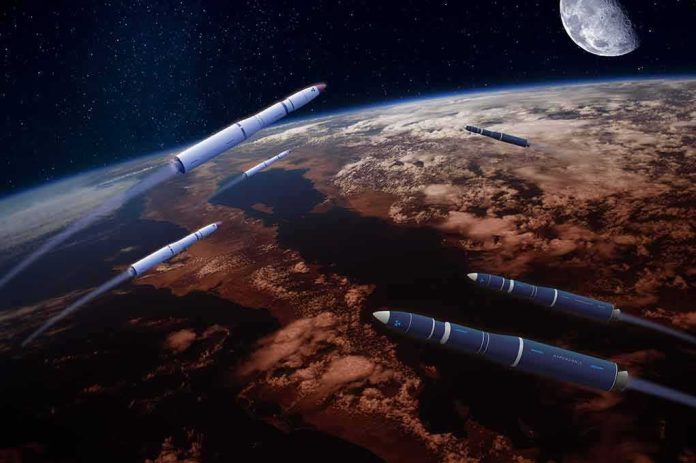
A spent SpaceX Falcon 9 upper stage on a predictable, tightly modeled trajectory is about to carve a small new crater into the Moon—an event that is utterly harmless yet scientifically valuable, precisely because we know so much about the object doing the damage.
At a Glance
- A derelict Falcon 9 upper stage, cataloged as 2025-010D, is projected to hit the Moon near Einstein Crater around 06:35 UTC on August 5, 2026.
- The five‑story, ~4‑ton stage will strike at about 2.4 km/s (5,400 mph), releasing energy comparable to a few tons of TNT and excavating a crater roughly 20–30 meters across.
- The impact poses no danger to people, spacecraft, or Earth; it is best understood as a controlled natural experiment in impact physics rather than a “crash” in any hazardous sense.
- Because the rocket’s mass, structure, trajectory, and impact conditions are unusually well known, the resulting crater and ejecta will help test and refine models of how high‑speed impacts shape airless worlds and how artificial strikes differ from natural ones.
What Exactly Is Going to Hit the Moon?
The impactor is the upper stage of a SpaceX Falcon 9 that launched two commercial lunar landers on January 15, 2025, then was left in a highly elongated, cislunar orbit once its job was done. After payload separation the stage had insufficient fuel to execute a clean disposal maneuver, so it became orbital debris, gradually perturbed by the combined gravity of Earth and the Moon onto a collision course with the lunar surface. The object is listed in tracking catalogs as 2025‑010D, with a dry mass in the range of 3,900–4,000 kilograms and a length on the order of 45 feet—roughly the height of a five‑story building.
Independent orbital analyst Bill Gray, who maintains the Project Pluto software used worldwide to track near‑Earth objects and space debris, has been following the stage since shortly after launch. Using thousands of positional measurements and standard gravitational dynamics, Gray’s solution converged on an impact near lunar latitude 19° north and longitude 93° west, close to Einstein Crater on the Moon’s Earth‑facing limb, with an impact time of about 06:35 UTC on August 5, 2026. Multiple news and science outlets now cite variants of this window—typically 2:34–2:44 a.m. Eastern Time—but all rest on the same underlying trajectory analysis.
How Big an Impact Are We Talking About?
By planetary‑science standards this is a modest event, but not a trivial one. At roughly 2.4 kilometers per second, a four‑ton impactor carries on the order of three tons’ worth of TNT equivalent kinetic energy. That is far below the yield of even a small nuclear test, yet more than enough to vaporize the rocket stage and excavate a fresh crater in the lunar regolith. Scaling laws derived from previous impacts suggest a resulting crater about 20–30 meters (65–100 feet) across and perhaps 5 meters deep, with a raised rim and an apron of ejecta rays around it.
Because the Moon has no atmosphere to slow the stage or spread out the blast, virtually all of the kinetic energy goes directly into crushing, heating, and lofting the regolith. Researchers modeling the event estimate that over a million kilograms of dust and debris may be thrown skyward, forming a conical curtain several kilometers tall and a narrower central jet reaching tens of kilometers above the surface. One study submitted to Geophysical Research Letters projects the primary plume to about 9–12 miles and a central spike as high as 75–100 kilometers, with ejecta spreading laterally more than 110 miles before falling back.
The crater, when imaged later by NASA’s Lunar Reconnaissance Orbiter (LRO), will be too small to see from Earth even through large telescopes, but it will stand out sharply against pre‑impact photos; that contrast is precisely what makes it valuable for calibrating impact models.
Will Anyone Be Able to See It Happen?
The collision will occur on sunlit terrain near the Moon’s limb as seen from Earth, which makes the viewing geometry favorable for ejecta but unforgiving for flash detection. Past lunar impact flashes—mostly from natural meteoroids striking the night side—have been recorded against dark terrain. No impact flash on the bright side has yet been unequivocally detected, largely because a millisecond‑scale burst has to compete with intense background glare.
For this event, the Moon will be above the horizon in dark skies for much of North and South America when the impact occurs around 2:34 a.m. Eastern Time. That gives observers in the eastern half of the United States, Canada, and much of South America the best chance to capture the plume as it rises beyond the bright limb. Multiple guides urge observers not to aim at the surface itself, but to frame a region just off the lunar edge where the dust cloud will appear silhouetted against black space. High‑cadence imaging—20 or more frames per second—with a reasonably large telescope and a sensitive camera is recommended; binoculars or naked‑eye viewing will not suffice.
Whether the flash itself will be detectable is less certain. Some modeling suggests a brief brightening in the 15th‑magnitude range, barely within reach of serious amateur setups; others caution that any flash may be smeared out over microseconds and drowned in glare, making the ejecta plume the more realistic target. Professional and amateur astronomers across three continents have nonetheless organized a coordinated campaign, in part because even a null result—no flash detected—helps constrain how bright such impacts can be and how best to observe them in the future.
Why Scientists Care About a Small, Harmless Lunar Crash
This impact is not news because it is dangerous; it is news because it is an unusually well‑characterized experiment in how high‑speed collisions work on airless worlds. Natural meteoroid strikes happen on the Moon all the time, but most involve projectiles of unknown size, mass, composition, and trajectory. Here, by contrast, researchers have a man‑made impactor whose mass, geometry, and impact speed are tightly constrained by launch records and tracking data. That makes any observed flash, plume, and crater far more informative per kilogram than a random, untracked rock.
The event also arrives at an interesting moment in lunar science. In 2022, a previously misidentified booster from China’s Chang’e 5‑T1 mission hit the far side of the Moon and produced a surprising double crater—two overlapping pits around 16 and 18 meters wide—rather than the single, roughly circular crater expected from a hollow stage with its main mass concentrated at one end.[Space Desk transcript] LRO imaging confirmed the anomaly, but because the impact was unobserved in real time and the stage’s detailed configuration remains murky, planetary scientists were left with competing explanations ranging from unusual hardware layout to gaps in crater‑formation theory.
The Falcon 9 upper stage provides a cleaner test. Its structure and center‑of‑mass distribution are well documented, and its predicted impact speed and angle fall squarely within regimes covered by existing scaling laws. If LRO later finds a single crater of the expected size, it will strengthen confidence that the 2022 double crater reflects some peculiarity of that Chinese booster. If, unexpectedly, a double crater appears again, it would point toward systemic shortcomings in current models of how elongated, partly hollow objects couple their energy into the ground—a result with implications reaching from planetary geology to asteroid‑defense planning.[Space Desk transcript]
On a finer level, spectroscopic observations of the ejecta plume may reveal signatures of the rocket’s materials, such as emission lines from aluminum‑lithium alloys used in its tanks.[Space Desk transcript] Distinguishing those from the spectral fingerprint of native lunar regolith would help researchers learn how to identify and filter artificial impact signals in future monitoring, a subtle but important skill as human hardware increasingly litters near‑lunar space.
Risk, Regulation, and the Growing Question of Lunar Debris
All credible analyses agree that this particular impact poses no risk to people or active spacecraft. The Moon is large, the crater will be small, and no operational landers or orbiters are close enough to be endangered by the ejecta. The stage itself is inert; there are no toxic propellants or explosive charges left on board. From a narrow safety perspective, the event is simply the predictable end of a piece of hardware that would eventually hit something—Earth’s atmosphere or the Moon—once its orbit degraded.
Nevertheless, the collision has sharpened discussion about how we manage debris beyond traditional low‑Earth orbit. Space‑environment guidelines and regulatory frameworks have long focused on clearing objects from crowded Earth‑orbit regimes within 25 years or less. But this Falcon 9 stage was left on a cislunar trajectory that no existing rule explicitly forbids, and that no agency is charged with mitigating. As commercial and national missions to the Moon proliferate, boosters and transfer stages will increasingly traverse this loosely governed volume, raising the possibility of more unplanned lunar impacts and occasional close approaches to operational craft.
Some commentators frame the event as a symbol of “space junk on the Moon,” echoing concerns voiced after the Chang’e 5‑T1 impact. Others see it as a reminder that disposal strategies need to extend beyond Earth orbit to encompass cislunar space and the lunar surface itself, especially as the Moon becomes a site of sustained human presence. The key policy question is not whether this single crater matters—scientifically, it is a boon—but rather how many such unplanned impacts the community is comfortable accepting as lunar traffic rises.
Where the Uncertainties Still Lie
Despite the strong consensus on the basic facts—object identity, impact timing within a few minutes, approximate location near Einstein Crater, and lack of hazard—several details remain legitimately uncertain and are part of what makes the event scientifically interesting rather than problematic. For one thing, the exact crater size and morphology depend sensitively on the local geology: a thick blanket of regolith will yield a larger, softer‑rimmed crater than a thin soil over hard bedrock, which tends to produce smaller, sharper features. Until LRO images the site, models can only bracket possibilities.
Visibility is another area where coverage sometimes outruns data. Different popular accounts variously promise that the flash “shall possibly be visible via telescope from the eastern United States” or caution that “it will not be visible from Earth—even through large telescopes,” while scientists in the underlying studies speak in terms of probabilities and magnitude ranges rather than guarantees. That spread reflects genuine uncertainty in how bright an impact flash on the sunlit surface can be and how effectively that brightness can be extracted from glare by real instruments under real sky conditions. The coordinated observing effort is designed in part to answer that question empirically, with calibrated cameras and shared data rather than anecdotes.
Finally, while Gray’s orbit solution is widely respected and has been cross‑checked by other trackers, the exact second and meter of impact cannot be known until the last observations are in; small perturbations from solar radiation pressure or tiny errors in early tracking can translate into hundreds of meters’ difference on the lunar surface. For science, those uncertainties are manageable; for the public narrative, they are a reminder that even well‑modeled events are predictions, not certainties, until nature has had its say.
A Falcon 9 upper stage is predicted to slam into the Moon near Einstein Crater on Aug 5, 2026 — 02:35 AM. This is a once‑in‑a‑lifetime moment. The world wants eyes on the impact.
Can SpaceX team up with NASA’s LRO or China’s Chang’e to capture it? Let’s make lunar history visible— Mr Sexy (@xrpstats) August 3, 2026
Sources:
zerohedge.com, projectpluto.com, en.wikipedia.org, yahoo.com, arstechnica.com, space.com, news.cgtn.com, ground.news, forbes.com, youtube.com, indiatoday.in, qz.com, arxiv.org, reddit.com