When a small, battered island warns that a U.S. strike would trigger a “bloodbath,” it is a reminder that in Washington’s secret games, ordinary Americans and Cubans could end up paying the price while the elites stay insulated.
Story Snapshot
- Cuban President Miguel Díaz-Canel warned that any U.S. military action would cause a “bloodbath” and shatter regional stability.
- The warning followed media reports that U.S. intelligence says Cuba has over 300 military drones and has discussed hitting U.S. targets.[1][2][3]
- Cuba denies posing a threat and accuses Washington of fabricating a pretext for intervention.[1][2][3]
- The U.S. Treasury has imposed new sanctions on Cuba’s main intelligence service and senior officials, escalating pressure on Havana.[3]
Díaz-Canel’s “Bloodbath” Warning And What Triggered It
Cuban President Miguel Díaz-Canel used the social platform X to warn that any United States military action against Cuba would lead to a “bloodbath” with “incalculable consequences” for regional peace and stability.[1][2] He added that Cuba “does not pose a threat,” framing his statement as a defensive warning rather than a promise of attack.[1][2] His post came one day after a report, based on classified United States intelligence, claimed Cuba had acquired more than 300 military drones and discussed using them against United States targets.[1][2][3]
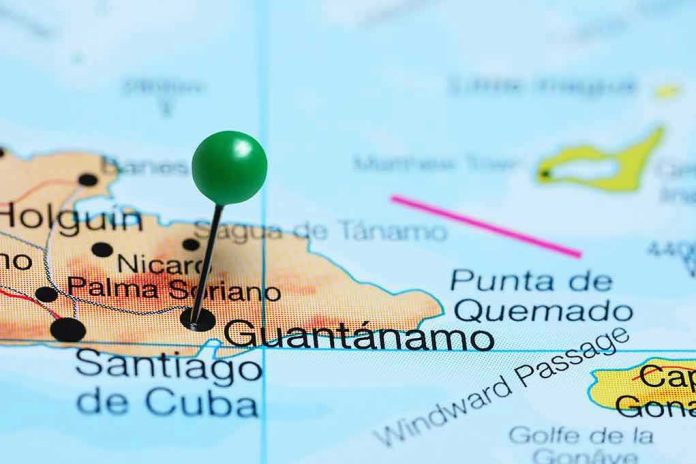
The Axios-summarized intelligence reportedly said Cuban officials talked about potential strikes on the United States naval base at Guantánamo Bay, United States military vessels, and possibly even Key West, Florida.[1][2][3] None of those underlying intelligence documents are public, so citizens are being asked to take unnamed officials’ word for it. Politico reported that it could not independently verify the drone details, and the Cuban Embassy in Washington called the allegations a false pretext for targeting the island.[3] That pattern—secret claims, public fear, and little transparency—feeds distrust on both left and right.
Sanctions, Drones, And A Familiar Playbook Of Pressure
While warning about a “bloodbath,” Havana also faces intensified economic and political pressure. France 24 reports that the United States Treasury Department has issued new sanctions on Cuba’s main intelligence agency and several senior leaders and ministers, another turn of the screw on an already fragile economy.[3] Those sanctions follow long-standing fears in Cuba of a United States invasion and come amid growing rhetoric about possible intervention, including reports that Pentagon planners have considered strike options.[3] For Americans who remember Iraq’s “weapons of mass destruction,” the mix of secret intelligence and public drumbeat is uncomfortably familiar.
Cuban officials insist the drone issue is being distorted. Coverage citing Havana’s position says Cuba acknowledges having drones but claims they would be used only defensively if attacked, denying any aggressive intent toward United States territory.[3] At the same time, United States voices quoted in television coverage say there is currently no public intelligence pointing to an imminent United States attack on Cuba, and experts question whether Cuba could seriously threaten the far larger United States military. That leaves the public stuck between Cuban warnings of catastrophe and United States assurances that there is no immediate war plan, without access to the documents that would settle the question.
Why This Matters To Ordinary Americans, Not Just Elites
This standoff lands in an America where many citizens across the spectrum already believe the federal government serves entrenched interests first. Conservatives see another possible foreign entanglement stirred by intelligence claims they cannot examine. Liberals see sanctions and military talk directed at a poorer neighbor already buckling under shortages. Both sides have watched Washington’s permanent political and security class make high-stakes decisions behind closed doors, while the costs fall on soldiers, taxpayers, and struggling communities in places like Miami and Havana.
The Cuba drama also highlights how quickly media can amplify the most alarming rhetoric—“bloodbath,” “drone threat to Florida”—without answering basic questions: What exactly did the intelligence say? Who reviewed it? What limits has the President placed on any military option? The available reporting confirms the warning, the sanctions, and the fear, but not a clear, public strategy.[1][2][3] In a system where both Cuban and American leaders have incentives to posture, the absence of hard evidence leaves citizens once again in the dark, asked to trust institutions many no longer believe.
Sources:
[1] YouTube – Cuban president warns against US military action
[2] Web – Cuba warns US military action would lead to ‘bloodbath’ – Dailymotion
[3] YouTube – Diaz-Canel warns of ‘bloodbath’ if U.S. attacks Cuba