While Venezuela’s regime struggles to admit the scale of its deadly twin earthquakes, nearly 1,000 confirmed dead and tens of thousands missing expose how fragile life becomes when a socialist state fails at its most basic job — protecting its people.
Story Snapshot
- Official death toll jumped from a few dozen to over 1,700 as outside pressure mounted.
- Opposition trackers list tens of thousands missing, far beyond government numbers.
- Journalists describe a near total absence of the state as citizens dig through rubble themselves.
- U.S. and U.N. aid flows through the same failed government, raising hard questions for American taxpayers.
Quakes Reveal a Human Disaster and a Data Disaster
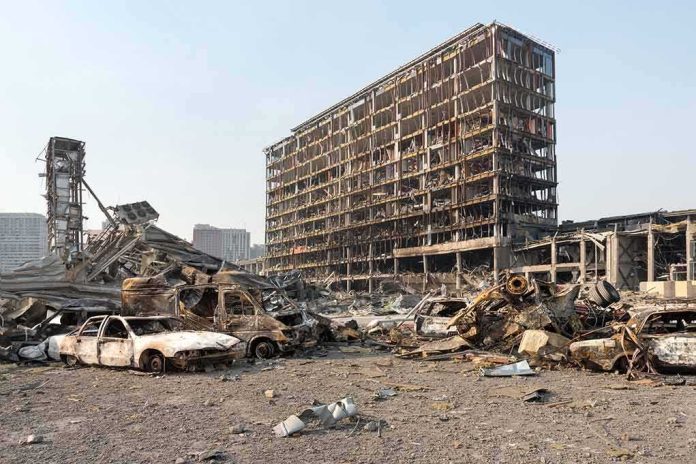
On June 24, back-to-back earthquakes, magnitude 7.2 and 7.5, slammed northern Venezuela near Caracas, collapsing homes, offices, and schools in minutes. Acting President Delcy Rodríguez first announced 32 dead and about 700 injured, a figure that quickly proved far too low as images of crushed buildings poured in. Within a day, officials raised the toll to around 164–188 deaths and more than 1,500 injured, with warnings it would rise as rescuers reached buried neighborhoods. By June 29, a United Nations-backed report put official fatalities at 1,719, over 5,000 injured, and more than 22,000 people directly affected, stressing that numbers were still “preliminary” and could change.
Even those grim figures may only tell part of the story. A missing persons registry created by opposition figures and shared widely online showed more than 10,000 people unaccounted for within a day of the quakes, later climbing past 35,000. The United States Geological Survey used modeling based on quake strength, building types, and population density and warned the final death toll would “most likely” be in the thousands, with a strong chance of topping 10,000. That gap between government counts in the low thousands and independent estimates in the tens of thousands sets up a familiar pattern in Venezuela: a disaster on the ground, and a fight over the truth in the numbers.
Citizens Dig While the State Hesitates
While officials held briefings and adjusted figures, ordinary Venezuelans clawed through concrete with bare hands. In La Guaira, the hardest-hit coastal state north of Caracas, journalists reported people yelling for help under collapsed apartment blocks as families, churches, and school staff formed their own rescue teams. Caracas-based reporter Tony Frangie Mawad described a “practical total absence of the state,” saying civil groups drove much of the early response while meaningful official help and foreign teams arrived roughly two days after the quakes. Survivors told of trapped relatives sending text messages from under the rubble, proof that lives could have been saved if organized search efforts had reached them in time.
The earthquakes shattered more than buildings. Power lines fell, internet service crashed, and phone networks went dark across large areas, making it hard for families to report missing loved ones or call for help. This communications breakdown may explain part of the delay in official data, but it also means citizen-led trackers and social media posts often became the only way to map the crisis in real time. That is where modern censorship dynamics bite: opposition lists claiming 49,000–70,000 missing have been flagged as “unverified” or “misinformation” by platforms, while the government’s far lower death toll is labeled “accurate,” even though no full forensic audit has yet settled the true count.
Foreign Aid Flows Through a Fragile State
As the scale of destruction became clear, foreign help began to move. The United States Treasury temporarily relaxed sanctions until October 23 to allow transactions for earthquake relief, and U.S. Secretary of State Marco Rubio said America was “immediately” deploying search and rescue teams, medical support, and humanitarian supplies despite the closure of Venezuela’s main airport. United Nations agencies dispatched 25 search and rescue teams, and international groups like the International Federation of Red Cross and Red Crescent Societies released funds to support recovery. Yet almost all of this aid must pass through or coordinate with the same Venezuelan state apparatus that citizens accuse of dragging its feet and keeping tight control on access to disaster zones.
For U.S. conservatives, that raises a hard but necessary question: are American dollars and troops strengthening a failing government narrative instead of empowering the citizen groups who stepped in first? Aid from Washington is largely routed through United Nations channels and official ministries, not directly to local organizations that neighbors trust. When La Guaira was declared a “disaster zone” under tight state control, independent journalists found it harder to reach rubble sites and verify claims of missing or dead. That kind of gatekeeping should worry anyone who values transparency, limited government, and honest accounting after tragedy.
A Pattern of Underreporting and What It Means for Americans
This fight over the Venezuela death toll did not appear out of nowhere. In the 1999 Vargas floods and landslides, officials first spoke of hundreds dead, while later estimates ranged from 3,000 to 30,000 deaths, with no official final count ever released. International disaster research shows that in weak, conflict-ridden states, casualty underreporting is common, and total economic losses from major earthquakes can reach 3–10% of a country’s yearly output. In Venezuela, years of institutional decay and collapsing health systems already produced higher infant and heart disease death rates tied to conflict intensity. When the ground shook in 2026, it hit a society whose safety net had already worn thin.
In a rare and miraculous turn of events, a 3-year-old boy was pulled alive from the rubble six days after last week’s devastating twin earthquakes in Venezuela.
📸: Courtesy pic.twitter.com/zW4crQ8sqc
— Hope TV Kenya (@HopeTV_KE) July 1, 2026
For Americans watching from home, especially those who remember how inflated numbers and secretive agencies have been used to push globalist spending or climate agendas, this disaster holds lessons. First, real compassion means insisting on honest data, not just writing checks to international bodies that take the host government’s numbers at face value. Second, when foreign aid props up opaque regimes, it can delay the reforms — free elections, independent courts, clean contracts — that would make future disasters less deadly. Finally, it reminds us why a strong, accountable state, bound by a real constitution and answerable to its people, matters. When government fails, it is family, faith, and local community that rush in first. Any U.S. response should stand with them.
Sources:
insiderpaper.com, batimes.com.ar, cnn.com, ualrpublicradio.org, facebook.com, youtube.com, instagram.com, thenewhumanitarian.org, bbc.com, x.com, ifrc.org