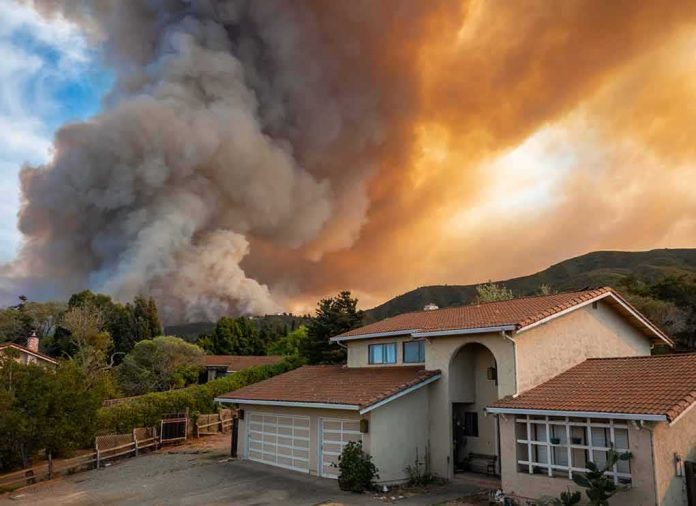
Utah’s biggest active wildfire has surged past 92,000 acres, and the damage now stretches far beyond the burn line.
Quick Take
- The Cottonwood Fire has grown to more than 92,000 acres and is being called the most destructive wildfire in Utah history for property loss.
- Utah fire officials have classified the blaze as human-caused, but the exact ignition source is still under investigation.
- Officials say the fire’s fast spread, strong winds, and shifting behavior made protection of homes and other assets extremely hard.
- Governor Spencer Cox has used emergency powers, including a fireworks ban for July Fourth, to lower the risk of more fires.
A Fire That Outran Crews
The Cottonwood Fire has become a public safety crisis and a political test for Utah leaders. State officials say the blaze has already passed 92,000 acres, making it the largest active wildfire in the country and the most destructive in Utah history for property loss.[1] The fire has spread fast enough that crews have struggled to protect structures, even as evacuation orders and emergency warnings kept expanding.
Governor Spencer Cox said the fire behaved in a way crews did not expect. In news reports from the scene, he described the blaze as unlike other fires and said it was “almost impossible” to protect some assets.[13] That warning matters because it points to a larger problem that many western states face each summer: once wind, heat, and dry fuel line up, even a large response can lose ground very quickly.
Human-Caused, But Not Fully Explained
Utah fire officials have said the Cottonwood Fire is human-caused, but they have not finished the investigation into the exact ignition source.[1] That gap leaves room for debate about what happened at the start, even if officials are confident the fire was not natural. Social media speculation has mentioned target shooting, but that claim has not been confirmed by authorities and should be treated as unproven.[7]
That distinction matters because a human-caused label is not the same as a full answer. It can support prevention efforts and emergency orders, but it does not yet explain who or what lit the fire. For a public already worn down by rising costs, shifting rules, and constant emergency alerts, incomplete answers can feed distrust fast. People want facts, not guesses, especially when homes, roads, and livelihoods are on the line.
Emergency Steps and Mixed Public Reporting
Officials have moved quickly to limit new fire risk. Governor Cox announced a state of emergency and a fireworks ban for July Fourth celebrations to reduce the chance of more ignitions.[4] Reports also say the fire was still at 0 percent containment when winds were pushing it toward nearby communities.[8] Even with no fatalities reported, the scale of evacuations and property loss shows how thin the margin can be once a fire gets this large.
Beaver City cancels Fourth of July celebrations amid ongoing Cottonwood Firehttps://t.co/lWv5nl8Ly1#UTLD#UTAH#JDATA pic.twitter.com/yeF05DUDck
— Utah Live Data (@UtahLiveData) June 29, 2026
At the same time, public reporting has not been perfectly consistent. Different outlets have used different acreage figures as the fire kept growing, and some reports have mixed up Utah’s Cottonwood Fire with a separate fire of the same name in Nebraska.[4][15] That kind of confusion may sound small, but it matters in a crisis. When the public cannot tell which fire is being discussed, confidence in the broader response starts to weaken.
What This Fire Says About Western Risk
The Cottonwood Fire also fits a larger western pattern: dry fuels, strong wind, and long fire seasons are making major blazes harder to stop. Fire weather across the region has stayed dangerous, and meteorologists have warned that dry thunderstorms can spark new fires even when rain does not reach the ground.[4] For residents, that means the threat is not only the current fire. It is also the next one, and the one after that.
For many families, the most frustrating part is that the big questions are still open. Officials still need a full ignition report, a complete damage count, and a clearer picture of what helped or hurt the evacuation effort. The fire has already shown how quickly a single blaze can expose weak points in emergency planning, public communication, and land management. That is why the story is about more than acres. It is about whether the system can keep up.
Sources:
[1] Web – The largest active wildfire in the U.S. has now exploded to more than …
[4] Web – CottonwoodFire MIDDAY UPDATE, June 24,2026 The fire is …
[7] Web – The Cottonwood Fire burned through structures as it exploded in …
[8] Web – The Cottonwood Fire burned through structures as it exploded in …
[13] Web – ‘It’s End-of-Days-Type Stuff’: Wildfires Rage in Utah’s Mountains
[15] Web – July-August human-caused wildfire comparisons: 159 in 2021 471 …