
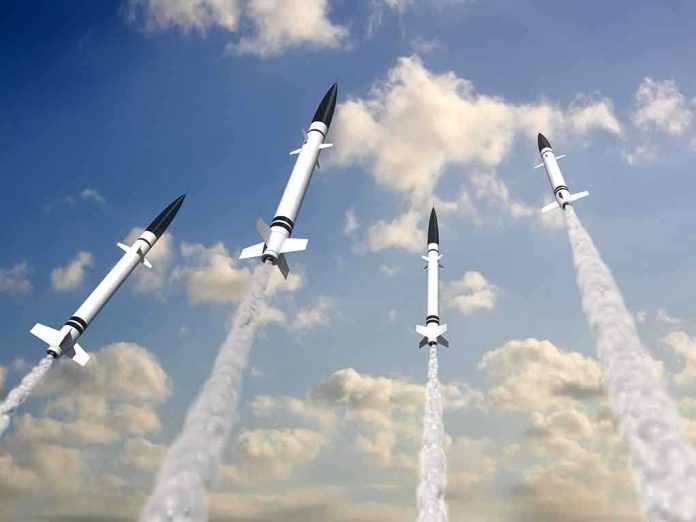
America’s long-range missile stockpile is being burned in Iran fast enough to raise a dangerous question: what’s left if China makes a move in the Pacific?
Quick Take
- Reports say the U.S. diverted most of its JASSM-ER cruise-missile reserve toward operations against Iran, shrinking a key deterrent meant for the Pacific.
- A high early “burn rate” in the first days of the air campaign accelerated concerns about running out of precision weapons during a Taiwan-scale contingency.
- The Pentagon has signaled a shift toward shorter-range weapons like JDAM and Hellfire as standoff inventories tighten.
- Analysts warn that production timelines may not match wartime consumption, potentially creating a multi-year “missile gap.”
How the Iran Air Campaign Collided With Pacific Deterrence
U.S. forces entered an air campaign against Iran alongside Israel on February 28, 2026, and standoff weapons quickly became central to the fight. According to reporting that cites defense and think-tank analysis, the U.S. decision in late March redirected JASSM-ER missiles previously held for broader global needs—especially the Pacific. The same reporting estimates about two-thirds of a pre-war inventory around 2,300 missiles became committed, leaving roughly 425 usable worldwide.
That scale matters because JASSM-ER is not a generic munition. It is designed to strike defended targets from long range, reducing risk to pilots and aircraft while complicating enemy air defenses. When these weapons shift theaters, the trade-off is immediate: Central Command gains standoff capacity, while the Indo-Pacific loses a portion of what planners assume would be essential in a conflict where U.S. aircraft must operate under heavy missile and air-defense pressure.
Burn Rates, Not Headlines, Drive the Readiness Debate
The readiness concern is less about any single strike and more about sustained consumption. In the opening 96 hours of “Operation Epic Fury,” analysts cited in the reporting estimate 135 JASSM/JASSM-ER missiles were fired. Separate tallies referenced in the same research place Tomahawk use above 1,000, with another 1,500–2,000 munitions expended as the campaign stretched past five weeks. Even with Iran’s firing rate reportedly reduced, the campaign still consumed the kinds of weapons the U.S. would also need against a peer competitor.
War-game modeling often provides the plainest way to understand the scale problem. Research referenced in the coverage points to Center for Strategic and International Studies (CSIS) simulations indicating that in a Taiwan scenario, stocks of these standoff weapons could be exhausted in roughly 30 days—meaning the “comfortable” inventory is smaller than many Americans assume. If those models are even directionally correct, then using large volumes in the Middle East creates a narrower margin for error in the Pacific.
The Pentagon’s Shift to Shorter-Range Weapons Signals a Constraint
Publicly, senior military leaders have acknowledged strain by discussing shifts in what the U.S. fires. Reporting cites Joint Chiefs Chairman Gen. Dan Caine describing a move toward shorter-range munitions such as JDAM and Hellfire as high-end stocks tighten. That is not a one-for-one substitution: shorter-range weapons can be effective, but they can also require aircraft to fly closer to threats, increasing risk when air defenses are resilient or when adversaries can contest airspace more seriously than Iran can.
This is where bipartisan frustration with Washington’s priorities tends to surface. Voters on the right see a pattern of strategic drift—big commitments abroad while domestic readiness and procurement lag. Voters on the left often see the same symptoms through a different lens, arguing that repeated military engagements produce predictable budget pressure while failing to deliver clear, stable outcomes. What both sides increasingly share is a belief that the federal system struggles to match rhetoric with execution when the stakes get high and the timelines get short.
Why China Watches U.S. Stockpiles as Closely as U.S. Speeches
China does not need to guess America’s intent if it can measure America’s inventory. Analysts highlighted in the research argue that a depletion-driven “window” could emerge if production cannot replenish what is being fired—potentially lasting several years. The same research notes uncertainty around classified stock levels and competing claims about operational effectiveness, but the central risk is straightforward: deterrence weakens when a rival believes the U.S. cannot sustain precision strike at scale.
Every Missile Fired in Iran Is One the U.S. Can’t Use to Deter Chinahttps://t.co/lR7uWxY0Em
— 19FortyFive (@19_forty_five) May 11, 2026
For Americans who value limited government and competent administration, the practical takeaway is not partisan: strategic commitments must be matched by industrial capacity, clear objectives, and realistic sustainment plans. If the U.S. needs long-range precision weapons to protect allies, keep sea lanes open, and deter major war, then repeated shortages become more than a Pentagon procurement issue—they become a national credibility issue. The research does not settle every classified detail, but it makes the readiness dilemma hard to ignore.
Sources:
US diverts JASSM-ER missiles to Iran, risking deterrence vs China
US military unprepared war China
Iran’s piracy, shoot-to-kill and deterrence of China (from Fox News)