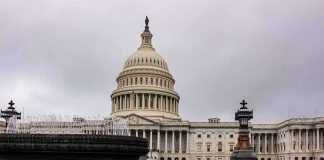

A federal judge ordered Donald Trump’s name stripped from the Kennedy Center, underscoring how courts can redraw the lines of authority over America’s monuments and send a message about who controls national symbols [3].
Story Highlights
- A judge ruled the Kennedy Center board violated the law by adding Trump’s name and ordered its removal [3].
- The ruling says Congress holds naming authority for the Kennedy Center as a memorial to John F. Kennedy [5].
- The court also blocked a planned multi‑year closure for renovations, questioning the board’s process [4].
- Reporting cites fundraising concerns from a Kennedy Center official if Trump’s name is removed [2].
Judge’s Order Centers On Congressional Control Of National Memorials
Reports state a federal judge concluded that the Kennedy Center, established as a memorial to President John F. Kennedy, cannot be retitled by the center’s board or executive leadership because Congress controls the memorial’s name [5]. Coverage says the court ordered removal of Trump’s name from the building and associated branding, framing the change as beyond the board’s legal authority [3]. Without the opinion text in hand, the precise statutory citations remain unavailable here, but outlets characterize the reasoning as tied to congressional prerogatives [5].
Associated coverage indicates the decision included an injunction halting a planned temporary closure for renovations, with the court questioning whether the board’s March actions were adequately justified or procedurally sound [4]. This combination order signals the court viewed the naming and closure decisions as linked governance moves requiring tighter legal basis and process. The reporting does not provide the case caption or full order, limiting verification of the exact scope, deadlines, and compliance mechanisms included in the ruling [3][4].
What The Ruling Means For Institutional Authority And Donor Politics
The judge’s directive, as reported, resets the center’s public identity to its congressional designation, narrowing the latitude of administrators to make unilateral branding changes that influence a national memorial’s meaning [5]. The Independent reported a Kennedy Center official argued that removing Trump’s name would sever a “vital fundraising connection,” highlighting how naming can double as donor signal and institutional leverage during contested cultural fights [2]. The court’s response, according to reports, subordinates those fundraising considerations to the limits of statutory authority [3].
This outcome matters beyond Washington arts politics. When a federally recognized memorial’s identity can be altered by board action, political branding risks eclipsing constitutional balance and congressional roles. By reasserting Congress’s naming authority, the court, as characterized by outlets, places elected accountability over administrative expedience [5]. For readers wary of mission drift, this underscores a first‑principles guardrail: institutions created by law answer to the law, not to temporary branding winds, donor pressures, or bureaucratic shortcutting [3][5].
Limits, Unknowns, And Next Steps In The Legal Fight
Key gaps remain. The available reporting does not include the judge’s memorandum opinion or the center’s enabling statute excerpts, so independent review of the exact legal test and remedy language is not yet possible here [3][5]. Coverage does not provide board minutes, internal resolutions, or contracts authorizing Trump branding, leaving open who approved the changes and how they believed they were permitted to act [3]. These missing records matter because governance authority often turns on specific delegations and procedures that can be proven or disproven only with documents.
🚨 BREAKING: Judge orders Donald Trump’s name REMOVED from the Kennedy Center within 14 days.
Full story 👇https://t.co/gSxrvC1q2d#Trump #DonaldTrump #KennedyCenter #BreakingNews #USPolitics #TrumpNews #America #Politics #WashingtonDC
— Worlds Trends (@usatrendsz) May 30, 2026
Further litigation is possible. Appeals commonly shift attention to threshold issues like standing or remedy scope, which could narrow or delay enforcement while the core naming question remains contested. For now, the public record, anchored in multiple news reports, presents a clear bottom line: the judge ordered Trump’s name removed and paused the closure plan, pending lawful process aligned with congressional authority [3][4][5]. Transparency from the center about its approvals and timelines would help resolve lingering factual disputes.
Why Conservatives Should Care About The Precedent
Conservatives value limited government, rule of law, and respect for national memorials. The reported ruling reinforces all three by curbing administrative freelancing that repackages a congressionally designated monument through branding moves. Whether audiences favored or opposed the added Trump labeling, the principle at stake is larger: political winds and fundraising strategies cannot overrule statute. Ensuring Congress, not unaccountable boards, governs memorial identity protects historical integrity and shields civic institutions from quick‑turn power plays [5].
What To Watch: Compliance, Congress, And Documentation
Watch for four developments. First, the compliance timeline, including removal of signage and digital branding if the order sets deadlines. Second, any appeal that could recalibrate the injunction’s reach. Third, whether Congress clarifies naming authority through updated statute. Fourth, release of board records explaining who initiated the branding, how contracts were executed, and which legal reviews were conducted. Those disclosures would test the board’s process claims and either validate or undercut future administrative discretion [3][4][5].
Sources:
[2] YouTube – Federal Judge orders Trump to take his name OFF Kennedy Center …
[3] Web – Kennedy Center official tells judge that removing Trump’s name …
[4] Web – Judge says Kennedy Center board violated law putting Trump’s …
[5] Web – Judge says Kennedy Center board broke law putting Trump’s name …