
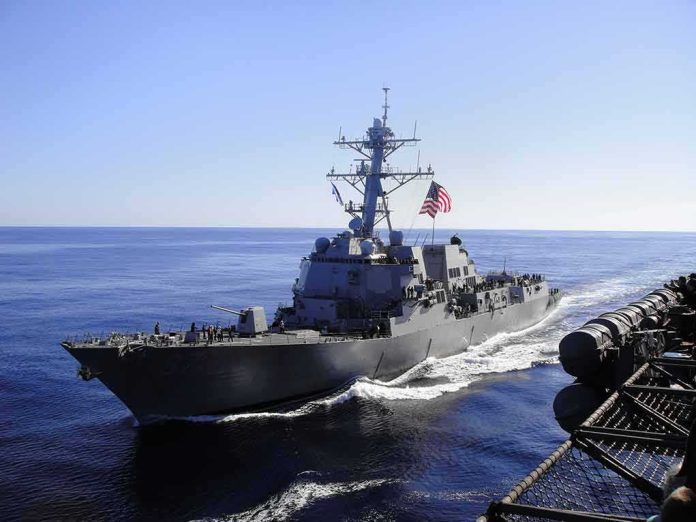
The United States has now hit Iran for 13 straight nights, turning a “powerful response” to surprise attacks on ships into a deepening Middle East war that many Americans fear their leaders can no longer control.
Story Snapshot
- U.S. forces, under President Trump, launched repeated strikes on Iranian military targets after attacks on commercial ships in the Strait of Hormuz.
- Central Command says the goal is to keep a key trade route open and protect civilian mariners and U.S. troops.
- The campaign has hit thousands of Iranian targets and sharply weakened Iran’s navy and missile forces, according to U.S. commanders.
- Legal experts worldwide clash over whether Washington’s “self-defense” claim truly fits international law, feeding public distrust of the war effort.
How the Strikes Started and What the U.S. Says They Are For
U.S. Central Command says the current wave of strikes began after Iran attacked commercial vessels moving through the Strait of Hormuz, one of the world’s most important shipping lanes. On July 7, Central Command reported striking more than 80 Iranian targets, including air defense systems, command and control networks, coastal radar, anti-ship missile units, and dozens of Islamic Revolutionary Guard Corps boats. The military says these strikes are meant to stop Iran from threatening global trade and to protect civilian mariners who have come under fire in recent weeks.
Central Command also links the campaign to earlier incidents, including an Iranian attack that downed a U.S. Army Apache helicopter near the Strait of Hormuz in June. In that case, the command called the American response “self-defense strikes” and said they were a proportional answer to attacks on U.S. forces and commercial ships. Together, these events create a picture of a fast-moving conflict where Iran is accused of hitting U.S. assets and civilian shipping, and the United States answers with air, sea, and drone power. This pattern alarms citizens on both the left and right who feel Washington reacts with force more quickly than with diplomacy.
Thirteen Nights of Strikes: Scope and Targets of the Campaign
Over nearly two weeks, the United States has turned this “response” into a major air and naval campaign. News outlets and Central Command statements show there were at least 11 straight nights of attacks by July 21, hitting Iranian operations centers, maritime assets, aircraft hangars, drone storage sites, and logistics hubs. By the 13th night, Central Command said U.S. forces were still targeting Iranian military command centers, drone storage facilities, communication networks, coastal surveillance sites, and maritime capabilities to reduce Iran’s ability to threaten civilian vessels. These are not small pinprick strikes; they represent a sustained effort to reshape Iran’s power in a key region.
Central Command leaders have given an even more sweeping picture of the damage. Admiral Brad Cooper said the Pentagon’s operations have hit over 8,000 targets in Iran since the wider conflict began. He claimed Iran’s navy is “not sailing,” its tactical aircraft are grounded, and its ability to fire missiles and drones at high frequency has been broken. He also described using large “bunker-buster” bombs against a hardened underground missile site along the coast, plus associated radar and intelligence nodes. For Americans already worried about endless wars and mission creep, these numbers sound less like a narrow defensive action and more like a full-scale effort to cripple another country’s military.
Freedom of Navigation, Surprise Attacks, and the Risk of Escalation
Central Command repeatedly frames the strikes around one main idea: protecting freedom of navigation in the Strait of Hormuz. U.S. releases say Iran has attacked more than 30 commercial ships, endangering hundreds of mariners and undermining safe passage for global trade. For conservatives, this looks like a clear test of strength and a chance to push back against a hostile regime that has long targeted U.S. forces and allies. For many liberals, it raises fears that American leaders are once again using “protection” of trade routes as a reason for open-ended war without a clear exit plan.
The U.S. also cites surprise and foiled attacks to justify acting quickly. Reports describe U.S. forces intercepting an Iranian missile attack and then launching new waves of strikes on Iranian missile sites and boats that were placing mines. Commanders say these are “self-defense” moves meant to shield American troops during a declared ceasefire. Yet every fresh strike risks a new round of Iranian retaliation, pulling in more countries and making it hard for regular Americans to tell where self-defense ends and a broader war for regional control begins. Many feel caught between fear of Iran and distrust of Washington’s long-term plan.
Legal Battles and Growing Doubts About Washington’s Judgment
While the Pentagon presents its case as clear self-defense under the United Nations Charter, many international law experts push back. A group of over 100 specialists has argued that the wider U.S. and Israeli operations against Iran violate the U.N.’s basic ban on using force except in strict self-defense. Other scholars say Washington cannot lean on self-defense when it does not share full evidence of an “armed attack,” when diplomacy is still possible, or when strikes appear aimed at long-term regime weakening instead of stopping immediate threats. These debates do not stop the bombs, but they sharpen public anger at a government seen as more secretive than honest.
#Iran says 3 people were killed & 2 injured in #US strikes on Qeshm Island in the Strait of Hormuz pic.twitter.com/yO8lZFd3od
— Ayman Mat News (@AymanMatNews) July 30, 2026
For many Americans, this war touches a deeper frustration they already feel. Conservatives see decades of “globalist” elites dragging the country into conflicts that drain resources while borders remain insecure and costs at home rise. Liberals see a government spending huge sums on missiles and jets while cutting help for families and ignoring the growing gap between rich and poor. Both sides look at 13 nights of strikes, thousands of targets hit, and a thin public legal record, and they wonder if anyone in Washington is truly putting the American people first. The fear is simple: a powerful response to real danger may be sliding, yet again, into a war that ordinary citizens neither asked for nor trust.
Sources:
townhall.com, centcom.mil, npr.org, aljazeera.com, cnn.com, reuters.com, justsecurity.org, blogs.timesofisrael.com, theconversation.com