
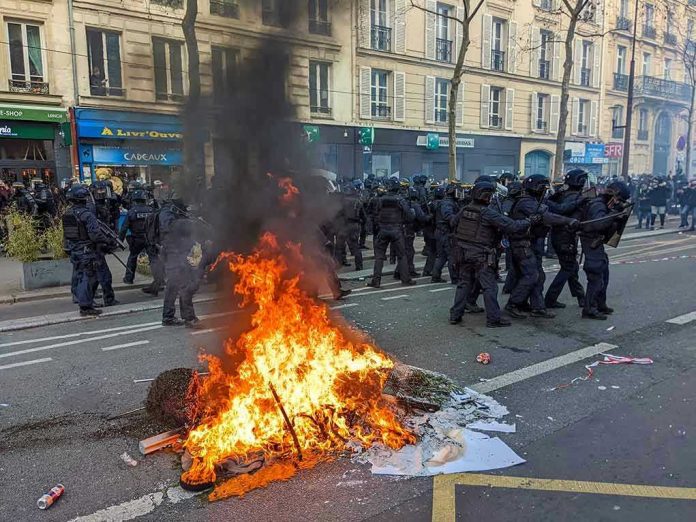
France moved to restrict public gatherings after days of street violence left police injured and cities on edge, raising fresh questions about liberty and order.
Story Highlights
- President Emmanuel Macron empowered local officials to ban certain rallies where safety is at risk.
- Police records show hundreds of injuries and more than a thousand arrests amid fires and looting.
- Marseille imposed a timed ban on gatherings; some areas faced curfews and protest limits.
- Opposition leader Marine Le Pen said democracy is at risk, pressing a law-and-order case.
What Macron Authorized And Why It Matters
President Emmanuel Macron told the nation that local prefects and mayors can ban specific gatherings when needed to protect public safety. He framed this step as a response to “unbridled” violence that damaged shops, public buildings, and neighborhoods. He backed police and vowed to shield cities and families. This is not a national shutdown of protests. It is targeted authority meant to stop fresh attacks and arson in hot spots while keeping the rest of civic life open.
The distinction matters. France often sees large demonstrations. But the Élysée address described injuries to officers and wide property damage across several cities and territories. That language aims to justify limits without invoking a nationwide emergency decree. The policy asks local leaders to act case by case. Supporters say this is precision policing. Critics fear it edges toward normalizing bans that can chill speech during tense times when people most want to be heard.
What The Data From The Streets Shows
Official police orders from Paris cite 1,260 arrests and hundreds of injured security personnel over repeated nights of fires, mortar-style fireworks, and smashed storefronts. The document notes damage to urban property and businesses. These numbers show a real public order crisis, not just noisy rallies. They also explain why authorities limited a planned march in the capital. That step marked a shift from managing traffic to blocking events deemed likely to turn violent.
Local controls followed. Marseille banned public gatherings and demonstrations during a midday-to-evening window. Other areas imposed partial curfews and protest limits to protect shops and transit. The government said the curfews should be local and temporary, not blanket rules for entire regions. That approach signals a desire to contain violence without punishing peaceful demonstrators across the board. It also creates uneven rules that can confuse residents about what is allowed where they live.
The Political Fight Over Blame And Direction
Opposition leader Marine Le Pen called the situation a threat to French democracy and argued that the government had lost control. Her charge taps into public anger over crime, inequality, and distrust in institutions. It also meets pushback because police are still making arrests, courts are still open, and elections remain on schedule. The democracy claim is powerful rhetoric, but the clearest proof on record points to severe disorder, not a shutdown of core institutions.
Macron’s team blamed ultra-left groups and criminals for hijacking protests and promised legal action against looters and those who attack police. At the same time, he said many citizens have real cost-of-living and public-service grievances and pledged talks with students, teachers, unions, lawmakers, and business leaders. This split message shows the core tension: contain violence fast while addressing the pain that fuels unrest. Both tasks are hard to do at once under pressure.
Why Americans Should Care
When leaders answer unrest with bans and curfews, even narrow ones, they test the line between safety and liberty. That line is thin in every democracy, including ours. The French case offers a warning about what happens when trust in government is low and daily costs feel out of control. People on the right and left see a system that protects elites while small businesses, workers, and families face rising risks. When peaceful outlets fail, the streets fill—and then the rules tighten.
What To Watch Next
Watch three signals. First, whether arrests lead to fast and fair trials that target violent actors without sweeping up peaceful protesters. Second, whether local bans lift quickly as conditions calm, or linger and become a habit. Third, whether talks on prices, schools, and services yield real fixes that ease pressure before the next flashpoint. If France moves on all three, order can return with legitimacy intact. If not, the cycle will repeat, only louder.
Sources:
aol.co.uk, uk.news.yahoo.com, independent.co.uk, irishtimes.com