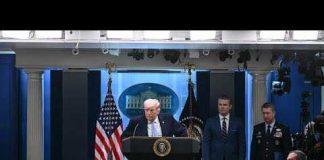
A Canadian Prime Minister’s speech in Davos challenges the very foundation of the US-led global order, prompting a strong reaction from President Trump.
Story Highlights
- Canadian PM Mark Carney declares the end of the US-led “rules-based international order” at Davos.
- Carney’s speech suggests a shift towards strategic autonomy for middle powers like Canada.
- President Trump responds to Carney’s remarks, emphasizing US unilateral interests.
- The speech highlights a rupture in the global economic and political landscape.
Carney’s Bold Declaration at Davos
On January 20, 2026, Canadian Prime Minister Mark Carney delivered a groundbreaking speech at the World Economic Forum in Davos, Switzerland. In his address, Carney proclaimed the end of the US-led “rules-based international order,” describing it as a rupture caused by great-power rivalry and economic coercion. He urged middle powers to pursue strategic autonomy and cooperation rather than nostalgia for a system that has failed them.
This declaration marks a significant departure from decades of US-led neoliberal globalization, which had been promulgated through institutions such as the WTO, IMF, and NATO. Carney’s speech acknowledges the asymmetries within this order and calls for a new approach among middle powers to resist subordination and build new institutions.
Trump’s Response and US Strategic Shift
Former President Donald Trump, representing US interests aligned with unilateralism, reportedly hit back at Carney’s speech. Although specifics of Trump’s response remain vague in primary sources, it underscores the ongoing debate within the US regarding globalization versus unilateral action. Trump’s previous policies, including tariffs and critiques of multilateral agreements, reflect a shift towards prioritizing US advantage through rivalry and transactionalism.
Trump’s stance is seen as a continuation of his first term policies, emphasizing “America First” and critiquing alliances like NATO. This approach has increasingly isolated the US from traditional allies, pushing middle powers to reevaluate their positions and pursue greater autonomy.
Implications for Global Politics and Economics
The ramifications of Carney’s speech are profound, suggesting a potential end to multilateralism and a move towards a fragmented global landscape. Middle powers, including Canada and EU states, face the challenge of navigating coercion risks and building coalitions to counterbalance US dominance. Carney’s call for strategic autonomy indicates a shift towards strengthening domestic capabilities, such as defense and energy, to mitigate vulnerabilities.
In the long term, this could lead to the rise of new institutions composed of middle powers seeking to establish a “third path” free from the influence of superpowers. However, the transition may be fraught with economic, social, and political challenges as countries adjust to a world where unilateralism prevails over collective governance.
Sources:
Carney’s Davos confession: Globalization’s rules-based order was a lie
Davos 2026: Special Address by Mark Carney, Prime Minister of Canada