Venezuela’s twin earthquakes exposed a rescue system that residents say moved too slowly when lives were still buried under the rubble.
Quick Take
- Residents said they saw too few rescue teams in the hardest-hit areas.[4]
- Reports said some families dug through debris on their own while waiting for help.[3][4]
- The government said it had rescued 243 people and declared a state of emergency.[3][5]
- International teams and supplies began arriving after the quakes, but damaged roads and airports slowed access.[1][5][6]
Residents Say Help Arrived Too Slowly
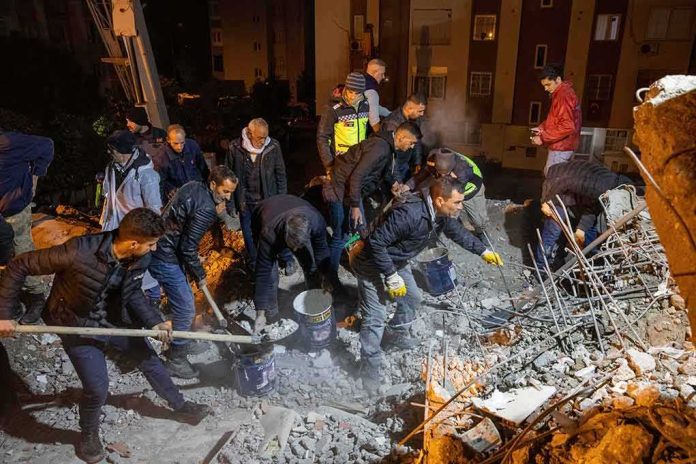
Families in La Guaira and nearby areas said they had to search for missing loved ones by hand.[4] Witnesses told reporters they saw few state rescue teams in the hardest-hit zones, even as the death toll rose fast.[3][4] One survivor’s complaint cut through the chaos: debris had not been cleared, and people still could not see enough help on the ground.
That anger came from the scale of the destruction and the delay in reaching trapped people. Reuters and Associated Press reports said citizens were digging through collapsed homes while foreign rescue teams were still arriving.[1][4] The same reports said more than two dozen rescue teams were being sent in, but that still left a dangerous gap in the first critical hours after the quakes.[4][6]
Broken Roads, Damaged Airports, and Missing Signals
News coverage said the quake damaged Caracas’s main airport and made delivery of aid harder.[5][6] Reporters also said communications failures left some families unable to confirm whether relatives were safe, with missing-person counts rising partly because many people could not be reached.[2][10] When airports, roads, and phone service fail at the same time, rescue work slows down fast, no matter who is in charge.
Those limits help explain why aid did not move at full speed, but they do not erase the public’s frustration. The United States said it was deploying disaster teams and search-and-rescue specialists, while the United Nations said about 1,000 emergency responders in 25 teams were heading in.[4][5][7] That outside help mattered, but it also showed how badly overwhelmed local response teams were.
A Crisis Built on Weak Infrastructure
Venezuela was already under severe strain before the earthquakes hit. One report said the country had been through years of economic collapse and a deep humanitarian crisis, with millions of people already in need.[7][21][23] Another report said hospitals were short on supplies and health workers were stretched thin, which made it harder to treat the injured once the quake victims started pouring in.[3]
🚨 "The death toll in the twin earthquakes which struck Venezuela earlier this week has risen to 1,430, according to one of the country’s top politicians Jorge Rodríguez."
Nadeem Badshah @guardian https://t.co/IeWrknLdt5— Stefan Bethlenfalvay (@SBethlenfalvay) June 27, 2026
The government did not stand still. Officials declared a state of emergency, asked for international help, and said they rescued 243 people on the first day.[3][5] Still, the strongest lesson from the disaster is clear: a country already battered by failing services, weak infrastructure, and mass hardship cannot absorb a major earthquake without heavy losses. For Venezuelans trapped in the wreckage, that failure felt immediate and personal.
Sources:
[1] Web – Venezuela earthquakes kill nearly 1,500, leave millions in need
[2] Web – Venezuela’s earthquake response hindered by economic and … – PBS
[3] Web – expert reaction to earthquake in Venezuela | Science Media Centre
[4] Web – The Venezuela Earthquakes Hit a Health System Already in Crisis
[5] YouTube – Venezuela’s earthquake response hindered by economic …
[6] YouTube – Trump’s Venezuela Earthquake Pledge BACKFIRES As …
[7] Web – Rescuers rush to save lives as Venezuela earthquakes kill at least 235
[10] Web – United Cajun Navy – Facebook
[21] Web – Debris-flow and flooding hazards caused by the December 1999 …
[23] Web – Venezuela Case Study | Climate Refugees