
The heart of the Roblox controversy is not whether predators exist online—they do everywhere—but whether a mass-market platform built for children designed, governed, and litigated its way into avoidable risk, then steered survivors away from court through private arbitration.
At a Glance
- More than 180 federal lawsuits accuse Roblox of failing to protect children from sexual exploitation; Roblox has moved to compel private arbitration rather than open court.
- Roblox’s own disclosures show large and rising volumes of suspected child-exploitation reports to NCMEC, while the company emphasizes aggressive reporting and law-enforcement partnerships.
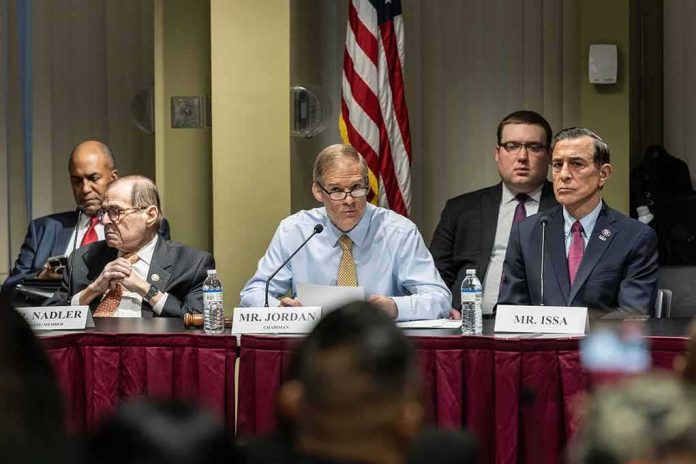
- Senators have introduced bills to bar forced arbitration for child-exploitation victims, spurred in part by the Roblox cases and hearing.
- Roblox now gates chat behind age checks, bands communication by age, and prohibits image/video sharing—strong measures that also imply earlier safeguards fell short.
What the litigation and the hearing are actually about
The core claim in the federal wave of cases is straightforward: plaintiffs allege Roblox’s product and safety systems were not reasonably designed to prevent adults from making contact with and grooming children on a platform whose user base skews young. According to reporting, a single federal judge in San Francisco is managing more than 180 such lawsuits, and Roblox’s threshold response has been to compel arbitration under its terms of use—terms that explicitly waive the right to bring an action in court, individually or as a class. The arbitration fight is not a sideshow; it determines whether evidence about design choices, moderation logs, and safety decisions will surface in public litigation or remain largely private. The text of Roblox’s agreement—“you give up the right to bring an action in court, individually or as part of a class action”—captures the stakes crisply.
Congress has taken notice. Press accounts describe senators introducing bills tailored to this problem: eliminating forced arbitration for child-sexual-exploitation claims so minors are not locked out of court by click-through terms accepted when they were children. Arbitration is not per se unlawful; Roblox’s motions are legally cognizable and plaintiffs are contesting them. But as a policy question, lawmakers are now asking whether a platform so heavily used by children should be able to privatize accountability for child-exploitation allegations at scale.
What Roblox’s own data and safeguards establish—and what they don’t
Roblox’s public materials confirm that suspected child-sexual-exploitation incidents are a persistent, measurable phenomenon on the service. The company has described reporting thousands of suspected cases to the National Center for Missing & Exploited Children (NCMEC) annually, including 13,316 in 2023 and a substantially higher figure in 2024, and it emphasizes direct escalation channels with NCMEC and the FBI. Those numbers are not synonymous with confirmed crimes; Roblox itself stresses it uses a low threshold to report suspected harm, as federal law requires providers to do. Yet the volume does at least two things: it validates that the risk space on Roblox is real and recurrent, and it supports the premise that safety architecture—not just after-the-fact moderation—has to work at industrial scale.
On architecture, Roblox points to a tightening safety stack. It prohibits photo and video sharing in chat, filters aggressively for sexual content and personal identifiers, and says it monitors communications for indicators of child endangerment. Most consequentially, it made unfiltered or any chat contingent on age checks and began banding communication by age cohort and “trusted connections,” with a global rollout of facial age checks required to use chat at all. As a pure safety design matter, those are meaningful interventions; the company also claims more than 40 new protections in a recent year and says its policies are stricter than typical social networks.
Design, causation, and the Section 230 boundary
Where the legal arguments sharpen is on causation and the boundary between content hosting and product design. Plaintiffs increasingly frame harm as the foreseeable consequence of platform design—recommendations, discovery, communications scaffolding, or reporting workflows—rather than the mere publication of third-party content. That distinction matters because courts often treat product-design and safety-infrastructure claims differently from publisher-liability claims under Section 230 of the Communications Decency Act. Recent appellate decisions have allowed certain design or reporting-infrastructure theories to proceed while dismissing classic publisher claims, reflecting a maturing jurisprudence that does not grant blanket immunity when plaintiffs target independent design choices rather than moderation of user speech.
Two caveats temper the plaintiff narrative. First, the available record summarized here does not establish that any particular Roblox feature proximately caused any specific criminal act; most cases remain at the pleading or procedural stage, and causation will be contested. Second, NCMEC report counts are inputs to an investigative pipeline, not adjudications; without outcome data—clearance, charges, convictions—those counts resist straightforward conversion into prevalence rates. Still, given Roblox’s youth-skewed user base and its own reporting volumes, a safety-by-design lens is the right one to apply—by courts, by parents, and by regulators.
Arbitration as the gatekeeper for facts
The most immediate procedural fight is over where these claims will be heard. Roblox’s terms require arbitration and waive class actions; the company has moved to compel arbitration in the consolidated litigation. Plaintiffs, for their part, argue various grounds to keep cases in court, and legal reporting indicates they are actively opposing those motions. The forum question is not academic. Court litigation creates public dockets, depositions, and opinions that surface what a company knew, when it knew it, and how its systems performed; arbitration tends toward confidentiality and fragmented, case-by-case outcomes. That privacy can be salutary in some contexts, but when allegations concern systemic child safety on a ubiquitous platform, opacity carries public costs.
Legislators have noticed this wedge issue. Reporting links the Roblox controversy to new bipartisan proposals to bar forced arbitration for child-exploitation and related harms; if enacted, such laws would remove the threshold fight and force design and safety questions into the open, in court. Until then, enforceability of Roblox’s clause will rise and fall on contract law, infancy doctrines, state-specific statutes, and any applicable federal carve-outs that plaintiffs can successfully invoke.
What changed inside Roblox—and how to judge it
Roblox’s progression from birthday self-attestation to age checks, then to facial age estimation for chat, paired with age-banded communications, is the clearest arc in the record. It indicates two truths at once: predators adapt, and so must safety systems. By eliminating image and video sharing in chat and restricting links, Roblox reduced one vector for distributing contraband content; by gating chat behind age verification and narrowing who can talk to whom, it addressed the age-mixing risk that underpins many grooming attempts. The company also highlights proactive monitoring, dedicated safety teams, and direct channels to law enforcement—signals that, at minimum, it is operationally engaged with the problem.
Do these changes solve the problem? No single intervention does. The right metric is whether exploitation indicators fall—grooming attempts, repeat-offender rates, law-enforcement referrals that result in action—after each product change. Roblox has not furnished independently audited, longitudinal results in the sources available here, and without that granularity, outside observers should withhold triumphalism. But it is also wrong to treat every safeguard as public-relations varnish. Age gating for chat and strict bans on multimedia sharing are heavy-handed by consumer-tech standards; they are evidence of real design tradeoffs in favor of safety.
Roblox: Hawley Says He'd 'Love to' Subpoena CEO After First-Ever Senate Hearing on Gaming Platform's Safety Issues and Child Sexual Exploitation Litigation https://t.co/kEcRJwmzgw
h/t @EthanEhrenhaft & @rebeccamkern$RBLX
— The Capitol Forum (@Capitol_Forum) November 19, 2026
How parents, policymakers, and courts should proceed
Three pragmatic steps cut through the noise. First, prioritize evidence that ties product choices to measurable outcomes: require independent audits of age checks, age-banded communications, and moderation efficacy before and after rollout. Second, clarify the law at the design boundary: allow claims that target defective safety systems or reporting infrastructure to be heard on the merits while preserving publisher protections for pure third-party speech. Recent appellate rulings already sketch that line. Third, resolve the forum fight for minors’ claims through statute rather than piecemeal motions practice; if Congress believes child-exploitation allegations should not be privatized, it should say so plainly.
Sources:
youtube.com, about.roblox.com, sfchronicle.com, reuters.com, en.help.roblox.com, ncmec.org, cdn.ca9.uscourts.gov