
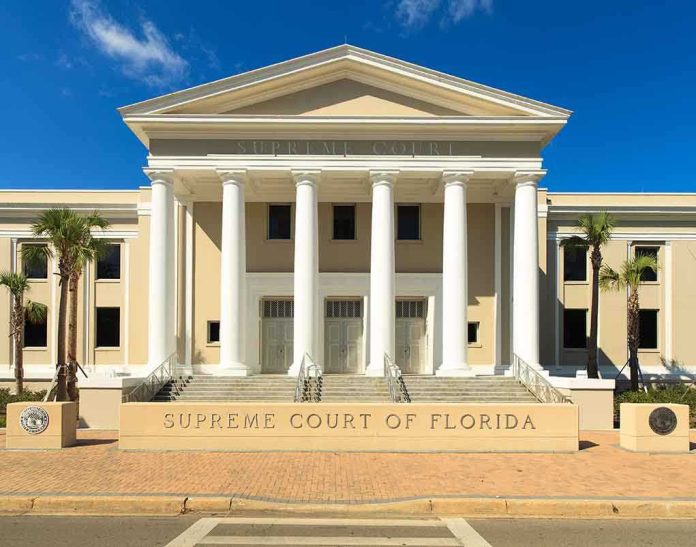
The Florida Supreme Court found Larry Klayman committed professional misconduct and suspended him for two years, and later reports say the U.S. Supreme Court separately disbarred him from practicing before the nation’s highest court.
Story Highlights
- Florida’s high court affirmed misconduct findings and imposed a two-year suspension on Larry Klayman.
- Reports say the U.S. Supreme Court disbarred Klayman from practice before the Court.
- Florida described conflict-of-interest violations tied to Klayman’s work opposing Judicial Watch, which he founded.
- A federal court in Florida reciprocally suspended Klayman after the state action.
Florida Court’s Misconduct Findings and Sanction
The Supreme Court of Florida reviewed a referee’s report on Larry Klayman and approved findings of professional misconduct. The court ordered a two-year suspension and assessed costs of $4,536.93. The opinion states Klayman challenged the report in full, but the justices upheld the findings and the sanction. The ruling anchors the disciplinary record with a clear adjudication and a set time bar from practice in Florida, which began with the November 2025 decision.
The Florida Bar’s summary explains the underlying misconduct categories that drove the sanction. It states Klayman represented plaintiffs in three suits against Judicial Watch, the organization he founded and once served as general counsel, without securing conflict waivers. It also states he kept representing a client after she ended the relationship and publicized details against her wishes. These are direct client-duty and conflict issues, not general political complaints.
Reported U.S. Supreme Court Disbarment and Terminology Gap
Multiple legal outlets reported that the Supreme Court of the United States disbarred Klayman from practice before that Court following earlier suspensions in other jurisdictions. Those stories describe a show-cause process and a final order removing him from the Supreme Court bar. The available state record is definitive on suspension, while public reporting uses “disbarment” for the separate Supreme Court action. Readers should keep those terms separate to avoid confusion about scope and forum.
Coverage also highlighted a notable line tied to the Florida record. Reports say the state materials included writings where Klayman told a client his emotions left him “nonfunctional as a lawyer.” That detail became part of the narrative carried into later discipline discussions at higher levels. However, the central point remains the Florida court’s affirmed findings on conflicts and client handling, which formed a clear basis for reciprocal steps elsewhere.
Reciprocal Discipline Spreads Consequences Across Courts
After the Florida suspension, the United States District Court for the Middle District of Florida entered a reciprocal order suspending Klayman from that federal court’s bar. That step is common when a lawyer faces final discipline in a state’s highest court. Federal and sister courts often apply similar limits unless the lawyer shows a due process failure or other narrow exceptions, which were not found here.
Judicial Watch founder Larry Klayman disbarred by Supreme Court. https://t.co/rm5SOXpA28 #ethics #legalethics #SCOTUS @KevDavis pic.twitter.com/vi0cVFGGOd
— ABA Journal (@ABAJournal) November 12, 2026
The pattern fits how discipline typically moves across jurisdictions. One court issues a final sanction after fact-finding. Other courts then decide whether to mirror that outcome for practice before their bars. Media reports indicate the U.S. Supreme Court took its own step, which would restrict appearances there. While headlines can blend “suspension” and “disbarment,” the record shows distinct forums, distinct orders, and a shared theme: courts protect clients and the integrity of the bar.
Why This Matters for Accountability and Equal Rules
Conservatives want the same rules for everyone, without politics. These actions arose from concrete client and conflict findings in Florida, then moved through reciprocal discipline channels. That path focuses on client protection and the duty of loyalty, not on a lawyer’s views. When courts enforce conflicts and respect client wishes, they defend basic ethics that keep the legal system fair and focused on facts, not fame or faction.
Sources:
acis.flcourts.gov, flcourts-media.flcourts.gov, news.bloomberglaw.com, floridabar.org, ecf.flmd.uscourts.gov