
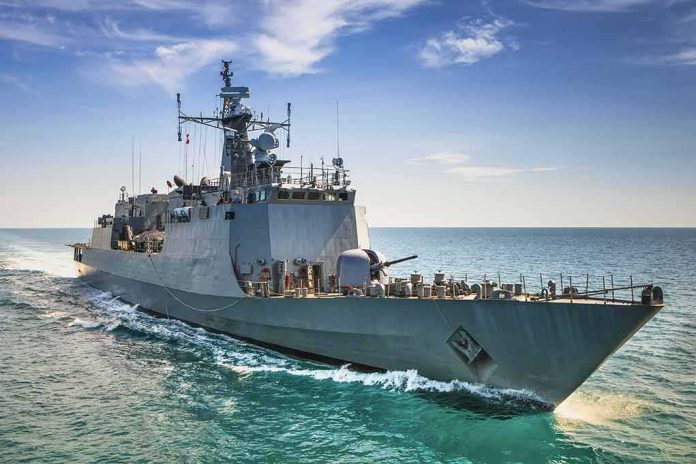
North Korea just put a 5,000‑ton “nuclear‑capable” destroyer into service and openly vowed to turn its navy into a nuclear strike force, raising fresh questions about how America defends its allies and homeland.
Story Snapshot
- Kim Jong Un commissioned the 5,000‑ton destroyer Choe Hyon, calling it proof his navy is going nuclear.
- State media claims the ship carries nuclear‑capable ballistic and cruise missiles after months of testing.
- Analysts say there is still no independent proof the warship can actually fire nuclear weapons.
- Kim ordered more large warships, including 10,000‑ton vessels, to expand sea‑based strike power.
Kim’s New Destroyer: What He Just Announced
North Korean leader Kim Jong Un stood at the western port of Nampo and formally commissioned the destroyer Choe Hyon, a 5,000‑ton warship he is selling as a symbol of his growing naval nuclear power. State media says the ship is loaded with anti‑air and anti‑ship weapons, plus ballistic and cruise missiles that can carry nuclear warheads, giving Pyongyang more ways to threaten targets at sea and on land. Kim told the ceremony that turning his navy nuclear is “following its planned course unerringly,” and that the service is now a “full‑fledged” strategic force, not just a coastal defense fleet.
Reports say the Choe Hyon spent about 14 months in operational testing before this commissioning, including multiple missile launches personally supervised by Kim. North Korean outlets claim the destroyer fired “nuclear‑capable” strategic cruise missiles and anti‑ship missiles during those trials, framing the tests as proof the new ship can support real combat operations. After placing the vessel into service, Kim said his navy’s nuclear armament effort would bring a “radical change” in defending North Korea’s maritime claims, hinting he may try to push new sea boundaries against South Korea and U.S. forces.
How Big a Threat Is the Choe Hyon Really?
Outside experts agree the Choe Hyon is now North Korea’s largest warship, around 144 meters long, with a displacement of about 5,000 tons and a dense vertical launch system for many missile types. They also note this fits a broader pattern: over the past decade, Pyongyang has rolled out several claimed nuclear‑capable sea platforms, including the Hero Kim Kun Ok submarine and the Haeil “radioactive tsunami” underwater drone, without ever allowing real inspection of nuclear warhead integration. Analysts stress there is still no hard technical proof that any North Korean ship or sub carries fully functional nuclear‑armed missiles ready for wartime use.
Recent research points out that most of what the world knows about the Choe Hyon’s weapons comes from North Korean propaganda and a few images, not from hands‑on evaluation. Some defense specialists warn that photos of the destroyer’s radar and gun systems suggest heavy reliance on Russian‑made hardware, raising doubts about how much of this program is truly domestic and how smoothly these foreign systems work with North Korea’s own missiles. Others question whether the vessel is truly combat‑ready, noting that earlier tests were held very close to port and might have been staged more for video clips and headlines than for full, realistic war games.
Why This Matters for the U.S. and Its Allies
For American readers, the most important fact is simple: North Korea is openly building a sea‑based nuclear force while already claiming status as a permanent nuclear weapons state. The regime has material for dozens of warheads, has tested long‑range missiles that could reach the United States, and now wants destroyers and submarines that can launch nuclear weapons from the ocean, making it harder to track and harder to stop. Kim’s promise to roll out 10,000‑ton “strategic warships” next, with more large vessels every year, shows he is not treating this as a one‑off showpiece but as the start of a fleet.
North Korea just commissioned the 5,000-ton Choe Hyon destroyer, armed with an 88-cell VLS capable of deploying sea-based nuclear missiles. With suspected Russian tech transfers, Pyongyang is actively shifting to a blue-water nuclear navy. 🚢🇰🇵 #Geopolitics #NavalDefense #DPRK pic.twitter.com/BOSsLVG5BL
— X News (@xnewsgusrix) June 26, 2026
At the same time, strict United Nations and Western sanctions mean no neutral inspectors can enter North Korean shipyards, look at the Choe Hyon’s launch cells, or verify what warheads are actually on board. That black box effect cuts both ways: it lets Pyongyang exaggerate its strength for propaganda, but it also forces American planners to assume the worst when they think about defending South Korea, Japan, and U.S. territory. For a Trump‑era Pentagon trying to restore hard power after years of cuts and “woke” distractions, this destroyer is one more reminder that serious adversaries are investing in real weapons, not social agendas, and that U.S. deterrence must stay ahead of regimes that see nuclear expansion as their main path to survival.
Sources:
realcleardefense.com, nbcnews.com, defencesecurityasia.com, en.wikipedia.org, beyondparallel.csis.org, youtube.com, facebook.com, reddit.com, instagram.com, inkl.com, modernghana.com, hamerintel.com