
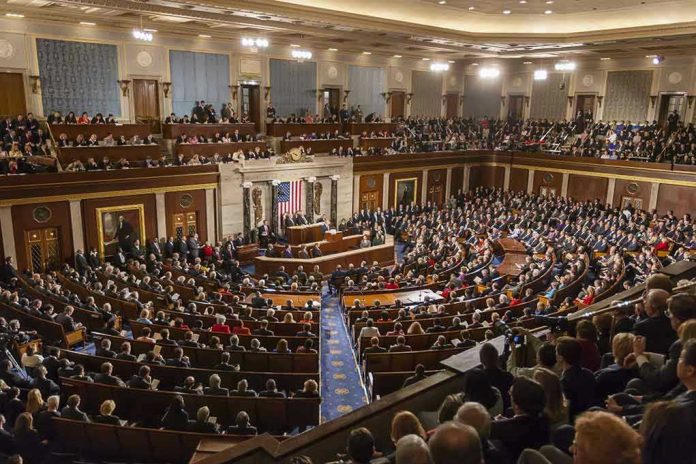
Americans woke up to “major combat operations” with no war vote, no public case, and no clear plan for what comes next.
Quick Take
- President Trump ordered strikes on Iran and later declared “major combat operations” without seeking a formal vote or authorization from Congress.
- Secretary of State Marco Rubio briefed the Gang of Eight after the strikes, leaving most lawmakers and the public outside the decision loop.
- Steve Inskeep argues the Constitution’s design puts Congress in charge of starting wars, but modern presidents routinely treat airstrikes as routine policy tools.
- Democrats called the action an “illegal war,” while the larger issue is Congress’s long-running habit of avoiding responsibility for war decisions.
Strikes First, Briefings Later: How the Decision Was Communicated
President Trump initiated strikes on Iran without a prior Congressional vote or a public address laying out objectives, risks, or a clear legal framework. After the operation began, Secretary of State Marco Rubio notified the Gang of Eight, the small circle of top Congressional leaders and intelligence committee heads. Democrats pressed Trump to explain the action publicly during the State of the Union, but the conflict was not addressed there, according to reporting and analysis.
That sequence matters because it frames war as something announced after the fact rather than debated before costs are imposed. When “major combat operations” are declared through a post-strike message rather than a formal request to Congress, citizens are effectively committed to outcomes—financial, strategic, and potentially human—without meaningful representation. The research does not provide operational details or casualty figures, but it does document the decision pathway and the limited pre-action consultation.
The Constitutional Tension: Commander in Chief vs. Congress’s War Power
The Constitution gives Congress the power to declare war while making the President the Commander in Chief, a split intended to force deliberation before major conflicts. Steve Inskeep’s analysis argues the law is “clear” in principle: Congress should decide whether a war begins, and the President commands once that political decision is made. In practice, modern presidents of both parties have expanded unilateral action, often portraying airstrikes as something less than “war.”
Inskeep’s core point is not that presidents never need speed or flexibility; it is that the republic’s safeguards were built to ensure multiple voices weigh in before escalation. Past precedents cited in the research—World Wars with declarations, Iraq with authorizations, and the post-9/11 authorization that broadened over time—required lawmakers to publicly own the decision. By contrast, unilateral strikes reduce the pressure on Congress to vote, explain, and accept accountability if the mission expands or fails.
Why Lawmakers Often Let This Happen—And Why Voters Feel Played
The research describes a familiar Washington dynamic: presidents prefer unconstrained action, while many lawmakers prefer avoiding a recorded “war vote” that could haunt them in the next election. That combination steadily shifts the center of gravity toward the executive branch, even when the stakes are enormous. For voters—especially those already frustrated with elite institutions—this looks like government by insider briefings, with the public asked to pay the bill later through taxes, inflationary spending, or long-term instability.
Escalation Risk Without Buy-In: The Hidden Cost of Skipping Debate
Inskeep warns that a conflict launched without broad political buy-in can produce a second-order problem if it becomes protracted: leaders who never voted for the action have incentives to distance themselves when costs mount. The research raises the possibility of “regime change” becoming a longer arc if events go badly, but it does not provide evidence of a specific plan or timeline. The key factual takeaway is the structural risk created when big commitments are made without debate.
Citizens Carry the Burden, Even When They Had No Voice
Even without a draft, major combat operations place obligations on the public, including paying for sustained operations and absorbing the domestic consequences of international escalation. The research also notes that conscientious objector processes exist under Selective Service rules, but those mechanisms apply after registration and do not substitute for democratic consent before war. In a system built on representation, the basic legitimacy question remains: who authorized the mission, and by what public argument?
The research ultimately highlights a bipartisan institutional problem that outlives any one president: Congress increasingly functions as a spectator to decisions it was designed to control. Conservatives who worry about an unaccountable “deep state” and liberals who fear executive overreach land in the same place when war is launched by narrow process and announced after the fact. If lawmakers want to rebuild trust, the evidence here points to a simple step: debate first, vote clearly, and own the outcome.
Sources:
https://steveinskeep.substack.com/p/on-war
https://www.sss.gov/conscientious-objectors/