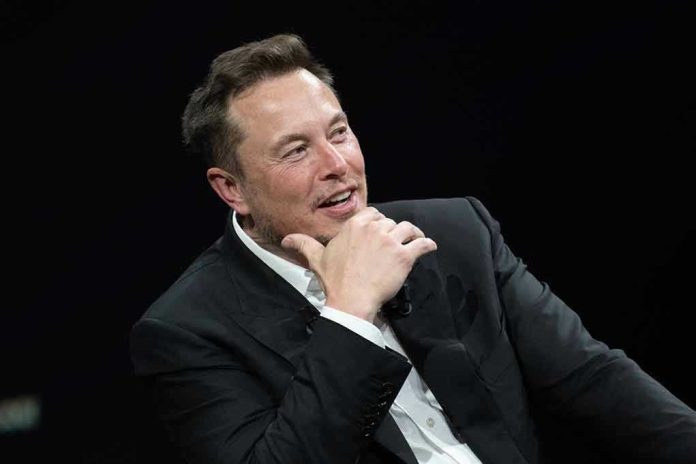
Elon Musk walking into a federal courthouse to challenge OpenAI’s for-profit pivot is forcing a blunt question many Americans already ask about powerful institutions: who are they really serving?
Story Snapshot
- Elon Musk appeared in person at the federal courthouse in Oakland, California, as his lawsuit against OpenAI moved into opening proceedings.
- The case centers on whether OpenAI’s shift toward a for-profit structure violated its original nonprofit mission and founding commitments.
- Video coverage captured Musk’s arrival, signaling the dispute has shifted from internet sparring and filings to a courtroom test with real consequences.
- The trial is being closely watched because it could shape how AI companies are governed, funded, and held to their stated public-interest promises.
Musk’s Court Appearance Signals the Fight Has Entered a New Phase
Elon Musk arrived Tuesday, April 28, 2026, at the U.S. District Court in Oakland as the legal fight he launched against OpenAI moved into in-court proceedings. The visuals matter because CEOs and founders often let lawyers do the talking; showing up personally telegraphs how high the stakes are. Coverage of the arrival also underscores that this case is no longer theoretical—arguments in front of a judge are now driving the timeline.
The dispute focuses on OpenAI’s restructuring and the allegation that it drifted away from the nonprofit mission it advertised when it launched. Musk, who co-founded OpenAI in 2015 and later departed, is pressing claims that the organization’s current direction conflicts with founding promises. OpenAI, for its part, has argued that restructuring is necessary to scale advanced AI systems—an argument common across the industry as compute, talent, and infrastructure costs surge.
What the Lawsuit Is Really About: Mission, Money, and Control
OpenAI began as a nonprofit aimed at developing advanced AI safely and for broad benefit, but the company later embraced a more commercial structure to attract capital and compete. That evolution is at the heart of the lawsuit: whether a mission-driven organization can change its operating model without violating obligations to its founding purpose. The trial puts a spotlight on the tension between public-interest branding and private-sector incentives once valuations and market dominance come into play.
That tension resonates beyond Silicon Valley because it echoes a broader frustration shared by voters across the political spectrum: institutions make promises, then re-interpret them when power and money are at stake. Conservatives often read this pattern as elite impunity—rules for ordinary citizens and different rules for influential networks. Many liberals frame it as corporate capture. Either way, the courtroom becomes one of the few places where competing narratives face evidence standards and cross-examination.
Why This Matters in 2026: AI Power Without Clear Accountability
This trial lands at a moment when Washington still struggles to define workable guardrails for AI, even as the technology increasingly touches jobs, education, media, and national security. With Republicans controlling Congress and the White House under President Trump’s second term, the politics around AI regulation have emphasized competitiveness and U.S. leadership while warning against bureaucratic overreach. The Musk-OpenAI dispute, however, highlights a separate issue: governance inside the companies building the tools.
AI systems are shaped less by slogans than by who pays, who controls the boardroom, and what the organization is legally obligated to do. If a company can advertise public-benefit goals and later prioritize investor returns without meaningful accountability, public trust will continue to erode. If courts set clearer expectations for mission commitments, it could encourage transparency and discourage bait-and-switch branding. The reporting available so far is heavy on courtroom moments and light on detailed filings, limiting firm conclusions.
What to Watch Next: Injunction Risks and Industry-Wide Precedent
The near-term risk for OpenAI is legal uncertainty that could affect operations, partnerships, or strategic decisions if the court signals skepticism about the restructuring. The near-term risk for Musk is that proving “mission drift” in a way that meets legal standards can be difficult, especially when tech organizations evolve rapidly and governance structures are complex. Observers should watch for how the judge frames the core questions: contracts and commitments, corporate structure, and what remedies—if any—are realistic.
Regardless of outcome, the case will be studied by other mission-driven or nonprofit-adjacent tech ventures considering profit pivots. It will also fuel a wider debate that neither party has fully resolved: whether critical technologies can be entrusted to institutions that answer primarily to investors, donors, or insiders, rather than the public. For Americans tired of elite promises that dissolve when convenient, the basic demand is simple—clear commitments, enforceable rules, and consequences when they’re ignored.
Limited public detail in the provided coverage means key legal arguments, exhibits, and testimony will determine whether this becomes a narrow founder dispute or a meaningful precedent on AI governance. For now, the clearest confirmed fact is the procedural shift: Musk is at court, the trial is underway, and the question of who controls the mission of a powerful AI platform is being tested in public.
Sources:
https://www.foxbusiness.com/video/6394103268112