
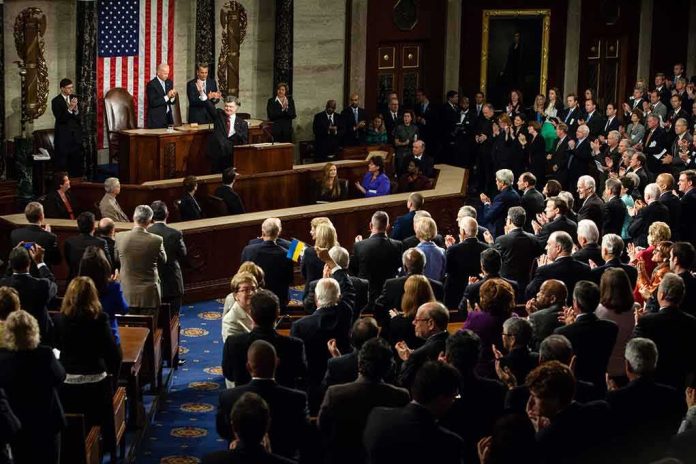
In a rare break with party leadership, the House ordered President Trump to pull U.S. forces from hostilities with Iran in a close vote that exposed deep strains over war powers and accountability.
Story Snapshot
- The House passed a war powers resolution directing a U.S. withdrawal from hostilities with Iran.
- The vote was narrow, with a small group of Republicans joining Democrats in support.
- The measure cites the War Powers Resolution to require congressional approval for further action.
- The move highlights a long fight between Congress and presidents over who decides war and peace.
House Orders End to Hostilities with Iran
On Wednesday, the U.S. House of Representatives approved a war powers resolution directing President Trump to remove United States Armed Forces from hostilities with Iran. The clerk’s roll call shows the measure passed 215 to 208 after a tense floor debate. The resolution invokes section 5(c) of the War Powers Resolution and asserts that Congress has not authorized the conflict. The vote is the latest effort by lawmakers to reclaim their constitutional role over decisions of war and peace.
News outlets that tracked the vote reported a tight margin and noted a handful of Republicans crossed the aisle. Coverage emphasized that the House action signals growing concern in both parties about open-ended military action without a clear authorization from Congress. Supporters say the move aims to force a strategy debate, not to hinder defense against an imminent attack. Opponents warn it could tie the President’s hands during fast-moving threats from Iran’s forces and proxies.
What the Resolution Says and What It Can Do
Congressional text states that Congress “directs the President to remove” U.S. forces from hostilities against the Islamic Republic of Iran. The measure requires any further sustained military action to have explicit congressional approval. The House used a concurrent resolution vehicle under the War Powers framework. That tool reflects Congress’s institutional position, but its legal punch has been debated since a key Supreme Court case involving legislative vetoes raised enforcement questions decades ago.
Legal and policy analysts note that war powers fights often serve as political guardrails more than courtroom battles. Presidents of both parties have argued they can conduct short or limited operations to address immediate threats. Lawmakers counter that the Constitution gives Congress the power to declare war and to set the terms for ongoing hostilities. This resolution leans on that view and applies pressure for a formal authorization, or for a wind-down if no authorization is granted.
Why This Matters Across the Political Spectrum
Americans who worry about forever wars see the vote as a check on mission creep and hidden costs. Families paying higher prices and taxes question why Washington can move fast on war, yet slow on fixing border security, health care bills, and housing. Voters on the right and left also doubt whether the permanent government listens. By forcing debate and votes, Congress at least puts names to choices and makes leaders own the risks and trade-offs of continued fighting.
BREAKING: House passes War Powers resolution directing the president to remove U.S. forces from hostilities with Iran.
Vote: 220-204. Seven Republicans joined all Democrats.GOP yes votes: Massie, Davidson, Fitzpatrick, Barrett, Mace, Miller-Meeks, and Nunn. pic.twitter.com/7FC3CbBSkv
— ☮️ Arizona Desert Dweller (@MzzzRMF) September 16, 2026
For the White House and the Pentagon, the resolution adds pressure but does not end the conflict on its own. The administration can argue it retains authority to respond to imminent threats and protect U.S. forces. The practical impact may hinge on next steps: whether Senate leaders take up the measure, whether the administration reports a change in operations, and whether Congress moves toward a clear authorization or funding limits to enforce its will.
Sources:
thegatewaypundit.com, apnews.com, npr.org, govinfo.gov, congress.gov, nytimes.com