
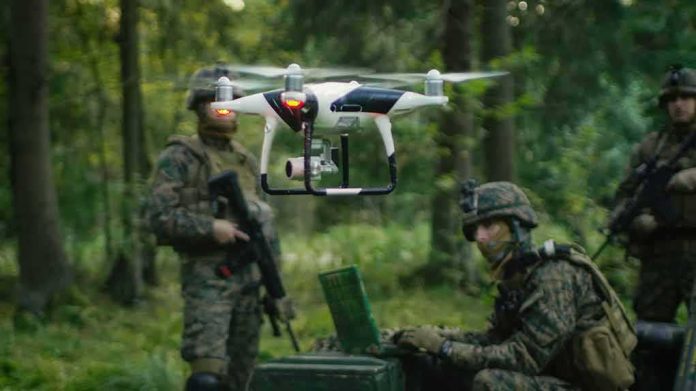
A wounded Ukrainian soldier waited two days for help until a heavy-lift drone flew him out under fire.
Story Snapshot
- Ukrainian troops executed a first-of-its-kind battlefield evacuation by heavy drone, saving a wounded infantryman.
- Landmines and hostile drones blocked ground rescue, forcing an unmanned airlift solution.
- Video shows the soldier strapped to a large hexacopter and flown to safety.
- This rescue reflects a wider shift in war medicine as drones reshape evacuation routes and timing.
A first on the front line: a human airlifted by unmanned aircraft
Ukraine’s 92nd Separate Assault Brigade shared video that shows a wounded soldier attached to a heavy hexacopter and lifted off the battlefield. The clip then shows the soldier lowered at a safer location. The brigade credited a Ukrainian-built system for the lift and called it the first battlefield air evacuation by an unmanned aircraft. The unit released the footage on October 20, drawing global attention to a rare use of drone power to save a life.
Reports describe why rescuers chose this path. The soldier lay in a zone seeded with mines. Enemy first-person-view drones hunted movement and attacked medics. Any truck or armored vehicle would have drawn fire within minutes. Commanders judged a manned helicopter too risky and too loud for a short hop. A heavy-lift drone, shielded by friendly scouts and jammers, could rise fast, fly low, and avoid the ground kill zones that had trapped the casualty.
The rescue sequence: strap, lift, guard, and drop
Footage and unit statements outline a tight sequence. Small scout drones first mapped the path and watched for threats. Electronic warfare teams dampened hostile signals for a short window. Ground troops helped the casualty strap into a harness fixed to the drone’s frame. The hexacopter then rose with controlled thrust, cleared obstacles, and moved at a steady speed toward a rally point. Escorts in the air and spotters on the ground guarded the flight until the aircraft lowered the soldier to medics.
Specialized reporting describes companion efforts elsewhere along the front. Another elite unit said it fielded a dedicated rescue platform built for casualty transport. Designers focused on low acoustic signature, high lift, and simple rigging that a weak or injured person could manage under stress. Operators emphasized that this is not for routine use. It is a lifeline when roads are cut, skies are hostile, and time is bleeding away on the ground.
Why drones now save lives where trucks and helicopters cannot
Modern battlefields are saturated with eyes in the sky and cheap guided bombs. Medical evacuation now faces instant detection and fast strikes. Analysts tracking recent wars report that the safe window for moving the wounded has shrunk. Many patients now reach higher care later than the old timelines allowed. Units push stabilization forward and hold casualties longer before they move them, because classic evacuation routes draw fire too fast to survive.
Peer-reviewed studies and professional briefs describe the same trend. Drone swarms, networked sensors, and long-range fires make routes predictable and deadly. Casualty movement stages have shifted farther from the fighting, stretching the clock for bleeding control and pain care. Unmanned systems offer one answer: they can brave risk without putting another human in harm’s way and can exploit small gaps in time and space for short, precise lifts when every minute counts.
What this means for battlefield medicine and American common sense
This rescue showcases a simple truth: when the enemy watches every road, agility beats bulk. The drone did not replace medics or surgeons. It created a narrow bridge across a killing field that no truck could cross in time. That approach aligns with conservative common sense: save lives with practical tools, spend less blood to solve hard problems, and let technology carry risk so people do not have to.
In what military commanders describe as the world’s first combat casualty evacuation by aerial drone, Ukrainian infantryman Kostiantyn Vlasenko was flown to safety after a harrowing 491-day ordeal.
Seriously wounded in a Russian drone strike and trapped under a destroyed… pic.twitter.com/WqlAWYwNGI
— The Daily Jagran (@TheDailyJagran) October 24, 2026
Leaders and planners should read the signal. Ground and air corridors will stay contested. Forces that invest in quiet lift, smart escorts, and fast rigging will pull more people home alive. Training should include drone-enabled casualty movement and electronic cover. Logistics should stock modular harness kits and batteries at the edge. Medics should drill short-hop transfers the same way they drill tourniquets. The next life saved may depend on a machine that can fly when nothing else can.
Sources:
military.com, aerotime.aero, apnews.com, today.com, militarytimes.com, academic.oup.com