When gunfire erupts in a crowded retail space, facts that matter most crystallize quickly: where, when, how many victims, and whether a threat remains. In Fairfield, California, police established those fundamentals within hours — seven people were shot inside the Spirit Halloween store at Solano Town Center around 8:30 p.m.; one person died, six were hospitalized, at least three in critical condition; and investigators launched an active search to identify the perpetrator or perpetrators.
The Short Version
- Fairfield police found seven gunshot victims at a Spirit Halloween store; one died, six were hospitalized, with at least three in critical condition.
- The shooting occurred around 8:30 p.m. at Solano Town Center; detectives reviewed mall surveillance and interviewed witnesses.
- No suspect was immediately identified; police urged the public to share tips and video while emphasizing no ongoing, immediate threat to the broader community.
- Early reports focused on the store setting and victim count — the verified parts of the story while motive and suspect details remained open.
What Happened: The Verified Core
Police responding to Solano Town Center in Fairfield at roughly 8:30 p.m. encountered a chaotic retail crime scene: seven people suffering gunshot wounds in and around the Spirit Halloween store. Fairfield Police Chief Dan Marshall said one victim died and six were taken to hospitals; at least three of the injured were in critical condition. Officers secured the area, canvassed for witnesses, and began collecting physical evidence while detectives pulled surveillance video from the mall’s camera system to reconstruct movements before and after the shooting.
In the first overnight briefing, Marshall emphasized two points. First, investigators had not identified a suspect or even confirmed whether there was a single shooter or more than one. Second, the department was already analyzing video and interviewing witnesses, and it requested community submissions — phone captures, dash cams, anything that might clarify the sequence of events. That is the standard immediate posture in public-place shootings: freeze the scene, triage the wounded, lock down reliable chronology, and then widen the perimeter of information gathering, usually through surveillance pulls and public appeals.
Location, Timeline, and Scene Control
Multiple outlets converged on the same police-sourced facts: the event centered on the Spirit Halloween store inside Solano Town Center, around closing time for most of the mall but within extended hours for the seasonal shop. That timing matters. Extended-hours retailers create islands of foot traffic after the main concourses empty, which concentrates potential victims and potential witnesses in a smaller footprint; in practical terms, that can both complicate escape routes and, paradoxically, simplify the camera geometry for investigators because more activity funnels through fewer entry points.
Within hours, Fairfield police declared the crime scene active but conveyed that there was no ongoing, immediate threat citywide — a crucial distinction for residents deciding whether to shelter in place. The active-scene designation signals that detectives are still working the interior and exterior perimeter for shell casings, impact marks, and trajectory evidence, as well as matching witness statements to video time stamps. For mall incidents, the surveillance stream is often decisive: retail corridors, vestibules, and anchor-store entries typically provide multiple angles on entrances and exits, even if audio is absent.
Victims and Medical Status
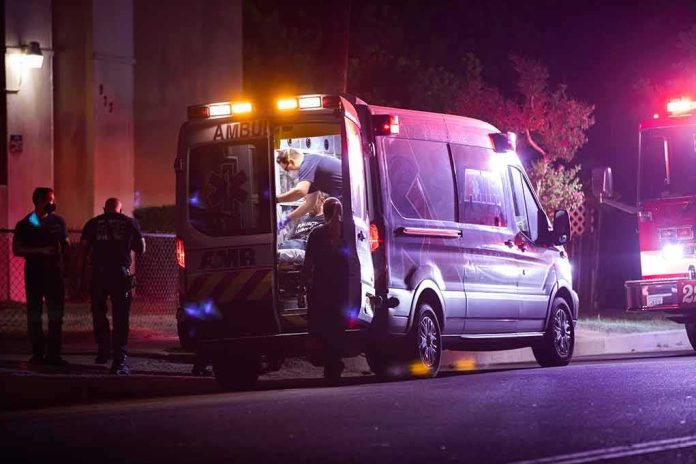
Initial casualty data in public shootings usually arrives from the on-scene command post and is carried forward by hospital liaisons. Here, the number settled quickly at seven gunshot victims, one deceased at the scene or shortly after, and six transported, with at least three in critical condition, according to Chief Marshall. Those are consequential figures that warranted cautious precision; they also explain why police tended to focus their early public messaging on verified counts, not speculation about motive or offender identity.
This is also where responsible reporting resists the pressure to over-interpret. Early medical statuses evolve. Trauma teams stabilize, operate, and reassess; survival curves can change within 24 to 72 hours. That is why police stuck to a narrow description — numbers, transport, and the critical-condition subset — rather than layering on inferences about the lethality of specific weapons or the intent signal in shot patterns. Those judgments, when they can be made at all, come later with ballistics and autopsy results.
The Investigation’s Early Priorities
With no suspect named in the immediate aftermath, investigators pursued the standard triad: video, witnesses, and physical evidence. Video establishes entry and egress, potential handoffs, vehicle associations, and whether the shooting appears targeted or opportunistic. Witnesses fill gaps: who argued with whom, who lingered, who appeared to signal. Physical evidence — casings, bullet impacts, gunshot residue transfer — can corroborate or contradict both video and testimony, and it anchors any later charges to specific acts and locations inside the store and adjacent corridors.
Police also noted they were checking social media chatter — a necessary but fraught domain. Initial posts can be invaluable for locating peripheral witnesses or unshared phone video; they can also propagate inaccuracies at speed. Fairfield’s clarifying updates, including the repeated confirmation of seven total gunshot victims, were designed to keep the public grounded in what the department could stand behind, while encouraging people with direct evidence to come forward.
How Coverage Finds Its Focus — And Why This Incident Drew It
Events at malls and other public, commercial spaces skew heavily in newsworthiness, especially when there are multiple victims. The academic literature is consistent on this point: shootings with higher victim counts, in salient public venues, attract disproportionate coverage relative to everyday gun violence. One scoping review of 76 studies found that multi-victim incidents and prominent civic or commercial locations are reliable predictors of heavier media attention. An earlier analysis of 90 shootings likewise showed that location and victim count drove placement and persistence of coverage.
That pattern explains both the rapid national pickup of Fairfield’s police briefings and the editorial emphasis on the Spirit Halloween setting. A seasonal retail brand inside a mall on the cusp of a holiday is, from a newsroom’s perspective, a magnet for audience attention; the risk is not that the core facts are wrong — the casualty count and setting were firm — but that the setting becomes a narrative character of its own, overshadowing the unresolved fundamentals around suspect identity or motive. Good coverage keeps the center of gravity where the facts are most solid, as Fairfield’s briefings encouraged.
BREAKING: A deadly shooting erupts inside a Spirit Halloween store at a California shopping mall on the eve of Halloween, leaving one person dead and six others wounded.
Police say officers rushed to the Solano Town Center mall in Fairfield around 8:30 p.m. Friday after reports… pic.twitter.com/CwTlcYsllo
— Dark Leaks (@DarkLeaksQ) November 1, 2026
Where the Facts Stop — For Now
Some questions simply take time. As of the initial briefings, police had not identified a suspect, confirmed whether there was more than one shooter, or explained the motive. They had not publicly mapped whether all gunfire occurred within the store’s footprint or spilled into adjacent corridors. Those are proper investigative holds, not gaps to fill with guesswork. What matters for the community is what police said they did know: seven people were shot, one died, six were hospitalized; at least three were in critical condition; the scene was secured; and the search to identify the responsible party or parties was active and ongoing.
What Comes Next
Expect the next substantive checkpoint to come from evidence-derived milestones: a suspect identification via video and witness triangulation, a public request for a specific person of interest, or an arrest based on probable cause. If charges follow, filings will crystallize the state’s theory of the case — number of shooters, alleged intent, whether the act was targeted or indiscriminate — and introduce ballistics linkages and any recovered firearm. Parallel to that, the coroner’s findings on the deceased and hospital updates on the injured will fix the casualty toll with greater finality. Until then, the verified backbone stands: the what, where, and how many are established; the who and why are work in progress, guided by the surveillance maps and statements already in investigators’ hands.
Sources:
thegatewaypundit.com, abcnews.com, weartv.com, newschannel10.com, nbclosangeles.com, wdam.com, channelstv.com, courtlistener.com, ideas.repec.org