
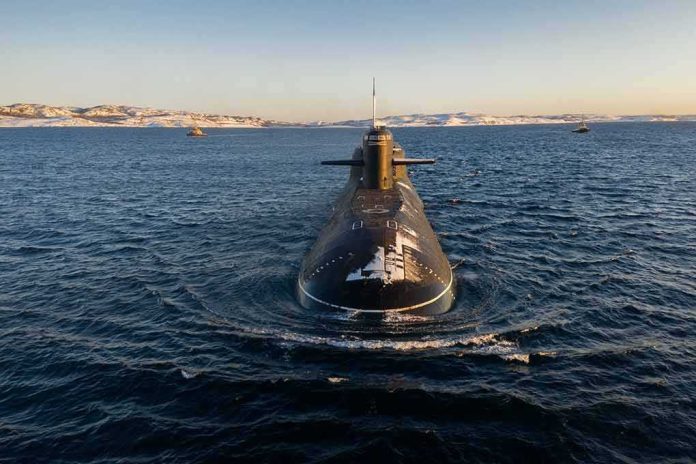
The Komsomolets is not a mystery wreck debated from a distance — it is a measured, documented, and still-active radiation source on the floor of the Norwegian Sea, and the real story is not whether it leaks but how much that leak actually matters.
Key Points
- A Soviet nuclear attack submarine sank in 1989 at roughly 1,680 meters (about 5,500 feet), carrying a live reactor and two plutonium-warhead torpedoes that were never recovered.
- Direct sampling in 2019 found cesium-137 in a ventilation pipe at concentrations roughly 800,000 times normal Norwegian Sea background, confirming decades-old suspicions of reactor leakage.
- Norwegian authorities who took the samples simultaneously concluded the releases pose no risk to people, fish, or the broader marine environment because of extreme dilution at depth.
- No study, Russian or Norwegian, has found evidence that the plutonium warheads themselves are leaking; the confirmed contamination traces to the reactor, not the torpedoes.
- The deeper uncertainty isn’t whether cesium is escaping — it is whether decades of corrosion will eventually change that calculus for the warheads.
A Titanium Hull, a Fire, and a Sinking That Outran the Cold War’s Secrecy
K-278 Komsomolets was the sole completed vessel of Project 685 Plavnik, a NATO-designated “Mike” class submarine built with a titanium pressure hull that let it dive deeper than any operational submarine before or since — past 1,000 meters in trials, a depth that made most Western anti-submarine weapons useless against it. On April 7, 1989, a short circuit in the seventh compartment ignited hydraulic oil, and a ruptured high-pressure air line fed the fire until it overwhelmed the boat’s systems. The crew scrammed the reactor and blew ballast to surface, but the stern seals failed. Komsomolets sank stern-first roughly 180 kilometers southwest of Bear Island, coming to rest at a depth near 1,680 meters — close to 5,500 feet. Of 69 men aboard, 42 died, most from hypothermia awaiting rescue in the Barents and Norwegian Sea’s frigid water.
What makes the wreck more than a tragic footnote is its cargo: a single OK-650 pressurized-water reactor loaded with highly enriched uranium, and two torpedoes fitted with plutonium warheads, still sitting in the forward compartment. Soviet and later Russian expeditions through the early 1990s used the deep-submergence vehicles Mir 1 and Mir 2 to inspect and partially seal the hull, applying rubberized blankets and a gelatinous sealant to the bow torpedo tubes intended to hold for twenty to thirty years. That patch job, not a permanent fix, is still the only barrier between the warheads and the open ocean.
What the 2019 Expedition Actually Found — And Didn’t
In July 2019, a joint Norwegian-Russian research cruise aboard the vessel G.O. Sars sampled water directly from a ventilation pipe on the wreck, the same duct where Russian scientists had already documented releases in the 1990s and again in 2007. Onboard analysis measured cesium-137 activity ranging from below 8 Bq/L to as high as 857 Bq/L in that pipe — against an ordinary Norwegian Sea background of roughly 0.001 Bq/L, a ratio on the order of 800,000 to one. The Institute of Marine Research’s own report stated plainly that this indicates releases from the reactor are still occurring, three decades after the sinking. That finding resolved a long-running question: this was not a one-time anomaly from the early 1990s but a persistent, if variable, seep.
What the expedition did not find is just as important to the full picture. Other samples taken from the same pipe, and from the surrounding water column, showed much lower or undetectable levels, and researchers attributed that to rapid dilution at nearly 1,700 meters of depth. The Norwegian Radiation and Nuclear Safety Authority stated outright that the releases pose no risk to people or the marine environment, and the expedition’s own scientists said the results would have no impact on Norwegian seafood. A follow-up analysis cited by the Barents Observer went further, reporting no evidence of weapons-grade plutonium in sediment or seawater near the wreck and crediting the aging titanium patches with still functioning as intended. The laboratory work proposed to check for strontium-90 and plutonium isotopes was never reported with a confirmed positive result in the public record — a gap, not a finding of harm.
The Designer’s Case: Why Russia Has Never Treated This as a Crisis
The strongest counter-voice in this story is not a skeptic but the man who built the submarine. Igor Spassky of the Rubin Design Bureau, which designed Komsomolets, told interviewers in the early 1990s that the situation was “not catastrophic,” arguing that the near-freezing water at the wreck site — about minus 1 degree Celsius — would slow corrosion of the warheads considerably, potentially for decades beyond initial estimates. He also described the physical layout of the hull: seawater had entered the reactor’s primary loop, but for radioactive particles to reach the ventilation trunk in the submarine’s sail, they would have to pass through an internal labyrinth of compartments, limiting how fast and how far contamination could travel. A contemporaneous CIA assessment echoed that framing, describing radiation leakage as minimal while acknowledging corrosion could increase it over time, and judging plutonium leakage neither immediately evident nor likely to spread far if it occurred.
Monitoring Natural Attenuation Is a Policy, Not an Accident
Every proposal to raise Komsomolets — and there have been several since the 1990s — has been rejected by Russia, which controls the wreck as both sovereign military property and a designated war grave. The practical argument against recovery is not sentimental: lifting an imploded, corroded titanium hull from 1,680 meters carries real risk of catastrophic structural failure mid-salvage, which could release in days what three decades of slow seepage has not. That risk calculus, more than secrecy, explains why the current approach on both sides is continued monitoring rather than intervention. Cooperative Norwegian-Russian sampling, which had produced the clearest data available, reportedly lapsed after 2022 amid broader diplomatic deterioration — meaning the best public evidence on the wreck’s condition may now be several years old at any given point, a gap worth tracking rather than ignoring.
What the Evidence Actually Supports
The honest synthesis is narrower than either the alarmed headlines or the reassurances suggest. A confirmed, reactor-sourced cesium leak is real, measured, and decades-old; it is not a present-day threat to fisheries or public health at any scale yet documented, because dilution at depth is doing exactly what Norwegian scientists say it does. The torpedo warheads remain the open question — not because anyone has found plutonium escaping, but because no one has proven the patches will outlast the corrosion clock Spassky himself flagged in 1994. That is the kind of risk that rewards patient, instrumented monitoring over dramatic claims in either direction, and it is why serious researchers keep going back to the same ventilation pipe, three decades on.
Sources:
19fortyfive.com, dsa.no, themoscowtimes.com, bbc.com, rferl.org, usni.org, thebarentsobserver.com, cia.gov