
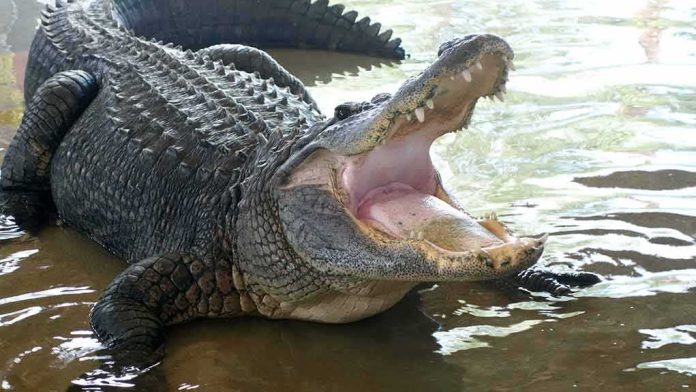
When a 14-foot, 844‑pound American alligator nicknamed Snaggletooth was hauled from South Carolina’s Lake Moultrie, it wasn’t merely a spectacle; it was a case study in how modern wildlife management, local hunting culture, and the mechanics of measurement converge to turn one animal into a benchmark.
At a Glance
- Snaggletooth, an 844‑pound alligator taken from Lake Moultrie, ranks as South Carolina’s second‑largest confirmed alligator harvest by widely cited accounts.
- The capture ended a multi‑year pursuit by Renegade Bowfishing guide Cole Poplin and his team, who secured the animal around 11 p.m. on September 28.
- South Carolina’s system relies on hunter-reported measurements within a defined harvest framework; “record” status stems from those reports and strong local documentation.
- Big‑gator stories sit inside an established management program: a limited seasonal hunt that has expanded since the 1990s and now sees hundreds of legal harvests annually.
What Happened: A Rare Giant, Finally Brought to Boat
The essential facts are clear. In late September, a guided party on Lake Moultrie — about 50 miles north of Charleston — captured a massive American alligator widely reported at 14 feet in length and 844 pounds in weight. The hunt culminated around 11 p.m. on September 28 and closed a years‑long effort by guide Cole Poplin and his collaborators at Renegade Bowfishing, who had tracked the animal — recognizable enough to earn the nickname Snaggletooth — across seasons on one of the state’s great Lowcountry reservoirs. National outlets and regional reporting align on the particulars: length near 14 feet, an 844‑pound scale reading, and the catch’s ranking as South Carolina’s second‑largest confirmed alligator harvest.
Poplin and his team have described a protracted chase punctuated by few clean sightings, the kind of long‑arc pursuit that serious alligator guides accept as the price of finding truly outsized animals in expansive water. Lake Moultrie’s size and habitat complexity reward persistence; territorial gators can be predictably present yet maddeningly elusive. Ultimately, the team closed the distance and landed what multiple reports now treat as a near‑record South Carolina specimen.
How South Carolina’s Alligator Harvest System Frames “Second‑Largest”
South Carolina’s public alligator season is a modern program with clear rules, forms, and measurement language that collectively lend structure to claims about size and rank. The Department of Natural Resources (SCDNR) defines total length as tip‑of‑snout to tail end, trains hunters through annual guides, and requires a harvest report that records carcass length in feet and inches as well as weight if actually measured on a scale — estimates are not to be submitted as weights. While South Carolina does not maintain a simple, public, ever‑updated “all‑time record book” for every dimension, the combination of formal harvest reporting and well‑sourced journalism creates a sturdy ledger for extraordinary catches. That is why a single capture can rapidly and credibly be situated as second‑largest: the measurement definitions are standardized, and the paper trail exists within a constrained, permitted season.
Against that background, Snaggletooth’s 844‑pound weight and near‑14‑foot length present a meaningful outlier compared with typical harvests. In a recent season, SCDNR reported 380 public‑season alligators taken at an average of 8.9 feet; the largest that year reached 13 feet, 6 inches. Even in a higher‑harvest year with 467 gators reported, the state’s data reinforce how rare truly giant animals are relative to the broader take. Placing Snaggletooth in that distribution makes the “second‑largest” framing intelligible: there are few verified peers at that weight class and length interval, and most public‑season alligators are several feet shorter.
Mechanics and Measurement: Why Numbers on Giants Demand Care
Seasoned guides know two things can be simultaneously true: measurement protocols are well defined, and giant animals are difficult to measure with laboratory neatness in the field. Total length should be taken on a straightened carcass, nose to tail; weight requires a scale reading. Handling an 800‑plus‑pound reptile complicates both. Transport, cooling, and carcass curvature can change the tape result by inches; the difference between “14 feet” and “13 feet, 8 inches” is dramatic in headlines but mechanically plausible as the carcass is repositioned and re‑measured over hours. The state’s own documents anticipate the need for clarity: weight must be an actual scale value, not a guess; length is a nose‑to‑tail standard that allows direct comparison across seasons.
This is why credible stories about giant alligators often hinge on the quality of documentation and the reporting chain rather than on mystery or myth. In Snaggletooth’s case, contemporaneous accounts are consistent about the weight and about ranking; where narratives vary by inches, they reflect the on‑the‑ground reality of moving and measuring a half‑ton reptile under time pressure and within the constraints of boats, ramps, and coolers.
How We Got Here: A Program Built Over Decades
South Carolina’s alligator management is not an ad hoc trophy chase; it is the product of decades of regulated harvest designed to balance human safety, ecological function, and recreational opportunity. After a long dormancy, limited modern seasons began in the 1990s, expanding cautiously as the state aligned biology, public access, and enforcement. Today’s framework sets minimum legal lengths, uses a tag‑based permit system, and publishes season summaries that let the public see trends: how many alligators were taken, average sizes, and regional variation by management unit. Those summaries show that harvesting a 13‑plus‑foot animal is noteworthy in any given year. Landing an animal pushing 14 feet and measured in the mid‑800‑pound range is rarer still, which is precisely why Snaggletooth vaulted into the upper tier of state lore.
The middle‑coastal and Lowcountry waters — Lake Moultrie among them — have the habitat and forage base to produce occasional giants. But system‑level data tell the honest story: the vast majority of legal, reported alligators are under 10 feet, and the program’s health is not indexed to record‑chasing but to steady, transparent harvests within clear biological and legal guardrails.
What Size Means in the Field — and Why It Captures Us
To people who work these waters, scale is more than a number. A giant alligator changes the risk calculus at the boat, taxes the winch, and dictates a choreography for landing and transport that simply does not apply to a nine‑footer. Guides speak about these animals with the reverence reserved for apex veterans: territorial, sparse in sightings, and stubbornly uncooperative with human plans. That aura is part biology, part craft — and part story. The chase across seasons, the handful of near misses, the late‑night closing act — all of it feeds the narrative power of a single successful capture. When the figure attached is 844 pounds, the story travels far beyond Berkeley County because it signals a specimen so unusual that even those outside the hunting world appreciate the scale.
But the meaning of such a catch also returns to the program that makes it legible. The state’s insistence on measured weights, standardized length definitions, and post‑season reporting does not kill the romance of the chase; it gives that romance a ledger. In doing so, it lets one animal — Snaggletooth — stand both as a personal culmination for a guide team and as a data point that enriches the public’s picture of South Carolina’s living dinosaurs.
The Takeaway
Snaggletooth’s capture is not just a viral big‑gator story; it is the outcome of a mature, rules‑driven harvest system producing a verifiable outlier. The hunt was real, the measurements are intelligible within the state’s standards, and the ranking as a near‑record South Carolina alligator is well supported by the reporting chain. If you care about the craft of wildlife pursuit, you see years of scouting finally rewarded. If you care about management, you see a program doing exactly what it is supposed to do: turn anecdotes into accountable facts — and, every so often, into history.
Sources:
youtube.com, usatoday.com, people.com, wjcl.com, postandcourier.com, thecooldown.com, internewscast.com, us.headtopics.com, dailymail.com, dnr.sc.gov