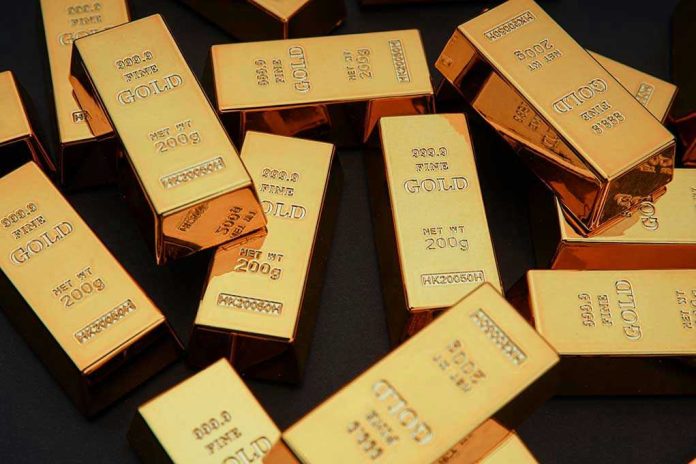
For the first time in decades, central banks worldwide now hold more of their reserves in gold than in U.S. Treasury securities — and a new European Central Bank report confirms it.
At a Glance
- Gold accounted for 27% of global central bank reserve assets at the end of 2025, surpassing U.S. Treasuries at 22%, according to a European Central Bank analysis.
- Central banks have been steadily accumulating gold bullion while prices near record highs pushed gold’s reserve share sharply higher — up from 20% just one year earlier.
- The ECB’s own data show the ranking is price-sensitive: using 2023 gold prices, U.S. Treasuries would still lead at 26% versus 16% for gold, meaning valuation effects are a major driver.
- The shift signals growing geopolitical distrust of dollar-denominated assets, but the U.S. dollar itself remains dominant in global payments, trade invoicing, and overall foreign exchange reserves.
What the ECB Data Actually Show
The European Central Bank (ECB) published an analysis in June 2026 showing gold had reached 27% of global official reserve assets at the end of 2025, compared to 22% for U.S. Treasury securities. [1] That marks a significant reversal from just a year earlier, when gold held a 20% share. [1] Multiple independent outlets — including Morningstar, Mining.com, and Statista — all reported the same end-of-year figures, reducing the likelihood of a simple data error. [2][3]
The ECB’s own publication frames the finding carefully. Gold achieved this ranking due to a combination of sustained central bank buying and gold prices near historic highs. [10] Critically, the ECB tested a valuation-adjusted scenario: if 2023 gold prices were applied instead of current market prices, U.S. Treasuries would still lead at 26% versus 16% for gold. [3] That distinction matters. Part of gold’s rise reflects price appreciation, not purely a deliberate policy decision by reserve managers to dump Treasuries.
Why Central Banks Are Buying Gold
Survey data cited in the ECB report indicate central banks hold gold primarily for portfolio diversification but increasingly for geopolitical risk hedging. [10] Countries concerned about potential U.S. sanctions — or simply wary of holding assets that Washington could freeze — have quietly shifted reserves toward bullion, which no government can confiscate remotely. China has been identified among the top buyers in this cycle. [12] That pattern accelerated after Russia’s dollar reserves were frozen following its 2022 invasion of Ukraine, a move that sent a clear warning to other governments.
The World Gold Council tracks reserve holdings by country, and the trend of accumulation has been broad-based across emerging market central banks for several years. [4] Turkey, India, Poland, and several Gulf states have all added significantly to gold reserves. The sustained buying, combined with gold prices remaining near record levels, created the conditions for the reserve-share crossover that the ECB’s June 2026 report documents.
What This Doesn’t Mean — and Why It Still Matters
The headline claim requires careful reading. Gold surpassing U.S. Treasuries in reserve share is not the same as gold replacing the U.S. dollar as the world’s dominant reserve currency. The dollar still dominates global trade invoicing, international payments, and the broader foreign exchange reserve pool. [3] The ECB’s own language describes gold as the second-largest global reserve asset — after the U.S. dollar as a currency — not the undisputed singular top asset in all categories. The comparison in the report is specifically between gold and U.S. Treasury securities as a debt instrument class.
Gold Overtakes US Treasuries on Central Bank Balance Sheets
Gold has overtaken the US Treasuries to become the largest reserve asset held by the world's central banks. According to the ECB's report (“The International Role of the Euro”), gold accounted for 27% of global… pic.twitter.com/GfKGwKa9Ox— Headway (@headway_world) June 3, 2026
Even with those qualifications, the shift carries real significance. The fact that central banks worldwide now collectively hold more in gold than in U.S. government bonds reflects eroding confidence in dollar-denominated sovereign debt as the default safe haven. For ordinary Americans already watching inflation eat into savings and seeing the federal government pile on trillions in new debt, this development is a signal worth paying attention to. When the world’s central banks quietly start hedging against U.S. Treasury securities, it raises legitimate questions about the long-term cost of Washington’s fiscal trajectory — questions that both frustrated conservatives and worried liberals have every reason to ask.
Sources:
[1] Web – European Central Bank: Gold Has Replaced US Treasuries as the World’s …
[2] Web – Gold overtakes US Treasuries in global reserve shift: ECB
[3] Web – Gold Has Overtaken the U.S. Dollar in Central Bank Reserves | Statista
[4] Web – How gold overtook U.S. Treasurys as number-one reserve asset
[10] YouTube – Gold Replaces U.S. Treasuries as Major Reserve Asset. Move Over …
[12] YouTube – Gold Overtakes US Government Bonds As Top Global Reserve Asset