When disorder erupts in public, the first question is safety; the second is what system will take custody of the crisis. A rare but telling incident in a West Yorkshire village shows how those two imperatives meet on the pavement—first with bystanders, then with armed police, and finally with the mental-health framework that now governs many such encounters.
At a Glance
- A 68-year-old man fired a bow and arrow at passing vehicles on Huddersfield Road in Skelmanthorpe; members of the public restrained him before armed police arrived.
- Police had earlier received reports of the same man driving dangerously and throwing items from his car; several vehicles were damaged, and no injuries were reported.
- The man was arrested on suspicion of possessing an offensive weapon in a public place; subsequent reporting indicates he was detained under mental health powers.
- The case illustrates how UK public-order incidents often move from immediate containment to assessment under the Mental Health Act, a pathway used tens of thousands of times annually.
What happened on Huddersfield Road
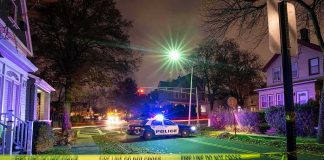
West Yorkshire Police received calls around 5:30 p.m. reporting a man behaving erratically on Huddersfield Road in Skelmanthorpe: witnesses described rubbish and household items being thrown from a moving car and dangerous driving. Shortly thereafter, the man exited the vehicle, produced a bow, and began firing arrows at passing traffic. Multiple vehicles sustained damage; remarkably, no injuries were recorded. Before officers reached the scene, members of the public intervened, tackled the archer, and restrained him. Armed police took custody and arrested the 68-year-old on suspicion of possessing an offensive weapon in a public place, opening an investigation into the sequence and motive of the attack.
This is not a matter of conflicting narratives. The essential chronology—erratic driving and littering from a car, escalation to discharging a bow in the street, community restraint, and arrest—comes directly from police and aligns with on-the-ground reporting. The immediate risk to life was obvious; arrows can penetrate vehicle glass and bodywork, particularly at close range, and drivers reacting to sudden impacts are vulnerable to secondary crashes. That none occurred here owes much to chance and the speed with which bystanders intervened.
Public restraint and the law of breach of the peace
Some readers will ask whether civilians should ever “pile in.” English common law has long recognized a limited right—indeed a duty—of any person to take reasonable steps to prevent or halt a breach of the peace, including detention where immediate violence is occurring or imminent. Courts have articulated that power narrowly, tethered to necessity and proportionality; the test is whether a reasonable person would apprehend imminent harm and whether the steps taken were no more than needed to avert it. In Skelmanthorpe, the facts satisfy that standard. A weapon was being used against passing traffic; the public’s intervention ceased the ongoing risk and yielded quickly to police control. That sequence is as close to the textbook as such messy events allow.
Police guidance mirrors the same logic in uniform. Officers are trained to end immediate threats swiftly, then transition to containment and care if there are indicators of mental ill health. The tactical goal is to stop the violence with the least intrusive means compatible with safety, then hand off to investigative and clinical pathways as appropriate. That is roughly what happened here.
From offense to health powers: how the pathway works
UK policing is increasingly configured for a dual mandate in such incidents: enforce criminal law where an offense is apparent and, in parallel, assess for mental disorder that may require compulsory care. Arrest on offense grounds addresses immediate public-safety and evidential needs—securing the weapon, protecting the scene, and enabling interview under caution. In many cases, after initial custody risk assessment and clinical screening, the legal basis for continued detention shifts onto mental-health law if criteria are met.
Local reporting following the arrest indicated that the Skelmanthorpe suspect was detained under mental-health powers. That is a familiar outcome nationally rather than an outlier: in the year ending March 2025, police used Section 136 of the Mental Health Act—authority to remove a person appearing mentally disordered and in need of immediate care to a place of safety—31,779 times in England and Wales. The statute is designed for precisely the kind of scenario where a person in public presents an acute risk to themselves or others and needs clinical assessment more than a charge sheet.
Why restraint decisions matter
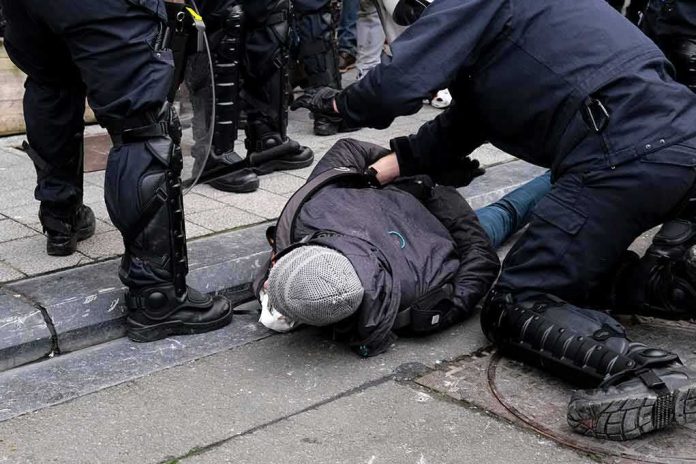
The most sensitive inflection point in these cases is restraint—who applies it, how long it lasts, and under what conditions. Oversight bodies and the College of Policing’s authorised professional practice state the rule plainly: avoid restraint on people with mental ill health or vulnerability unless absolutely necessary to prevent immediate harm, and when force is necessary, use the minimum effective level and treat the situation as a medical emergency. Prolonged or high-risk restraint is linked to adverse outcomes, particularly in people with acute behavioral disturbance; the safer approach, once the threat is contained, is rapid transition to clinical evaluation and safe containment rather than continued force.
The Skelmanthorpe sequence shows both sides of that ledger. Members of the public employed decisive physical intervention to end an ongoing weapons offense—there is no non-physical alternative to halting a bow mid-discharge. Police then assumed control, with armed officers present to manage any residual risk. The available reporting offers no suggestion of injuries in the restraint itself, consistent with the guidance’s aim: force to end the danger, then de-escalation and handoff to assessment.
Risk, rarity, and the temptation of spectacle
A man with a bow on a village high street is, by its nature, a spectacle; footage circulates quickly and commentary tends to reduce complex realities to slogans about crime or social breakdown. It helps to keep two truths in mind. First, even archaic-seeming weapons can be lethal in confined urban spaces; motor traffic multiplies the hazard by adding speed and inattention to the physics of projectiles. Second, pathways from apparent criminality to mental-health detention are not theatrical leniency; they reflect a statutory architecture built to triage risk, stabilize people in crisis, and prevent further harm—to the public and the individual alike.
None of that minimizes liability. Damage to vehicles and endangerment of the public are offenses with real victims. Mental-health detention and criminal charging are not mutually exclusive; prosecutors and clinicians operate in adjacent lanes, and the outcomes can be concurrent—treatment orders, conditional discharges, or prosecutions post-assessment all exist within the framework.
🇬🇧 Police have arrested a 68-year-old man after a bow and arrow was reportedly fired at passing vehicles in Skelmanthorpe
The man was restrained by members of the public before officers arrived and arrested him at 5.58pm. No-one was injured, although several vehicles were damaged pic.twitter.com/kbbcFQSOMV— DJ CandyMan (@DrCandymn) September 23, 2026
What responsible response looks like going forward
Three operational lessons recur across incidents like Skelmanthorpe’s. First, early calls from witnesses matter. The timeline here—dangerous driving, items thrown from a car, weapon drawn—unfolded in minutes. Prompt reporting allowed police to surge the right resources, including armed officers trained for public-space weapons calls. Second, community intervention is sometimes the only barrier between an escalating attack and a tragic outcome, but it must remain bounded by reasonableness: stop the harm, relinquish control to police immediately, and avoid unnecessary force beyond that purpose. Third, once the danger is neutralized, the mental-health pathway should be engaged quickly, with clinical assessment dictating the next steps and custody officers following established safeguards for vulnerable detainees.
Sources:
thegatewaypundit.com, westyorkshire.police.uk, bbc.com, yahoo.com, examinerlive.co.uk, thesun.co.uk, ground.news, hellorayo.co.uk