
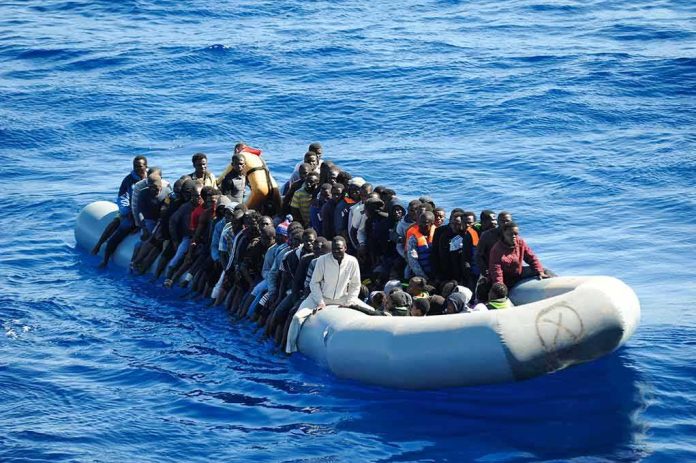
A record surge of Channel crossings has pushed 2026 arrivals past 10,000, raising fresh alarm over Britain’s borders and who is really in control.
Story Snapshot
- More than 10,000 people have crossed the English Channel in small boats already in 2026, including a single day with 710 arrivals.
- Since 2018, over 200,000 people have entered the United Kingdom by this illegal route, many later claiming asylum and tapping public services.
- Analysts estimate the small-boats crisis costs taxpayers billions of pounds while squeezing housing, schools, health care, and local communities.
- Despite new laws and deals with France, people‑smuggling gangs still move mostly young men across one of the world’s busiest sea lanes.
Record 2026 crossings show a system that still is not under control
Home Office figures show that on 15 June 2026, 710 people reached the United Kingdom in just 11 small boats, the highest one‑day total recorded this year and a stark sign the route remains wide open.[1] That spike came on top of a steady flow that had already brought 9,852 people across the Channel by mid‑June, putting the 2026 total above 10,000 shortly after.[1] Officials say this is about 40 percent below the same point in 2025, but it still means thousands more people who arrived outside normal rules.[1]
Since records began in 2018, more than 200,000 people have crossed the English Channel in small boats, roughly equal to the population of a medium‑sized British city.[2] This route has become the primary way people enter the country illegally, often using cheap inflatable dinghies pushed out by smugglers from the French coast.[4] Crossing without permission is a crime under United Kingdom law, and using unsafe or unregistered craft also breaks French law, yet the traffic keeps growing year after year.[2]
The real cost: taxpayers, local services, and rule of law
The small‑boats route is not just a headline issue; it is a major drain on public money. A report cited by Migration Watch United Kingdom said the small‑boats crisis costs “in the region of £3.5 billion” per year once hotel housing, processing, legal appeals, and related spending are counted.[4] The National Audit Office warned in 2025 that the asylum system alone was on track to cost more than £15 billion over ten years, much of that linked to Channel arrivals.[4] Those are funds that cannot go to defence, policing, or tax relief.
Behind those national numbers are real pressures on local communities. Many of those arriving by small boat go on to claim asylum, and in recent years small‑boat arrivals made up about 40 percent of all asylum applicants.[5] Most are adult men, with figures for 2025 showing about three‑quarters of arrivals were male and over 18.[5] Councils then must find housing, schooling, and health care in areas that already struggle with long waiting lists, rising rents, and stretched police forces. For many British families, it feels like they play by the rules while those who arrive illegally jump the queue.
Why numbers fell on paper but the threat has not gone away
Some analysts note that Channel arrivals in early 2026 were lower than the same period in 2025 and argue this shows the problem is being “managed.”[5] They point out that around 36,000 people arrived by small boat in the year ending 31 May 2026, about 13 percent fewer than the year before.[5] Weather clearly plays a role, with stretches of stormy conditions in winter and early spring that can pause crossings for days at a time.[8] When seas calm, however, smugglers quickly push out more boats and daily totals can jump into the hundreds again.[1]
This fight over how to frame the issue is common in migration debates. Those who want urgency highlight record single‑day spikes, huge lifetime totals, and the rising cost to taxpayers and services.[2] Those who prefer a softer line focus on short‑term dips or averages and talk about “management” instead of crisis.[3] Both can quote real numbers, but for many ordinary people watching boats land in Dover and beyond, the simple truth is clear: the route is still open, smugglers still in business, and Britain’s laws still not being enforced as written.
French cooperation, new laws, and what still needs to change
United Kingdom leaders have poured money into deals with France in an effort to stop boats before they leave the beach. One 2026 agreement worth around £662 million included drones, helicopters, cameras, and more riot‑trained police on French shores to target smugglers and launch sites.[1] The Home Office says joint work has stopped tens of thousands of crossing attempts in recent years and led to many arrests.[8] Yet cameras and patrols only matter if boats are actually intercepted and turned back, not waved through once they leave French sand.
'When will you stop these crossings?'
'We have brought numbers down… We're gradually ramping up the work we are doing.'
Prime Minister Keir Starmer discusses Labour's efforts to stop migrant boat crossings in the English Channel. pic.twitter.com/jbt9v3aelK
— GB News (@GBNEWS) June 17, 2026
On the legal side, Parliament passed the Border Security, Asylum and Immigration Act in late 2025 with the goal of deterring illegal crossings by making it harder to win long‑term status if someone arrives by small boat.[4] New asylum rules now limit direct pathways to permanent settlement for those who enter without permission and stretch out the time before they can stay for good.[3] There is also a pilot “one in, one out” return deal with France, but only a few hundred people had actually been sent back under that scheme by the end of 2025.[3] Until removals are swift and certain, smugglers will keep selling crossings and people will keep taking the risk.
Sources:
[1] Web – 10,000 migrants surge across English Channel in 2026 as UK sees RECORD …
[2] Web – More than 700 people cross Channel in small boats – BBC
[3] Web – English Channel illegal migrant crossings (2018–present) – Wikipedia
[4] YouTube – Nearly 1000 migrant small-boat arrivals in just 48 hours …
[5] Web – Channel Crossing Tracker | Migration Watch UK
[8] Web – Small boat arrivals: last 7 days – GOV.UK