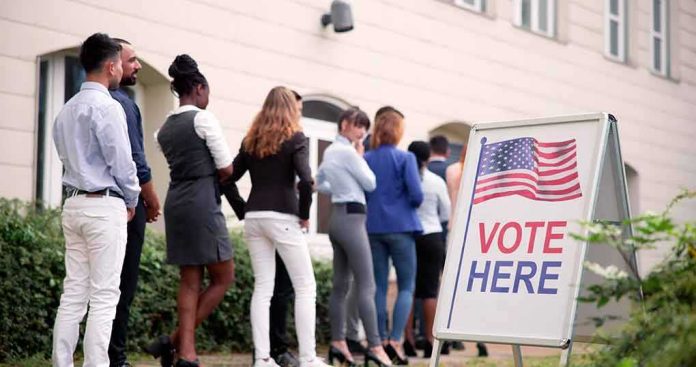
Republican National Committee Chair Joe Gruters warned that Republicans face a turnout problem as Democrats build a clear early-vote lead.
Story Highlights
- RNC Chair Joe Gruters said Republicans have a turnout problem and urged strong Election Day voting.
- Associated Press data showed Democrats ahead of Republicans in early ballots where party data is reported.
- Total early votes surged past 43 million nationwide, outpacing 2022 by millions.
- Experts caution early-vote party numbers track participation, not final support for candidates.
RNC Chair Flags Risk, Ties Warning To Mobilization
Republican National Committee Chair Joe Gruters said Republicans have a turnout problem and pressed supporters to vote, stressing that victory depends on participation. Gruters told NewsNation’s The Hill Sunday that Democrats tend to vote early, while Republicans often show up on Election Day. He added, “If our voters turn out, we win,” signaling urgency while projecting confidence that late participation can close gaps if Republicans cast ballots at scale.
Gruters’s comments followed days of media coverage about early voting. The reporting highlighted Democratic advantages in states that disclose party registration on returned ballots. His message aimed to prevent complacency and to focus volunteers on get-out-the-vote efforts. The chair did not release internal targets or state-by-state goals. He centered the appeal on a simple charge: show up and vote, and do not assume others will carry the load.
Early-Vote Data Shows Democratic Edge In Reported States
An Associated Press review reported that, five days before Election Day, about 6.8 million Democrats and 5.2 million Republicans had cast early ballots in states that publicly report party affiliation. The same analysis counted more than 43 million early votes nationwide and noted the total was nearly 10 million higher than at a similar point in 2022. The figures indicate a participation gap in early voting where party data exists, not a final outcome.
USA Today described similar patterns, citing preliminary shares that showed Democrats making up a larger slice of early voters than Republicans across the available data. The paper framed the concern inside a familiar rhythm of American elections. Democrats often lead early voting, while Republicans lean toward Election Day turnout. The question is whether late Republican voters will match or beat the early pace. That is the strategic risk Gruters spotlighted with his warning.
What The Numbers Mean—And Do Not Mean
Election analysts and state data managers stress that early-vote party labels track participation, not candidate choice. A registered Democrat can split a ticket. A registered Republican can do the same. The Associated Press noted that the affiliation gap should be read as a timing and mobilization signal, not as a count of votes for any candidate or party slate. That guardrail helps readers weigh chatter about “leads” without mistaking them for final tallies.
The reach of the data also varies by state law and reporting practice. Some states share party labels on returned ballots; others do not. That means national summaries depend on partial files and should be paired with on-the-ground organizing. Gruters’s emphasis on turning out core voters matches that reality. The path is clear: identify supporters, remind them of voting hours and locations, and build redundancy so weather or lines do not suppress Election Day participation.
How Republicans Can Close The Gap
Republican campaigns can use simple steps to convert enthusiasm into ballots. Field teams can confirm polling places, offer legal ride-to-poll options, and run targeted reminders by text and phone. Church networks, veterans’ groups, and small-business owners can share voting information in their communities. Clear messages about border security, crime, energy, and the cost of living can motivate late deciders to vote. Gruters’s point is practical: turnout wins close races when supporters act, not when they assume.
Bottom Line For Voters
The early-vote scoreboard shows Democrats ahead where party data is public, while total early turnout has surged past recent cycles. Those facts support Gruters’s warning and his call to action. Early numbers do not decide the result; ballots do. Conservatives who want secure borders, affordable energy, safer streets, and a government that respects the Constitution must vote. President Trump’s agenda advances when Republicans show up. The window to close the gap is Election Day.
Sources:
yahoo.com, dailykos.com, thehill.com