A Chicago-area businessman ran a scheme so brazen he charged people thousands of dollars to be “robbed” at gunpoint, all so they could use the staged crime to apply for a visa meant for real crime victims.
Story Snapshot
- Parth Nayi pleaded guilty to conspiracy to commit visa fraud and was sentenced to two years in federal prison plus a $50,000 fine.
- Prosecutors say participants paid Nayi between $5,000 and $30,000 each to take part in staged armed robberies.
- The indictment names six defendants and describes fake robberies at restaurants, coffee shops, liquor stores, and gas stations across Illinois, Louisiana, and Tennessee.
- A convenience store clerk in Chicago’s Bucktown neighborhood was actually shot during one of the staged robberies tied to the scheme.
A Scheme Built Around a Visa for Crime Victims
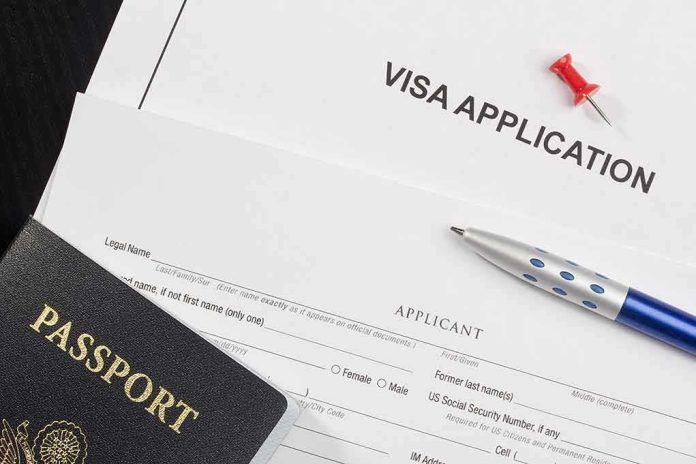
The case centers on the U visa, a special immigration status created for victims of certain crimes who help police. Federal prosecutors say Nayi and his co-conspirators turned that protection into a product. They allegedly staged fake armed robberies so participants could claim victim status, then used those bogus incidents to support U visa applications.
A federal grand jury indictment, unsealed in May 2024, names Nayi along with Kewon Young, Bhikhabhai Patel, Nilesh Patel, Ravinaben Patel, and Rajnikumar Patel. Prosecutors say the group organized robberies at businesses in the Chicago suburbs, Rayne, Louisiana, and Belvidere, Tennessee, turning ordinary storefronts into staged crime scenes.
Hundreds of Fake Robberies and a Real Shooting
Prosecutors describe the operation as running from 2022 through 2024 and involving hundreds of staged robberies, not a one-time stunt. Participants reportedly paid Nayi anywhere from $5,000 to $30,000 for their spot in a fake crime, according to sentencing materials summarized by Fox 32 Chicago. That price range suggests a business model, not a favor between friends.
The scheme stopped being harmless theater at least once. A local report says a clerk in Chicago’s Bucktown neighborhood was shot during a robbery connected to the nationwide operation, turning a staged crime into a real one with real consequences. The staged-robbery business model carried genuine danger the moment a real gun entered the picture.
A Guilty Plea and a Tougher-Than-Expected Sentence
Nayi pleaded guilty earlier in 2026 to conspiracy to commit visa fraud, with reporting placing the plea date at January 14, 2026. U.S. District Judge Mary M. Rowland sentenced him on October 22, 2026, to two years in prison and a $50,000 fine, a term that reportedly ran a year longer than what prosecutors had recommended.
Nayi’s defense attorney, George M. Gomez, argued the robberies involved no unwilling victims and no real violence against anyone who didn’t consent to the setup, according to reporting from the Lake and McHenry County Scanner. He also said Nayi did not personally prepare or file the fraudulent paperwork and cooperated with investigators once charged.
Why U Visas Are Vulnerable to This Kind of Fraud
The U visa program was built on a simple idea: crime victims who help police should get protection, even if the criminal is never caught. That design means an applicant doesn’t need a conviction or even an arrest of the supposed attacker, just documented victimization and a certification from an authorized agency confirming they cooperated. That flexibility, meant to help real victims, also opens a door fraud can walk through.
Government data shows fraud concerns in the U visa program are real, though not rampant. U.S. Citizenship and Immigration Services found 198 suspect applications out of 7,360 filed in 2014, a number that grew to 801 suspect applications, about 6 percent, out of nearly 12,801 self-petitions by 2018. That trend line matters because it shows regulators were already watching for schemes like Nayi’s well before this case broke.
What This Case Means Going Forward
This prosecution shows what happens when a well-intentioned legal protection gets treated as a product to be bought and sold. Hundreds of staged crimes, a real shooting victim, and a two-year sentence tell a story about how easily a paperwork shortcut can spiral into actual violence. Immigration fraud cases rarely make headlines this vivid, but the underlying lesson, that loose verification standards invite exploitation, applies far beyond one Chicago suburb.
𝐑𝐈𝐍𝐆𝐋𝐄𝐀𝐃𝐄𝐑 𝐖𝐇𝐎 𝐒𝐓𝐀𝐆𝐄𝐃 𝐇𝐔𝐍𝐃𝐑𝐄𝐃𝐒 𝐎𝐅 𝐅𝐀𝐊𝐄 𝐑𝐎𝐁𝐁𝐄𝐑𝐈𝐄𝐒 𝐅𝐎𝐑 𝐌𝐈𝐆𝐑𝐀𝐍𝐓 𝐕𝐈𝐒𝐀𝐒 𝐆𝐄𝐓𝐒 𝐉𝐔𝐒𝐓 𝐓𝐖𝐎 𝐘𝐄𝐀𝐑𝐒
𝐏𝐚𝐫𝐭𝐡 𝐍𝐚𝐲𝐢, 29, ran a Chicago-based scheme that staged fake armed robberies at restaurants, convenience… pic.twitter.com/tEvwAQtKJW
— M.A. Rothman (@MichaelARothman) October 26, 2026
Federal prosecutors have not announced whether additional charges or sentences are pending for the five other named defendants, but the Justice Department’s own description of the case, “significantly corrupted” is the phrase prosecutors used, signals this investigation reached well beyond one man’s bank account. For a visa program designed to protect the vulnerable, that corruption carries a cost measured in more than dollars.
Sources:
redstate.com, justice.gov, chicagotribune.com, fox32chicago.com, lakemchenryscanner.com